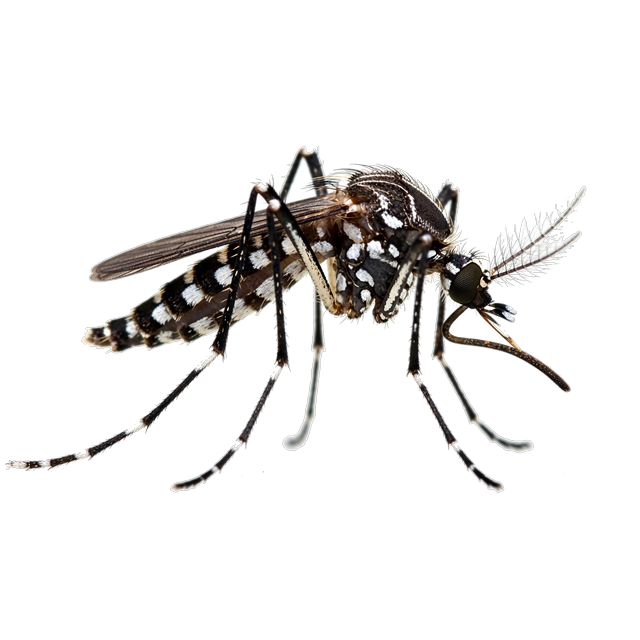
 Yellow fever mosquito
Aedes aegypti (Linnaeus, 1762)
Yellow fever mosquito
A dark mosquito with white markings, found in the southern US.
- Order
- Diptera
- Family
- Culicidae
- Group
- Mosquitoes
- Ontario status
- Not established in Ontario, southern US (e.g., Florida, Texas)
Why it matters
Not an Ontario threat, but the most dangerous mosquito on Earth where it occurs: the primary vector of yellow fever, dengue, Zika, and chikungunya viruses. Included because travelers and the southern US need to know it on sight.
Origin
Native to sub-Saharan Africa, where it evolved alongside humans, then sailed the world in shipboard water casks. A tropical mosquito, not an Ontario one.
Behavior
An aggressive daytime biter with a strong preference for humans, it will bite ankles under tables and follow people indoors. Rests inside houses. Females need blood for every egg batch; males feed on nectar.
Living conditions
Warm climates only: it cannot survive Ontario winters. Breeds in small artificial containers, tires, buckets, plant saucers, gutters, holding clean-ish stagnant water. Bites indoors and out, by day.
Signs of presence
- Daytime ankle-biting indoors (unusual for most mosquitoes)
- Wrigglers in saucers, buckets, tires, and clogged gutters
- A dark mosquito with white markings resting on walls
- Not an Ontario sign at all, if you're seeing this at home in Florida or Texas, it's this species
Weaknesses
- Killed by frost, winter is an absolute barrier, which is why Ontario is safe
- Breeds only in small containers: tip, toss, and cover every one and breeding stops
- Weak disperser, rarely flies more than 100-200 m from where it hatched
- Eggs need water to hatch; dry containers are dead ends until rain
Myths and facts
Myth It's the mosquito biting me in Ontario.
Reality It cannot overwinter here. Ontario's biters are Culex, Aedes vexans, and black flies, not this species.
Myth It only breeds in swamps.
Reality The opposite: it prefers clean water in tiny man-made containers, a bottle cap of water suffices.
Research notes
Morphology
Adult 4-7 mm, dark with distinctive white lyre-shaped markings on the scutum (the 'lyre' is the field mark) and white-banded legs. Larvae ('wrigglers') hang at an angle from the water surface; pupae ('tumblers') comma-shaped.
Diagnostics
Confirm by: white lyre markings on the thorax + white leg bands + daytime indoor biting. The Asian tiger mosquito (Ae. albopictus) has a single straight white stripe down the thorax instead of the lyre.
Easily confused with
- Asian tiger mosquito, Aedes albopictus Tiger has one straight white stripe down the middle of the scutum; aegypti has the lyre-shaped double curve. Both are container breeders.
Life cycle
- Egg
- Laid singly just above the waterline in containers; desiccation-resistant, survive months dry, hatch when flooded
- Nymph or larva
- Aquatic wrigglers feeding on microorganisms; 4 instars over ~7-10 days in warm water
- Adult
- Lives 2-4 weeks; females blood-feed every 2-3 days, laying ~100 eggs per batch
- Egg to adult
- 7-10 days at 28 °C; slower when cooler
- Generations per year
- Continuous year-round in the tropics; absent where frost occurs
Development
Complete metamorphosis: egg → larva (wriggler, 4 instars) → pupa (tumbler) → adult.
Reproduction
~100 eggs per batch × a batch every few days across her life, explosive potential from a single container.
Distribution
- Native range
- Sub-Saharan Africa
- Ontario
- Not established, cannot overwinter; no records of breeding populations
- Global
- Pantropical: established across the tropics and subtropics worldwide
Ecology
Highly anthropophilic and endophilic: prefers human blood, rests indoors, bites by day with dawn/dusk peaks. Eggs' desiccation resistance is the trait that let it colonize the globe via trade.
Resistance
Extensively documented: pyrethroid resistance via kdr target-site mutations plus metabolic resistance in populations across the Americas, Africa, and Asia, a major operational challenge for dengue control programs.
IPM implications
Reference species for Ontario readers; operational where established. Biology dictates container management: the entire program is tip-toss-cover-screen of small water-holding containers within 100-200 m, adulticiding without source reduction fails because emergence is continuous. Monitoring: ovitraps and adult traps. Resistance status must be established before any adulticide use.
Chemical ecology
Host-seeking via CO₂, lactic acid, skin volatiles, heat, and visual contrast; prefers human odor over animal. Oviposition cued by water volatiles and existing egg pheromones in containers.
Genetics and DNA
Genome published 2007 (~1,380 Mb), among the first mosquito genomes sequenced (Nene et al., Science).
Taxonomy
Diptera: Culicidae. Aedes aegypti (Linnaeus, 1762); among the most studied insects in medical entomology.
Open questions
Northern range-limit dynamics under warming climates, the expansion-watch question for the southern US.
References
- Nene et al. (2007), Science, genome sequence of Aedes aegypti
- CDC, About Aedes aegypti (cdc.gov/mosquitoes)