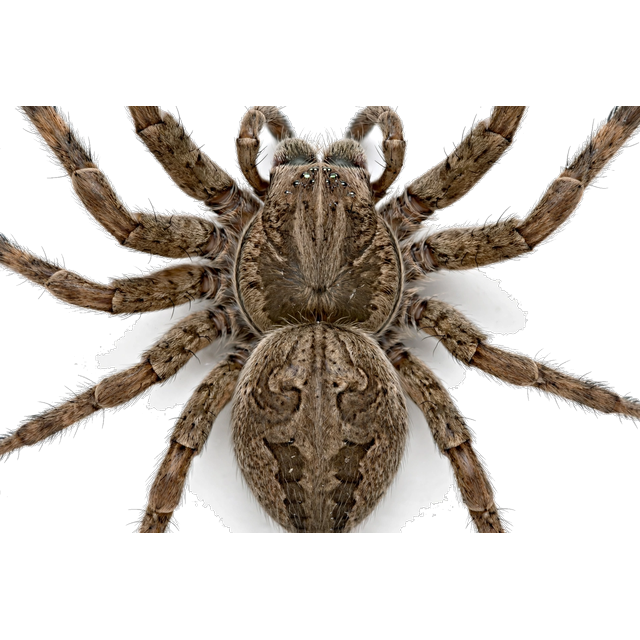
 Wolf spider
Lycosidae
Wolf spider
The big fast hunter sprinting across your basement floor, frightening to look at, not dangerous.
- Order
- Araneae
- Family
- Lycosidae
- Group
- Spiders
- Ontario status
- Native, common outdoors; accidental indoor visitor, especially in fall
Why it matters
Wolf spiders are elite outdoor pest controllers, eating crop and garden pests by the thousands. Indoors they are harmless accidentals, they can bite if grabbed, but the bite is no worse than a bee sting and they would far rather run away.
Origin
Native to Ontario and found on every continent, these are wild hunting spiders, not house spiders.
Behavior
Active daytime hunters that chase down prey on foot instead of building webs. Excellent eyesight. Females carry their white egg sac attached to their spinnerets, and the babies ride on her back after hatching.
Living conditions
Outdoors in gardens, leaf litter, and grass. Indoors only by accident, they wander in through open doors and gaps in fall looking for shelter.
Signs of presence
- A large fast-moving spider on the floor (not in a web)
- A female carrying a round white silk ball at her rear
- Tiny spiderlings covering a female's back in summer
- Sightings concentrated near ground-level doors in September-October
Weaknesses
- Cannot establish breeding populations indoors, every indoor wolf spider wandered in from outside
- Dependent on ground-level entry points; door sweeps and sealed gaps stop them
- Diurnal and conspicuous, easy to catch and release
- Short indoor lifespan without prey
Myths and facts
Myth The giant spider in my basement is infesting my house and will multiply.
Reality Wolf spiders do not infest homes. Each one is a lone wanderer from outside; catch it in a cup and put it back in the garden, where it belongs and does good work.
Research notes
Morphology
Robust body 5-35 mm depending on species (Ontario species mostly 8-20 mm). Diagnostic eye arrangement: three rows, 4 small - 2 large - 2 medium, the large posterior median eyes giving strong eyeshine at night. Stout spiny legs built for running.
Diagnostics
Eye arrangement (4-2-2) is the field diagnostic. Female with egg sac attached to spinnerets, or spiderlings riding the abdomen, confirms the family at a glance.
Easily confused with
- Grass spiders / funnel weavers (Agelenidae) Agelenids have prominent rear spinnerets that look like twin tails and build funnel webs; wolf spiders have inconspicuous spinnerets and build no prey-catching web.
- Fishing spiders (Dolomedes spp., Pisauridae) Fishing spiders are larger, associated with water, and hold their legs in a distinctive crab-like stance; eye arrangement differs.
Life cycle
- Adult
- Most Ontario species live 1-2 years; females survive winter as adults in leaf litter
- Egg
- 50-200+ eggs in a spherical sac carried by the female; she opens it at hatching
- Egg to adult
- One full season to a year depending on species and latitude
- Generations per year
- One in Ontario
- Nymph or larva
- Spiderlings ride the mother's back, then disperse; 5-10 molts to maturity
Development
Egg to spiderling to adult through successive molts. Extended maternal care: egg sac carried on spinnerets, spiderlings ride the mother's abdomen for 1-2 weeks.
Reproduction
Males perform visual courtship displays (leg waving, palpal drumming). Female tears open the egg sac at hatching and the young climb aboard, among the most developed parental care in spiders.
Distribution
- Global
- One of the most widespread spider families on Earth
- Native range
- Worldwide; many species native to Ontario
- Ontario
- Native and widespread outdoors; indoor records are accidental wanderers, concentrated in fall
Ecology
Dominant ground predators in Ontario gardens, fields, and forest floors. Regulate insect populations including agricultural pests. Overwinter as adults or subadults under debris; enter buildings only incidentally.
Resistance
Unknown, not a pesticide target; no documented resistance.
IPM implications
No indoor management program is ever warranted, exclusion (door sweeps, sealing gaps) plus catch-and-release. Outdoors, they are a protected asset: broad-spectrum treatments that kill wolf spiders reliably cause secondary pest outbreaks. Educate, don't exterminate.
Chemical ecology
Venom is insect-targeted; bites to humans produce local pain and redness only. Silk used for egg sacs, draglines, and nursery retreats, not prey capture. Vision, not chemistry, is their hunting superpower.
Genetics and DNA
Chromosome-level reference genome published for a lycosid: the pond wolf spider Pardosa pseudoannulata (Scientific Data, 2024, 11:121).
Taxonomy
Order Araneae, family Lycosidae, a large, diverse family of cursorial hunters. Ontario fauna includes Pardosa, Hogna, Trochosa and others; species-level ID requires genitalia examination.
Open questions
Ontario species-level diversity and distributions are incompletely surveyed; overwintering physiology understudied.
References
- Foelix, R.F. (2011). Biology of Spiders, 3rd ed., Oxford University Press.
- Ebeling, W. (1978). Urban Entomology, University of California, Riverside.