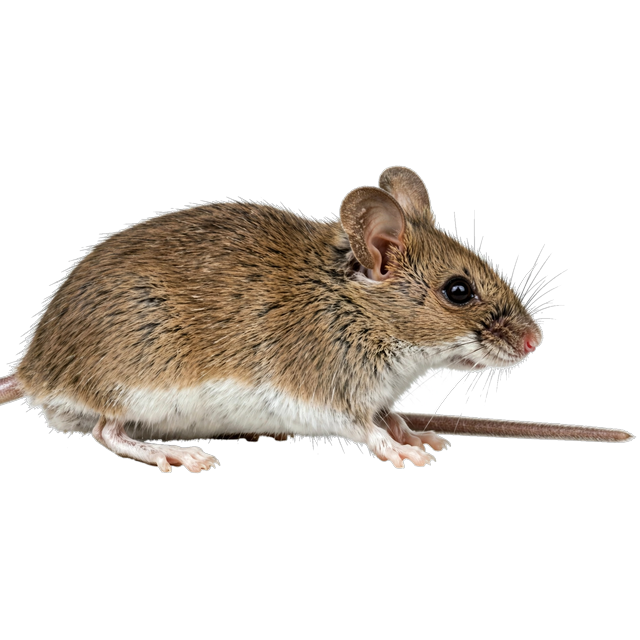
 White-footed mouse
Peromyscus leucopus (Rafinesque, 1818)
White-footed mouse
The deer mouse's twin, and the main animal reservoir of Lyme disease.
- Order
- Rodentia
- Family
- Cricetidae
- Group
- Rodents
- Ontario status
- Native, common; Lyme reservoir
Why it matters
Primary reservoir host of Borrelia burgdorferi, the Lyme disease bacterium, it infects the black-legged ticks that bite it.
Origin
Native to eastern North American woodlands, the mouse of the forest floor.
Behavior
Nocturnal; an agile climber, more arboreal than the deer mouse. Caches acorns and seeds.
Living conditions
Deciduous forest, brushy edges, and nearby homes, sheds, and cabins. Nests in tree cavities, stumps, wall voids, and attics.
Signs of presence
- Pointed droppings 3-6 mm in attics, sheds, and cabins
- Acorn and seed caches in boxes and wall voids
- Nests of shredded bark, leaves, and insulation
- Gnawed acorns with neat round holes
Weaknesses
- Acorn-driven: mast years predict mouse (and tick) booms the following year
- Brushy edges are its highway, clearing vegetation near homes reduces visits
- Discrete nests: droppings and caches lead straight to them
Myths and facts
Myth Only deer carry Lyme disease.
Reality Deer feed adult ticks, but white-footed mice infect the ticks. The mouse is the reservoir that matters most.
Research notes
Morphology
Body 85-105 mm, tail 65-100 mm, weight 15-25 g. Grey-brown to reddish above, white below; bicolored tail; large ears. Nearly identical to deer mouse in the field.
Diagnostics
Field separation from deer mouse is unreliable, white-footed averages slightly larger with a proportionately longer tail; definitive ID needs dental or genetic characters.
Easily confused with
- Deer mouse (Peromyscus maniculatus) Overlap in every field character; treat Peromyscus sightings as the complex unless lab ID is available.
Life cycle
- Adult
- Lifespan ~12 months wild; several years captive
- Egg
- N/A, viviparous
- Egg to adult
- Gestation 22-24 days; maturity at 6-8 weeks
- Generations per year
- 2-4 (seasonal, spring, autumn)
- Nymph or larva
- Pups weaned at ~25-30 days; mature at 6-8 weeks
Development
Viviparous; altricial.
Reproduction
3-5 pups per litter × 3-4 litters/year.
Distribution
- Global
- North America only
- Native range
- Eastern North America
- Ontario
- Native, common; expanding northward with warming winters
Ecology
Forest-floor omnivore; acorn caching drives population dynamics; the keystone host in the Lyme disease cycle, infects larval ticks that later bite humans.
Resistance
Unknown.
IPM implications
Peridomestic tick risk tracks mouse density: reduce brushy edge habitat and acorn-bearing trees near homes, seal ≥6 mm gaps before autumn. Acorn mast forecasting predicts next-year mouse and nymphal-tick abundance, a genuine predictive tool.
Chemical ecology
Urine and plantar-gland scent marking; olfactory mate assessment.
Genetics and DNA
Reference genome published: PGSC P. leucopus reference genome (Sci Rep 2019); chromosome-length Hi-C assembly (eScholarship).
Taxonomy
Order Rodentia › family Cricetidae › genus Peromyscus › P. leucopus (Rafinesque, 1818). Sister species to the deer mouse.
Open questions
Rate of northward range expansion in Ontario and its effect on local Lyme incidence.
References
- CDC, Lyme Disease: Transmission
- Cornell Cooperative Extension, White-footed Mouse