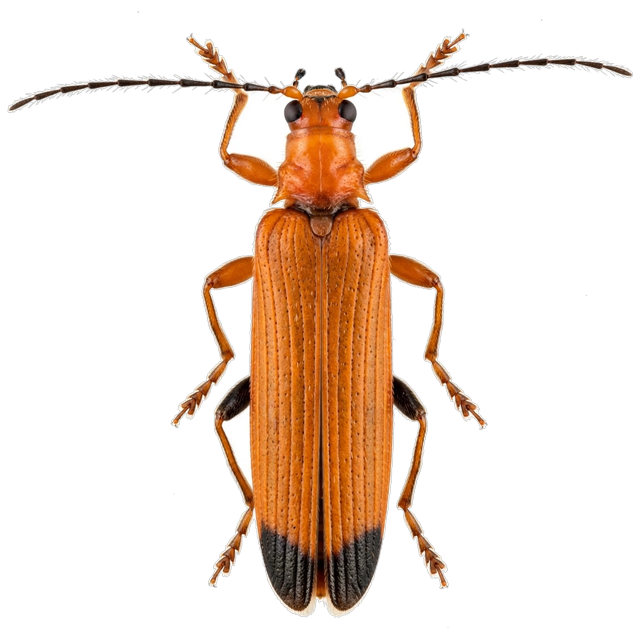
 Wharf borer
Nacerdes melanura (Linnaeus, 1758)
Wharf borer
An orange-and-black beetle whose larvae honeycomb the wet pilings of old wharves, and whose relatives can blister skin.
- Order
- Coleoptera
- Family
- Oedemeridae
- Group
- Fabric & structural beetles
- Ontario status
- Not established in Ontario, coastal wharf/piling species; reference for damp-wood borer comparisons
Why it matters
A structural pest of waterfront infrastructure elsewhere in the world; in Ontario, a reference species for the damp-wood borer category, and a cautionary note, since its family can cause skin blisters.
Origin
Coastal Europe and worldwide ports, it travels in ships' timbers and dock wood.
Behavior
Adults are often seen on flowers near the coast in summer. Larvae tunnel in the sodden wood for a year or more, honeycombing it.
Living conditions
Waterlogged, decaying wood: wharf pilings, dock timbers, wet fence posts, damp cellar wood. The wood must be wet and rotting.
Signs of presence
- Slender orange beetles (10-12 mm) with black-tipped wing covers near old docks
- Honeycombed, punky pilings that crumble
- Oval emergence holes in wet timbers
Weaknesses
- Requires saturated decaying wood, dry the timber and the colony dies
- Restricted to waterfront and very damp sites
- Conspicuous adults are easy to spot
Myths and facts
Myth Wharf borers sting.
Reality They don't sting or bite. But like other oedemerid (false blister) beetles, handling them can irritate skin, look, don't touch.
Research notes
Morphology
Adult 10-12 mm, slender, orange-yellow head and pronotum, elytra orange with black tips. Larva white, up to ~20 mm, with dark mandibles. Emergence holes oval, ~5 mm.
Diagnostics
Orange/black coloration + slender body + wet rotting timber habitat = wharf borer. Unmistakable among wood borers.
Easily confused with
- Old house borer, Hylotrupes bajulus Old house borer is black, attacks dry seasoned softwood; wharf borer is orange, attacks only saturated decaying wood.
Life cycle
- Adult
- Emerge in summer; visit flowers; live weeks
- Egg
- Laid in cracks of wet decaying wood
- Egg to adult
- 1-2 years
- Generations per year
- Less than one
- Nymph or larva
- Larvae tunnel 1-2 years in saturated timber
Development
Complete metamorphosis in waterlogged wood.
Reproduction
Moderate fecundity; females oviposit in wet rot.
Distribution
- Global
- Ports and coasts worldwide
- Native range
- Coastal Europe; spread via shipping
- Ontario
- Not established; reference species
Ecology
Decomposer of waterlogged wood; part of the waterfront decay community. Oedemeridae contain cantharidin-like defensive compounds (vesicants).
Resistance
Unknown, no documented resistance.
IPM implications
Wharf infrastructure logic: replace or isolate the saturated timber, the infestation is a moisture problem, and borer control without timber replacement fails. Handler caution for the vesicant chemistry.
Chemical ecology
Cantharidin-related defensive chemistry (skin-blistering in handlers); floral visitation by adults.
Genetics and DNA
No reference genome published as of 2026.
Taxonomy
Order Coleoptera, family Oedemeridae (false blister beetles). Nacerdes melanura = 'black-tailed.'
Open questions
Cantharidin-pathway biochemistry in Oedemeridae; northern range limits under warming coasts.
References
- Ebeling, W. (1978). Urban Entomology. University of California, Riverside.