 Western conifer seed bug
Leptoglossus occidentalis Heidemann, 1910
Western conifer seed bug
The long brown bug mistaken for a kissing bug, it wants your pine cones, not your blood.
- Order
- Hemiptera
- Family
- Coreidae
- Group
- Occasional invaders
- Ontario status
- Expanding eastward, now established in Ontario; fall indoor wanderer
Why it matters
Mostly a case of mistaken identity with real consequences, kissing-bug panic is stressful and pointless here. Once identified by its leaf feet, it's just another harmless fall visitor that better weatherstripping would have prevented.
Origin
Western North America; marching east across the continent and now established in Ontario.
Behavior
Sucks developing seeds from pine and spruce cones all summer, then wanders indoors in fall to overwinter. Slow, clumsy, harmless, but alarming to anyone who mistakes it for a kissing bug.
Living conditions
Conifer trees in summer; attics, wall voids, and window frames from fall through spring.
Signs of presence
- Large elongated brown bugs indoors in fall, especially near conifers
- A faint piney odor when handled
- Slow fliers bumping around lights on autumn evenings
Weaknesses
- Cannot bite or feed on anything indoors, it is just sheltering
- Blocked by the same fall exclusion that stops boxelder bugs
- Slow and conspicuous; easily caught and released
- Its range here is new, so local populations are still small and patchy
Myths and facts
Myth It's a kissing bug that feeds on human blood and spreads disease.
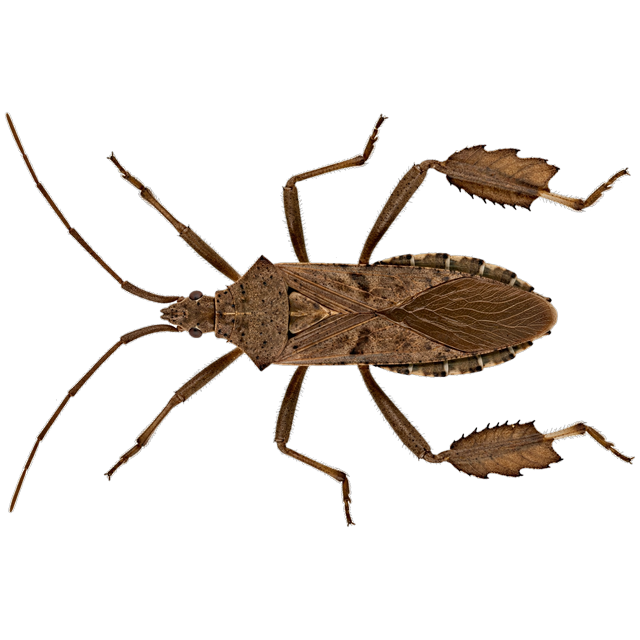
Reality It has never fed on blood in its life, its mouthparts are built for pine seeds. The leaf-shaped flanges on its back legs prove it: kissing bugs don't have those.
Research notes
Morphology
Body 16-20 mm; elongated, flattened, brown; the hind tibiae are expanded into flat leaf-like flanges, the definitive field mark; long antennae; piercing-sucking beak.
Diagnostics
16-20 mm elongated brown bug + flattened leaf-like expansions on the hind tibiae + long body. The 'leaf feet' separate it from every lookalike, including the kissing bugs people fear.
Easily confused with
- Kissing/assassin bugs (Triatominae, Reduviidae) Kissing bugs have a narrow cone-shaped head and feed on blood; seed bugs have leaf-like hind leg expansions and feed on seeds. Different families, different diets, different risk.
- Boxelder bug (Boisea trivittata) Boxelder bugs are smaller with red edge stripes; seed bugs are larger, uniformly brown, with flattened hind tibiae.
Life cycle
- Adult
- Adults overwinter in buildings; emerge in spring to mate on conifers
- Egg
- Eggs laid in rows on conifer needles
- Egg to adult
- One summer of development
- Generations per year
- One
- Nymph or larva
- Reddish nymphs feed on developing seeds through summer
Development
Hemimetabolous, egg to nymph to adult. Nymphs are reddish and lack the full leaf-foot expansions.
Reproduction
Mating on conifers in spring; females lay eggs in neat rows on needles near developing cones.
Distribution
- Global
- North America; introduced to Europe
- Native range
- Western North America
- Ontario
- Eastward expansion now established in Ontario, a recent arrival still spreading
Ecology
Feeds on developing seeds of pines, spruce, and other conifers; can damage seed orchards. Overwinters as adults in buildings. Harmless to structures and people.
Resistance
Unknown, managed by exclusion; no documented resistance.
IPM implications
Exclusion insect like the boxelder bug: seal fall entry points, vacuum indoor individuals. Its eastward march makes it a good surveillance species, new Ontario records are worth reporting to extension. The kissing-bug confusion means part of the job is reassurance with the leg character.
Chemical ecology
Coreid defensive odors (aldehydes) when handled, pungent but harmless. Feeds with piercing-sucking mouthparts on developing conifer seeds.
Genetics and DNA
A draft reference genome (1.74 Gb) with whole-genome, RNA-seq, and Hi-C data was published and deposited under NCBI BioProject PRJNA1140410.
Taxonomy
Order Hemiptera, family Coreidae (leaf-footed bugs). Authority Heidemann, 1910. A western species whose eastward expansion is one of the best-documented insect range shifts in North America.
Open questions
Eastern range-limit dynamics in Ontario; seed-orchard impact quantification.
References
- Ebeling, W. (1978). Urban Entomology, University of California, Riverside.