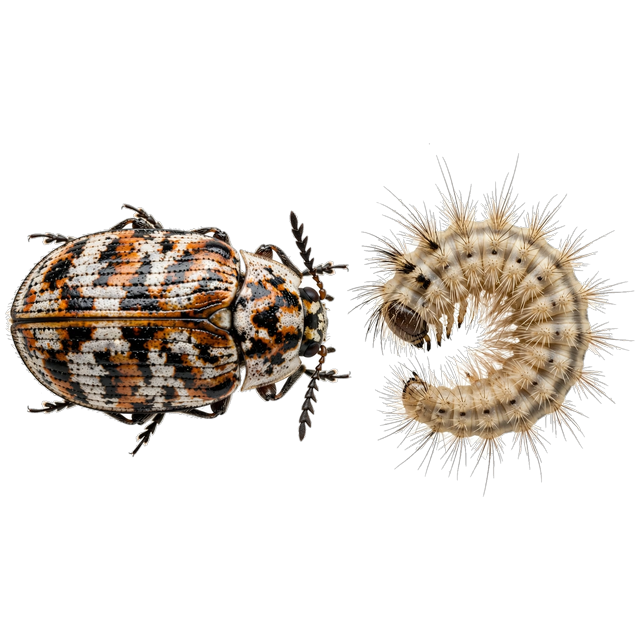
 Varied carpet beetle
Anthrenus verbasci (Linnaeus, 1767)
Varied carpet beetle
Its fuzzy larvae eat wool sweaters and the adults visit flowers, the most common fabric pest in Ontario homes.
- Order
- Coleoptera
- Family
- Dermestidae
- Group
- Fabric & structural beetles
- Ontario status
- Established, the most common carpet beetle in Ontario homes; larvae in woolens, adults on flowers outdoors
Why it matters
The number-one fabric pest of Ontario homes and a serious pest of museums, where larvae destroy specimens, textiles, and insect collections.
Origin
Europe originally; now worldwide wherever wool, fur, and feathers are stored.
Behavior
Adults fly to flowers in spring and summer to feed on pollen, people often find them on windowsills without realizing the larvae are elsewhere in the house. Larvae are shy, hairy, and avoid light.
Living conditions
Larvae live in dark undisturbed places, closets, under furniture, in wall voids with dead insects, in bird nests in attics. They eat keratin: wool, fur, feathers, silk, and also dead insects and pet hair.
Signs of presence
- Irregular holes in wool, silk, or fur garments, often in stored clothes
- Hairy 'woolly bear' larvae (4-5 mm) and their shed skins in closets or under furniture
- Small mottled beetles (2-3 mm) on windowsills in spring
Weaknesses
- Larvae need undisturbed keratin, regular vacuuming and closet turnover starve them
- Cannot digest synthetic fibers; damage to synthetics only happens in blends
- Adults must reach flowers to feed; window screens reduce indoor breeding
Myths and facts
Myth The little beetles on the windowsill are eating my clothes.
Reality The adults eat pollen. The damage is done by the hairy larvae hiding in the dark, by the time you see adults, larvae have been feeding for months.
Research notes
Morphology
Adult 2-3 mm, oval, covered in colorful scales: mottled white, orange-brown, and black. Scales rub off with age, making old specimens look dark. Larva 4-5 mm, carrot-shaped, densely hairy with tufts ('woolly bear'), brown banded.
Diagnostics
Mottled scale pattern + 2-3 mm size + hairy larvae = varied carpet beetle. Scale pattern distinguishes it from furniture carpet beetle (more orange/yellow).
Easily confused with
- Furniture carpet beetle, Anthrenus flavipes Furniture carpet beetle has more extensive yellow-orange mottling and a paler underside; varied carpet beetle shows bolder white scale patches.
Life cycle
- Adult
- Live 2-6 weeks; feed on pollen outdoors, mate, and re-enter buildings to lay eggs
- Egg
- Laid in larval food (lint, wool, carcasses); hatch in ~2 weeks
- Egg to adult
- Typically ~1 year in temperate homes
- Generations per year
- 1 per year in Ontario
- Nymph or larva
- Larvae feed 2-12 months depending on food and temperature; can enter facultative diapause
Development
Complete metamorphosis: egg → larva → pupa → adult. Larvae pass through 5-6+ instars and can pause development (diapause) for months.
Reproduction
Females lay ~40-100 eggs in suitable larval food.
Distribution
- Global
- Cosmopolitan
- Native range
- Europe
- Ontario
- Established; the dominant Anthrenus provincewide, indoors and on spring flowers
Ecology
Natural habitat is bird nests, where larvae scavenge feathers and dead nestlings, attics with old nests are classic reservoirs. Keratin digestion via specialized gut enzymes and symbionts.
Resistance
Unknown, no significant documented resistance.
IPM implications
Source logic beats spray logic: find the larval reservoir (bird nest in the attic, dead cluster flies in a wall void, undisturbed woolens) and remove it. Vacuuming lint and hair removes both food and eggs. Attic nest removal cuts reinfestation at the source.
Chemical ecology
Adult aggregation on flowers mediated by floral volatiles; larval food-finding by keratin-degradation odors. Defensive hastisetae (barbed hairs) detach and irritate predators, and human skin.
Genetics and DNA
No reference genome published as of 2026.
Taxonomy
Order Coleoptera, family Dermestidae (skin/carpet beetles). Genus Anthrenus; verbasci = 'of mullein,' an early host record.
Open questions
Diapause regulation and its interaction with heated-building microclimates.
References
- Hinton, H.E. (1945). A Monograph of the Beetles Associated with Stored Products, Vol. 1. British Museum (Natural History).
- Jacobs, S. (Penn State Extension). Carpet Beetles fact sheet.