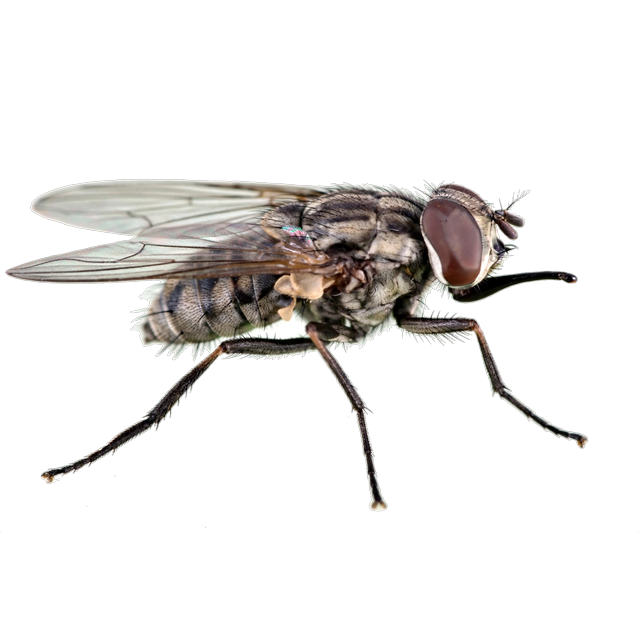
 Stable fly
Stomoxys calcitrans Linnaeus, 1758
Stable fly
Looks exactly like a house fly, but this one bites, hard, usually around your ankles.
- Order
- Diptera
- Family
- Muscidae
- Group
- Flies
- Ontario status
- Established, seasonal (livestock areas)
Why it matters
A painful biter and livestock pest, heavy feeding stresses cattle and horses. Can mechanically carry germs between animals (e.g., equine infectious anemia).
Origin
Old World in origin; spread worldwide with livestock.
Behavior
Bites people, pets and livestock by day, often around the ankles and lower legs. Painful bite. Rests head-up on walls and fences. Both males and females bite.
Living conditions
Breeds in decaying straw, manure mixed with bedding, moist grass clippings, and compost, the wet farmyard edge. Needs blood meals to reproduce.
Signs of presence
- Painful daytime bites around ankles near farms, stables, or compost areas
- Flies that look like house flies but land and bite immediately
- Flies resting head-up on sunny walls
Weaknesses
- Breeding needs wet, decaying vegetation/manure, clean, dry bedding breaks the cycle
- Bites by day, so evening outdoor time avoids the worst
- Exclusion (screens) works as for house flies
- Larvae drown in saturated media and desiccate in dry media, moisture management is control
Myths and facts
Myth It's just an aggressive house fly.
Reality It is a separate species with piercing mouthparts. If a 'house fly' bites you, it was a stable fly.
Research notes
Morphology
Adult 6-8 mm; grey with 4 thoracic stripes like the house fly. Diagnostic: a stiff, bayonet-like piercing proboscis projecting forward from the head (visible in profile). Fourth wing vein bent forward as in Musca. Rests with head up, a behavioral field mark.
Diagnostics
Confirm by: house-fly size and stripes PLUS the forward-projecting piercing proboscis. Biting behavior confirms it functionally.
Easily confused with
- House fly, Musca domestica The house fly's mouthparts are soft and sponge-like and it never bites; the stable fly's rigid proboscis is visible in side view and it bites readily.
Life cycle
- Egg
- Laid in moist decaying vegetation, manure-straw mixes
- Nymph or larva
- Maggots feed in wet organic matter; 3 instars
- Adult
- Both sexes take blood meals (needed for egg development); also feed on nectar; live 2-4 weeks
- Egg to adult
- Approximately 2-3 weeks at 25-30 °C; longer in cool weather
- Generations per year
- Multiple in summer; seasonal in Ontario
Development
Complete metamorphosis: egg → larva (maggot, 3 instars) → pupa → adult.
Reproduction
Females require blood meals to develop eggs; fecundity tied to host availability, the biting is reproductive biology, not aggression.
Distribution
- Native range
- Old World (Africa/Eurasia)
- Ontario
- Common around livestock operations; seasonal suburban incursions near farms
- Global
- Cosmopolitan with livestock
Ecology
Breeding media: decaying straw, manure-bedding mixes, grass clippings, silage. Dispersal: several kilometres; follows livestock and moves into suburbs from nearby farms. Overwinters as larvae/pupae in warm breeding media.
Resistance
Pyrethroid resistance documented in livestock-associated populations in several regions; a growing management concern.
IPM implications
Manure and bedding management is the control: the biology says larvae need moist decaying vegetation, so dry, frequently removed bedding and proper composting eliminate breeding. Sticky traps monitor adult pressure around facilities. Biting peaks are daytime, scheduling and physical barriers (screens, protective clothing) are rational responses.
Chemical ecology
Host-seeking driven by CO2, body heat and visual cues; breeding-site selection follows moist decaying-vegetation volatiles.
Genetics and DNA
Reference genome published 2021 (Olafson et al., BMC Biology 19:41; ~1.02 Gb; expanded detox, vision and chemosensation gene families).
Taxonomy
Diptera: Muscidae. Stomoxys calcitrans (Linnaeus, 1758). The biting member of the house-fly family.
Open questions
Dispersal distances from Ontario livestock operations into suburbs; overwintering survival in composting facilities.
References
- Foil & Hogsette (1994), Annual Review of Entomology, stable fly biology and impact
- UF/IFAS Extension, stable fly management around livestock
- Taylor et al., stable fly dispersal studies, primary literature