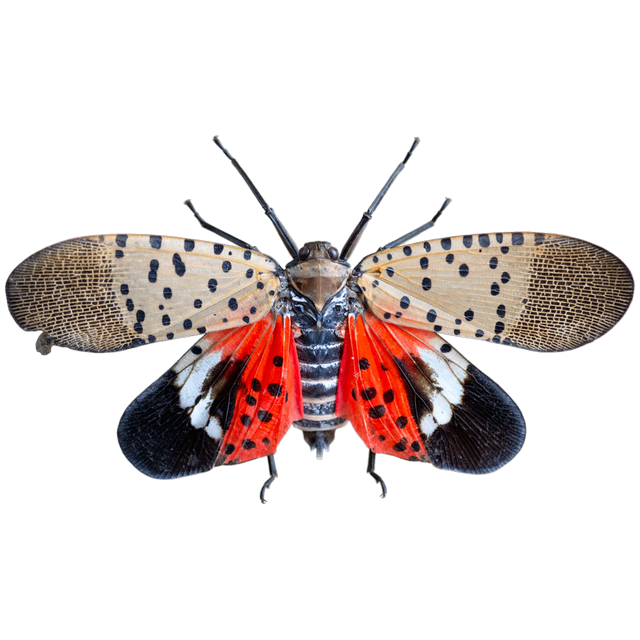
 Spotted lanternfly
Lycorma delicatula (White, 1845)
Spotted lanternfly
A showy invasive planthopper, first detected in Canada (Windsor, Sept 2026), spreading through the eastern US.
- Order
- Hemiptera
- Family
- Fulgoridae
- Group
- Occasional invaders
- Ontario status
- First detected in Windsor, Ontario (CFIA, Sept 15, 2026); not yet established, movement restrictions in place, surveillance ongoing
Why it matters
A serious threat to grapes, orchards and hardwood forests, feeding weakens plants and honeydew ruins fruit quality. Ontario's wine country is directly in the risk zone if it arrives.
Origin
Native to China, India, and Vietnam; arrived in Pennsylvania around 2014 on a stone shipment, now spreading through the eastern US.
Behavior
Nymphs hop; adults fly short distances. Feeds in groups, excreting sticky honeydew that coats everything below and grows black sooty mold. One generation per year, overwintering as eggs.
Living conditions
Feeds on trees, especially tree-of-heaven (itself invasive), plus maple, walnut, willow and grapevines. Lays mud-like egg masses on any smooth surface: trees, stones, vehicles, outdoor furniture.
Signs of presence
- Mud-like gray egg masses on trees, stones or vehicles (fall, spring)
- Black-and-white spotted nymphs hopping on plants (spring, summer)
- Red-winged adults on tree trunks (late summer)
- Sticky honeydew and black sooty mold under infested trees
- Swarms on tree-of-heaven
Weaknesses
- Not established in Ontario, surveillance is the current game
- Egg masses are conspicuous once you know the look, scraping destroys a generation
- Needs tree-of-heaven and other hosts; host removal hurts it
- Weak fliers, long-distance spread is human-driven via egg masses on vehicles and goods
Myths and facts
Myth It bites or stings people.
Reality It's a plant feeder, completely harmless to people and pets.
Myth Squashing every one you see will stop it.
Reality Individual kills don't slow the invasion; reporting sightings to authorities does.
Research notes
Morphology
Adults ~25 mm body, wingspan ~50 mm. Forewings gray with black spots; hindwings red with black spots, hidden at rest, the flash of red in flight is diagnostic. Early nymphs black with white spots; late nymphs red, black and white.
Diagnostics
Confirm by spotted forewings + red hindwings (adults), the red/black/white late nymphs, or mud-like egg masses in winter.
Easily confused with
- Native tiger moths, Arctiinae Moths have feathery antennae and scale-covered wings; lanternfly nymphs and wing venation are planthopper characters.
Life cycle
- Adult
- Emerge midsummer, feed and mate, lay eggs in fall; die with frost.
- Egg
- Mud-like masses of 30-50 eggs laid on smooth surfaces in fall; overwinter as eggs.
- Egg to adult
- ~1 year (univoltine)
- Generations per year
- One
- Nymph or larva
- Four instars in spring, summer; early instars black with white spots, later instars red, black and white; all feed on phloem.
Development
Incomplete metamorphosis: egg → nymph (4 instars) → adult.
Reproduction
Females lay several egg masses of 30-50 eggs each.
Distribution
- Global
- Eastern US (expanding); South Korea, Japan (invasive)
- Native range
- China, Vietnam
- Ontario
- First detection confirmed in Windsor, Ontario (CFIA, Sept 15, 2026); not yet established; surveillance ongoing to determine extent
Ecology
Primary host is tree-of-heaven (Ailanthus altissima); polyphagous on 100+ species including grape, maple and walnut. Honeydew supports sooty mold; feeding stresses hosts. Human-mediated egg-mass transport drives long-distance spread.
Resistance
Unknown.
IPM implications
Surveillance biology: egg-mass surveys in fall and winter on high-risk surfaces (vehicles, stone, tree-of-heaven) are the detection tool, adults are conspicuous, but the invasion moves as eggs. Host management (tree-of-heaven removal) is the landscape-level lever.
Chemical ecology
Honeydew-mediated interactions with ants and sooty mold; host-plant volatiles guide feeding-site selection.
Genetics and DNA
Reference genome published 2019 (2.3-Gb, GigaScience) and a diploid chromosome-level annotated assembly published 2025 (2.2 Gbp, 13 chromosomes).
Taxonomy
Order Hemiptera, family Fulgoridae (lanternflies/planthoppers). Described by White, 1845. A phloem-feeding planthopper, not a true fly despite the name.
Open questions
Overwintering egg cold-tolerance thresholds, the key Ontario establishment question.
References
- USDA APHIS, Spotted lanternfly program resources
- Penn State Extension, Spotted lanternfly
- Urban, J. et al., spotted lanternfly invasion biology