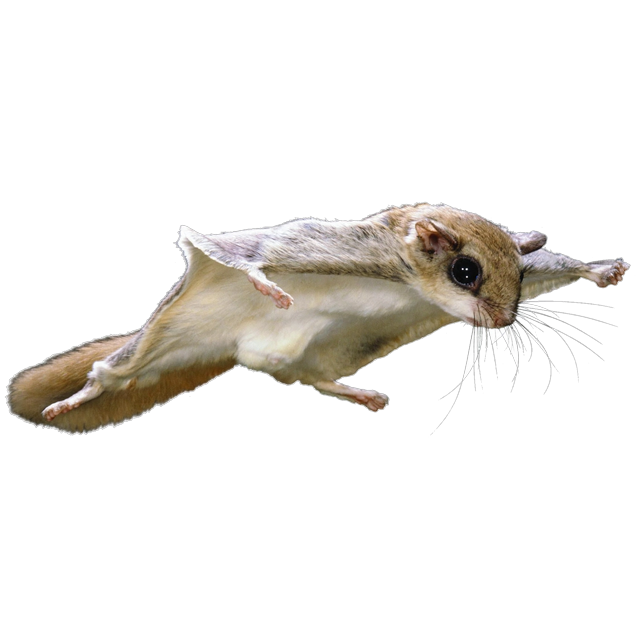
 Southern flying squirrel
Glaucomys volans (Linnaeus, 1758)
Southern flying squirrel
A nocturnal gliding squirrel that dens in southern Ontario attics.
- Order
- Rodentia
- Family
- Sciuridae
- Group
- Rodents
- Ontario status
- Established in southern Ontario, nocturnal attic invader
Why it matters
The classic 'mystery attic noise' animal in southern Ontario, nocturnal activity distinguishes it from gray squirrels (daytime). Chews wiring and insulation, contaminates insulation with droppings and urine. Protected as wildlife: removal is regulated.
Origin
Native to eastern North America's hardwood forests, a long-time Ontarian, though most people never know it's there because it only comes out after dark.
Behavior
Strictly nocturnal, you will hear it, not see it: scampering and gnawing in the attic after midnight. Glides tree to tree on a furred membrane, steering with its flattened tail. Dens communally in winter, sometimes a dozen to a cavity, for warmth.
Living conditions
Mature hardwood forest with cavity trees; in suburbs, attics and wall voids substitute for tree holes. Needs connected tree canopy to glide between feeding areas.
Signs of presence
- Night-time scampering, gnawing, and high-pitched chattering from the attic (silent by day, that day/night split is diagnostic)
- Small round entry holes ~40 mm at rooflines, soffits, and dormers
- Scattered small droppings like large mouse pellets in the attic
- Stains and odor at entry points from communal denning
Weaknesses
- Completely dependent on cavities, no tree holes or attic gaps, no squirrels
- Gliding needs launch height and landing targets; isolated trees are unreachable
- Communal winter denning means one entry point serves the whole group
- Nocturnal habits make its schedule predictable: silent by day, active after midnight
Myths and facts
Myth Flying squirrels actually fly.
Reality They glide, the patagium is a parachute, not wings. They launch, steer with the tail, and land, covering 10-50 m per glide.
Myth One squirrel in the attic.
Reality They den communally in winter, where there's one, expect the whole group using the same entry hole.
Research notes
Morphology
Head-body 120-140 mm, tail 80-120 mm (flattened, used as a rudder), weight 50-85 g. Huge dark eyes; soft gray-brown fur; patagium, the furred gliding membrane, stretches from wrist to ankle. Belly fur white to the base.
Diagnostics
Confirm by: nocturnal attic sounds + 40 mm round entries + white-to-the-base belly fur. The northern flying squirrel (G. sabrinus) is larger (130-180 mm body, 90-140 g) with gray-based belly fur and a more northerly range.
Easily confused with
- Northern flying squirrel, Glaucomys sabrinus Northern is bigger with gray-based belly fur; southern's belly hairs are white all the way to the skin. Southern dominates south of the Shield.
- Gray squirrel, Sciurus carolinensis Gray squirrel is diurnal and three times the weight, any attic noise heard only at night is not a gray squirrel.
Life cycle
- Egg
- N/A, viviparous
- Nymph or larva
- Pups blind ~3 weeks; glide-capable at ~8 weeks; stay with the mother through first winter
- Adult
- Lifespan 3-5 years in the wild; breeds the spring after birth
- Egg to adult
- Gestation ~40 days
- Generations per year
- 2 litters per year possible (spring and late summer)
Development
Viviparous; altricial young born in a tree cavity or attic nest.
Reproduction
2-4 pups per litter × up to 2 litters/year.
Distribution
- Native range
- Eastern North America, southern Ontario to Florida and eastern Texas
- Ontario
- Established in southern Ontario's Carolinian zone; the attic invader of the region
- Global
- Eastern North America only
Ecology
Nocturnal omnivore: nuts, seeds, fungi (truffles, a major food), insects, and bird eggs. Does not hibernate; communal winter denning of up to 20 animals. Home range 2-7 ha. Important mycorrhizal-fungus disperser.
Resistance
N/A, not a pesticide target species.
IPM implications
Monitoring is acoustic: night-only activity mapping locates the den and entry. Exclusion must seal every 40 mm+ gap at rooflines after confirming exit at dusk, one-way doors work because the whole colony uses few entries. Never seal during the breeding season with flightless young inside. FWCA licensing applies.
Chemical ecology
Scent glands mark den entrances; communal denning is mediated by familiar-group odor. Urine latrines at den sites.
Genetics and DNA
Reference genome published: de novo assembly and annotation (Wolf et al. 2021, G3), ~2.40 Gb, 19,124 protein-coding genes, from a southern Ontario individual.
Taxonomy
Rodentia: Sciuridae. Glaucomys volans (Linnaeus, 1758), 'glaucomys' = gray mouse; 'volans' = flying.
Open questions
Attic-denning population density in GTA suburbs; competition dynamics with northern flying squirrels at the range boundary.
References
- Naughton, D. (2012) The Natural History of Canadian Mammals, Univ. of Toronto Press
- Dolan & Carter, Glaucomys volans, Mammalian Species