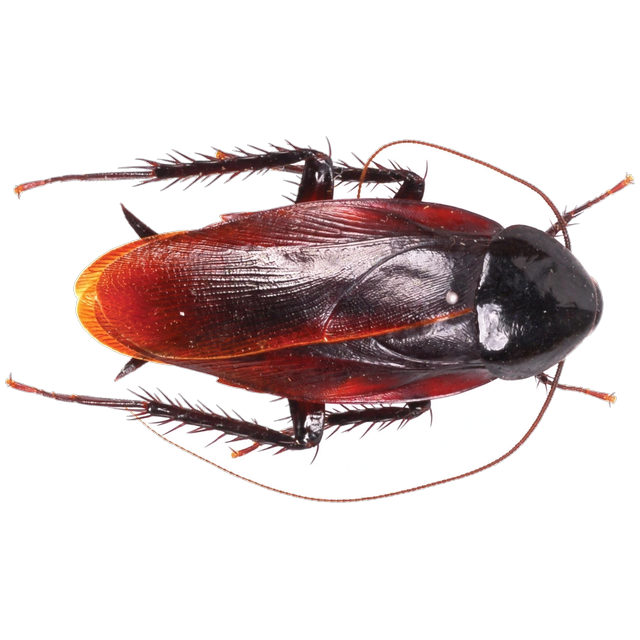
 Smokybrown cockroach
Validiblatta fuliginosa (syn. Periplaneta fuliginosa) (Serville, 1839)
Smokybrown cockroach
A large, dark, strong-flying southern cockroach, included for identification, not an Ontario problem.
- Order
- Blattodea
- Family
- Blattidae
- Group
- Cockroaches
- Ontario status
- Not established in Ontario, southern US species; reference only
Why it matters
A peridomestic nuisance in the US Southeast and a contamination concern where it occurs. In Ontario its value is as an identification reference, so it is not confused with the American or Oriental cockroach.
Origin
Likely Japan or Southeast Asia in origin; now common across the warm southeastern United States.
Behavior
Strong flier, very attracted to lights at night. Hides by day in moist, sheltered outdoor spots and comes to buildings after dark.
Living conditions
Lives outdoors and around buildings in warm climates, mulch beds, tree holes, gutters, attics. Needs warmth year-round, which is why it is not an Ontario species.
Signs of presence
- Not expected in Ontario, large dark cockroaches flying to lights are a southern US phenomenon
- If seen in Ontario, likely a hitchhiker in shipments from the south
- Interception records come from freight, greenhouses or nursery stock arriving from warm regions
Weaknesses
- Cannot survive cold winters, climate is the hard limit
- Attracted to lights, so light management reduces encounters
- Needs moist outdoor harborage near buildings
Myths and facts
Myth All big dark cockroaches in Ontario are smokybrowns.
Reality The smokybrown does not occur in Ontario; large dark cockroaches here are American or Oriental cockroaches.
Research notes
Morphology
Adults 25-38 mm, uniformly dark mahogany-brown to black, glossy. Both sexes fully winged; strong fliers. Nymphs dark brown to black with white-tipped antennae and cerci in early instars.
Diagnostics
Confirm by uniform dark mahogany coloration + large size + strong flight + absence of the American cockroach's pale pronotal margin.
Easily confused with
- American cockroach, Periplaneta americana American always shows a pale yellowish margin around the pronotum; smokybrown is uniformly dark with no pale margin.
- Oriental cockroach, Blatta orientalis Oriental females are short-winged and the species cannot fly or climb smooth surfaces; smokybrown flies strongly.
Life cycle
- Adult
- Lifespan ~6-12 months.
- Egg
- Ootheca with ~20-24 eggs, deposited in sheltered outdoor locations; hatches in ~40-50 days at warm temperatures.
- Egg to adult
- 6-12 months depending on temperature
- Generations per year
- ~1
- Nymph or larva
- 9-12 nymphal instars.
Development
Incomplete metamorphosis: egg → nymph → adult.
Reproduction
~20-24 eggs per ootheca, deposited (not carried) in mulch, tree holes and similar refugia.
Distribution
- Global
- Subtropical and warm-temperate regions worldwide
- Native range
- Likely Japan or Southeast Asia
- Ontario
- Not established; occasional interception records only
Ecology
Peridomestic in warm climates; strongly phototactic at night. Daytime refugia in moist, sheltered outdoor microhabitats. Enters structures through gaps, attracted by light.
Resistance
Limited published data.
IPM implications
Where established (not Ontario): exterior-focused monitoring, mulch beds, gutters, tree holes, attic vents, plus light management and exclusion. Included in this dossier set as the key differential for large dark Periplaneta specimens.
Chemical ecology
Not well characterized relative to Periplaneta americana.
Genetics and DNA
No reference genome published as of 2026.
Taxonomy
Order Blattodea, family Blattidae, genus Validiblatta (transferred from Periplaneta by Luo et al., 2025, Systematic Entomology). Described by Serville, 1839.
Open questions
Northern range limits under a warming climate; whether establishment in southern Ontario is plausible this century.
References
- Ebeling, W. Urban Entomology, UC Riverside
- Mallis Handbook of Pest Control