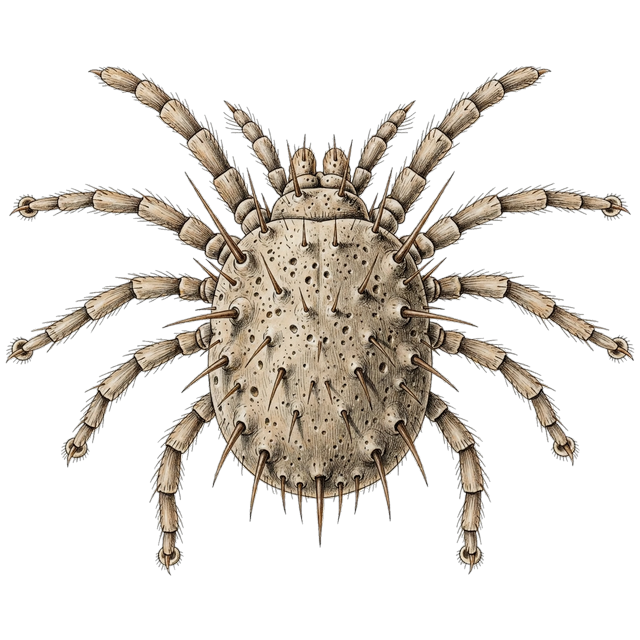
 Scabies mite
Sarcoptes scabiei (De Geer, 1778)
Scabies mite
The burrowing mite behind scabies, a medical condition, not a pest-control job.
- Order
- Sarcoptiformes
- Family
- Sarcoptidae
- Group
- Ticks & mites
- Ontario status
- Present, human parasite; a medical matter, not a structural pest
Why it matters
Scabies causes real suffering and spreads in households and care settings, but the suffering is prolonged by shame and by wrong responses like bug-bombing the house. The right response is medical: see a clinician, treat the people and the laundry, and leave the house alone.
Origin
An ancient human parasite, worldwide for all of recorded history.
Behavior
A pregnant female burrows into the top layer of skin and lays eggs in the tunnel. The intense itching, worse at night, is your immune system reacting, usually weeks after the mites arrive.
Living conditions
On people, transmitted by prolonged close contact, households, care homes, dormitories. It does not live in mattresses or carpets in any meaningful way.
Signs of presence
- Intense itching, worse at night, 2-6 weeks after exposure
- Thin burrow lines in finger webs, wrists, waistline, and other warm skin folds
- Similar itching in close contacts and household members
- Diagnosis confirmed only by a clinician's skin scraping
Weaknesses
- Dies within 1-3 days off the human body, the environment is not a reservoir
- Killed by hot-water laundering and drying
- Treatable with prescription medication, the infestation ends with medical care
- Cannot jump or fly; needs prolonged skin contact to spread
Myths and facts
Myth Scabies means you are dirty, and you need your house fumigated.
Reality Scabies has nothing to do with cleanliness, and the house needs no treatment, the mites die within days off the body. It is a medical condition treated with prescription medication, not a pest-control job.
Research notes
Morphology
0.3-0.45 mm; round tortoise-like body with dorsal spines and stubby legs with suckers. Females larger than males. Visible only under magnification.
Diagnostics
Clinical: burrows, nocturnal itch, distribution pattern. Confirmed by skin scraping microscopy. PestStudy documents the biology; diagnosis and treatment belong to healthcare providers.
Easily confused with
- Follicle mites (Demodex spp.) Follicle mites live in hair follicles of nearly everyone and cause no disease; scabies mites burrow in skin and cause intense itch.
Life cycle
- Adult
- Females burrow and live ~1-2 months in the skin
- Egg
- 2-3 eggs per day laid in the burrow; hatch in 3-4 days
- Egg to adult
- 10-14 days within the burrow
- Generations per year
- Continuous while infesting a host
- Nymph or larva
- Larvae and nymphs wander on the skin surface before burrowing
Development
Egg to larva to protonymph to tritonymph to adult, all within the skin burrow. Generation time ~2-3 weeks.
Reproduction
Mating on the skin surface; the fertilized female then burrows. A typical infestation holds only 10-15 mites, the symptoms come from allergy, not numbers.
Distribution
- Global
- Worldwide; ~200 million cases annually
- Native range
- Cosmopolitan with humans
- Ontario
- Present wherever people are; outbreaks in long-term care and institutional settings
Ecology
Obligate human parasite transmitted by prolonged skin-to-skin contact. Off-host survival is hours to a few days, fomite transmission is minor except in crusted scabies. Not a structural or environmental pest.
Resistance
Some treatment tolerance reported in the clinical literature; a medical matter, not a structural-pest issue.
IPM implications
None for structures, and saying so is the professional service. The protocol is: recognize it, refer to medical care (prescription treatment), advise hot laundering of bedding and clothing, and note that the home needs no pesticide treatment. Crusted scabies in care settings needs coordinated medical-environmental response, not a spray program.
Chemical ecology
Secretes proteases that dissolve skin for burrowing; saliva and feces drive the delayed hypersensitivity reaction, the itch is the immune system, weeks behind the infestation. No venom in the conventional sense.
Genetics and DNA
Draft genomes published 2016 (var. canis, Rider et al., Parasites & Vectors; var. hominis/suis, Mofiz et al., GigaScience); high-quality nuclear genome 2020 (Korhonen et al., PLoS Negl Trop Dis).
Taxonomy
Order Sarcoptiformes, family Sarcoptidae. Authority (De Geer, 1778). Human and animal scabies mites are host-adapted variants; the human form is the public-health concern.
Open questions
Why some individuals develop crusted scabies; immune evasion mechanisms still being mapped.
References
- Krantz, G.W. & Walter, D.E. (2009). A Manual of Acarology, 3rd ed., Texas Tech University Press.
- Chosidow, O. (2006). Scabies. New England Journal of Medicine., widely cited clinical review.