 Rice weevil
Sitophilus oryzae (Linnaeus, 1763)
Rice weevil
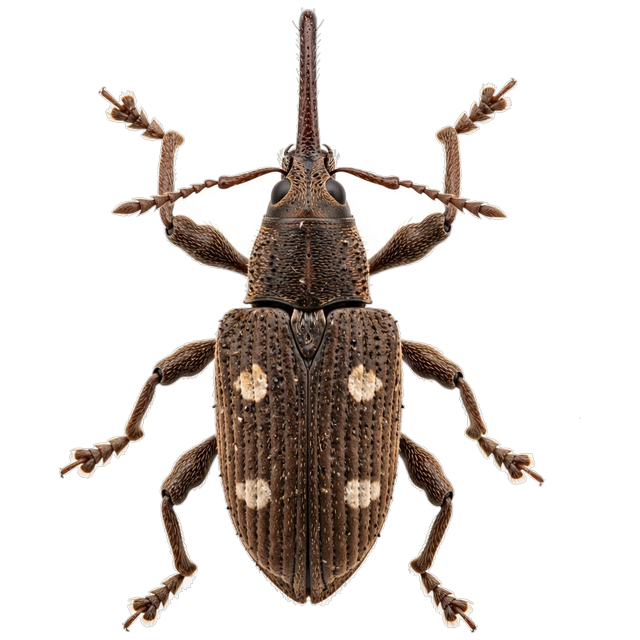
The granary weevil's smaller, flying cousin, with four pale spots on its back and a taste for warmer grain.
- Order
- Coleoptera
- Family
- Curculionidae
- Group
- Stored-product beetles
- Ontario status
- Established, the warm-climate grain weevil; in Ontario mainly in heated storage, mills, and imported product
Why it matters
One of the world's most important grain pests and a research celebrity: its intracellular bacterial symbiont is a model for how insects and microbes co-evolve.
Origin
Tropical Asia, where rice has been stored for millennia; now worldwide.
Behavior
Flies well, especially in warm weather, it can infest grain in the field before harvest as well as in storage. Otherwise the same hidden-larva lifestyle.
Living conditions
Whole grains, rice, wheat, corn, in warm storage. Like the granary weevil, the larva grows inside a single kernel.
Signs of presence
- Small weevils (2.5-3.5 mm) with four pale spots, sometimes seen flying in warm storages
- Exit holes in kernels
Weaknesses
- Killed by freezing and cooled grain
- Needs whole kernels; absent from flour
- Field infestations are minor in Ontario's climate, storage is the battleground
Myths and facts
Myth The spots mean it's a different, harmless beetle.
Reality The four pale spots are the rice weevil's ID badge, it is the more mobile and warm-adapted of the two grain weevils.
Research notes
Morphology
2.5-3.5 mm, brown, rostrum ~1 mm. Four distinct pale (reddish-yellow) spots on the elytra. Fully winged and a capable flier. Smaller and more active than S. granarius.
Diagnostics
Four elytral spots + flight + small size = rice weevil. Spots can be faint in worn specimens, check flight and size.
Easily confused with
- Granary weevil, Sitophilus granarius Rice weevil: smaller, spotted elytra, flies. Granary weevil: larger, unspotted, flightless.
- Maize weevil, Sitophilus zeamais Nearly identical; separated reliably only by genitalia or molecular markers, a known cryptic pair.
Life cycle
- Adult
- Emerges, feeds, flies; lives several months
- Egg
- One per kernel, sealed; hatch in under a week at 30 °C
- Egg to adult
- 4-5 weeks at 30 °C
- Generations per year
- 4-6 in warm storage
- Nymph or larva
- Internal feeding ~2-3 weeks
Development
Complete metamorphosis inside the kernel: egg → larva → pupa → adult.
Reproduction
~200-400 eggs per female, one per kernel.
Distribution
- Global
- Cosmopolitan; dominant Sitophilus in warm regions
- Native range
- Tropical Asia
- Ontario
- Established in heated storage; field activity limited by climate
Ecology
Field-to-storage continuum in warm climates, infests maturing grain pre-harvest. Carries the intracellular endosymbiont Sodalis pierantonius, which supplies B vitamins missing from the grain diet; the symbiosis is a model system in insect-microbe evolution.
Resistance
Phosphine resistance documented in several regions; monitored in the grain trade.
IPM implications
Flight plus pre-harvest infestation means incoming grain cannot be assumed clean, receiving inspection and monitoring matter more than for the flightless granary weevil. Cooling and sanitation apply equally.
Chemical ecology
Male-produced aggregation pheromone sitophilure ((4S,5R)-5-hydroxy-4-methyl-3-heptanone); symbiont-mediated nutritional ecology is the deeper chemical story.
Genetics and DNA
No reference genome published as of 2026 (endosymbiont genome and host-symbiont interaction well studied at the molecular level).
Taxonomy
Order Coleoptera, family Curculionidae. Sister species to S. granarius; the pair separates on flight, size, and elytral maculation.
Open questions
How the endosymbiont modulates host thermal tolerance and insecticide susceptibility.
References
- Hagstrum, D.W. & Subramanyam, B. (2006). Fundamentals of Stored-Product Entomology. AACC International.
- Vigneron, A. et al. (2014). Insects recycle endosymbionts when the benefit is over. Science, 344:1010-1012.