 Raccoon
Procyon lotor (Linnaeus, 1758)
Raccoon
North America's masked urban survivor, clever paws, clever problems.
- Order
- Carnivora
- Family
- Procyonidae
- Group
- Wildlife
- Ontario status
- Native, abundant urban
Why it matters
The GTA's top urban nuisance mammal: attic damage, tipped bins, latrines carrying raccoon roundworm, plus rabies-vector status in Ontario.
Origin
Native to North America; now abundant in every GTA neighbourhood, one of the continent's most successful urban adapters.
Behavior
Nocturnal and strikingly intelligent, solves latches and remembers solutions for years; dexterous front paws work like hands; mostly solitary except mothers with kits.
Living conditions
Dens in attics, chimneys, sheds, and hollow trees; needs water and food within about 1 km; active year-round but rests through deep winter cold.
Signs of presence
- Torn garbage and scattered refuse overnight
- Latrines on rooftops, decks, or logs, roundworm (Baylisascaris) risk, do not handle without precautions
- Five-toed hand-like tracks about 10 cm long
- Thumping and chattering in the attic after dark
Weaknesses
- Cannot resist accessible food, unsecured garbage is the main attractant
- Dens are fixed, once found, presence is predictable
- Relies more on touch and smell than on sight; easily startled by light and motion
Myths and facts
Myth A raccoon out in daytime must be rabid.
Reality Daytime foraging is normal, especially for nursing mothers in spring. Rabies signs are neurological, staggering, paralysis, unprovoked aggression, not the clock.
Research notes
Morphology
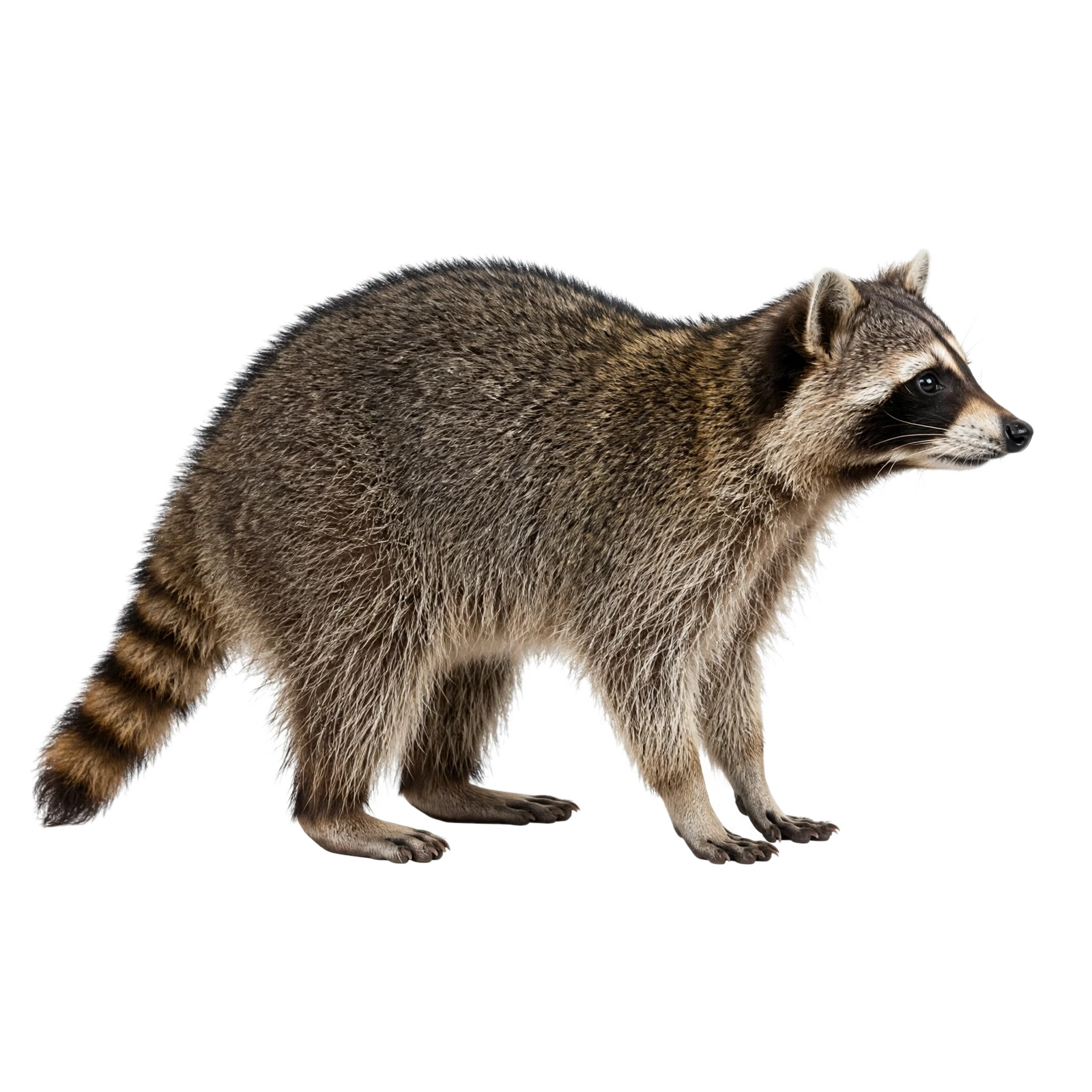
Body 40-70 cm, bushy ringed tail 20-40 cm; weight 5-12 kg (males larger; autumn fattening). Gray-brown pelage, black facial mask, plantigrade five-toed feet with highly dexterous forepaw digits.
Diagnostics
Mask + ringed tail + hand-like tracks are diagnostic in Ontario; no similar-sized native mammal combines all three.
Easily confused with
- Striped skunk (Mephitis mephitis) Skunk is smaller (2-6 kg) with white dorsal stripes and a waddling gait; its tracks lack the raccoon's long finger-like toes.
- Virginia opossum (Didelphis virginiana) Opossum has a naked prehensile tail and pointed snout; its tracks show an opposable hind 'thumb'.
Life cycle
- Egg
- N/A, viviparous (placental mammal)
- Nymph or larva
- Kits: altricial, den-bound about 8 weeks
- Adult
- Sexual maturity about 1 year (females); lifespan 2-3 years wild, up to 20 in captivity
- Egg to adult
- Gestation about 63 days; weaning 2-4 months
- Generations per year
- One litter per year (January, March breeding)
Development
Altricial young; kits born blind, eyes open at about 3 weeks, weaned at 2-4 months, independent by autumn.
Reproduction
2-5 kits per litter (typically 3-4) × 1 litter/year.
Distribution
- Native range
- North and Central America
- Ontario
- Native, abundant province-wide, highest densities in urban and suburban GTA
- Global
- Introduced and invasive in Europe and Japan
Ecology
Dens in tree cavities, attics, chimneys, burrows; no true hibernation, winter torpor with periodic arousal. Omnivore (crayfish, eggs, fruit, refuse); urban home range 1-3 km².
Resistance
Unknown, not applicable; no chemical-control context for a native mammal.
IPM implications
Exclusion logic follows behaviour: secure food waste (the attractant), cap chimneys, screen roof vents, entry points are structural, so the fix is structural. Latrines require decontamination precautions (Baylisascaris eggs survive years in soil). Under Ontario's Fish and Wildlife Conservation Act, trapping or relocating wildlife requires authorization, control is a licensed activity, not DIY.
Chemical ecology
Scent-marks via urine, faecal latrines, and anal glands; latrines serve as olfactory signposts. No defensive spray, defence is teeth, claws, and bluff.
Genetics and DNA
Reference genome published: chromosome-length assembly (DNA Zoo, 2n=38); NCBI GCA_028646535.1.
Taxonomy
Order Carnivora, family Procyonidae. Procyon lotor (Linnaeus, 1758), 'lotor' means 'washer', for the food-dousing behaviour.
Open questions
Urban population densities in the GTA are poorly censused; latrine-site fidelity and roundworm transmission dynamics in dense suburbs remain under study.
References
- Animal Diversity Web, Procyon lotor species account (University of Michigan)
- Feldhamer, Thompson & Chapman (eds.), Wild Mammals of North America