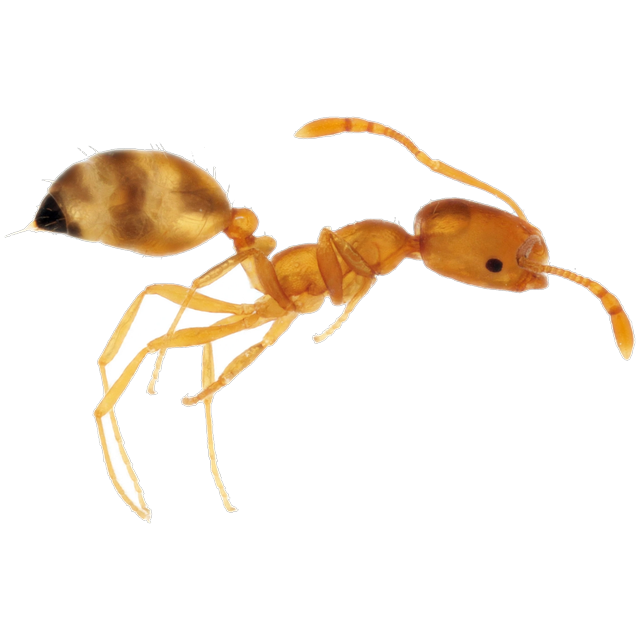
 Pharaoh ant
Monomorium pharaonis (Linnaeus, 1758)
Pharaoh ant
A 2 mm yellow ant that splits its colony when disturbed, the hospital and apartment-block specialist.
- Order
- Hymenoptera
- Family
- Formicidae
- Group
- Ants
- Ontario status
- Established indoors only (heated buildings); cannot overwinter outdoors
Why it matters
A serious concern in hospitals and care homes because it can carry germs between wards. In apartments it is famously hard to eliminate because the colony fragments.
Origin
Tropical in origin (likely Africa or Asia); in cold climates it lives only inside heated buildings.
Behavior
Forages day and night in faint trails. When its nest is disturbed, the colony splits into several new colonies ('budding'), which is why spraying the ants you see makes things worse.
Living conditions
Nests in wall voids, behind baseboards, in insulation, anywhere warm and hidden. Loves hospitals, apartment blocks, nursing homes and food plants. Needs steady indoor warmth year-round.
Signs of presence
- Tiny (2 mm) yellow ants trailing along walls, especially near moisture
- Ants appearing in many rooms at once, a sign of multiple nest fragments
- Activity continuing through winter (outdoor ants go dormant)
Weaknesses
- Cannot survive outdoors in Ontario at all
- Tiny colonies fragments depend on warmth, cold snaps indoors hurt them
- Foragers recruit nestmates to food, so bait placed correctly reaches the queens
Myths and facts
Myth Spraying the ants you see will solve a pharaoh ant problem.
Reality Disturbance causes budding, the colony splits and spreads. This species must be handled by targeting the colony, not the foragers.
Research notes
Morphology
Workers monomorphic, 1.5-2 mm, yellow to amber with a darker gaster tip. Two-segmented waist; 12-segmented antennae with distinct 3-segmented club; no propodeal spines.
Diagnostics
Confirm by tiny yellow size + indoor-only occurrence + budding behavior + multiple queens. Distinguished from thief ant by slightly larger size and clubbed antennae.
Easily confused with
- Thief ant, Solenopsis molesta Thief ant is smaller (1.3-1.8 mm) with 10-segmented antennae and a 2-segmented club; pharaoh has 12-segmented antennae with a 3-segmented club.
- Little black ant, Monomorium minimum Little black ant is dark brown to black; pharaoh ant is yellow-amber. Same genus, opposite color.
Life cycle
- Adult
- Workers live ~9-10 weeks; queens live ~1 year and lay hundreds of eggs.
- Egg
- Eggs hatch in ~1-2 weeks at 27-30 °C.
- Egg to adult
- ~36-45 days at 27-30 °C
- Generations per year
- Continuous indoors, many overlapping generations
- Nymph or larva
- Legless larvae; naked pupae.
Development
Complete metamorphosis: egg → larva → pupa → adult.
Reproduction
Hundreds of queens per colony; mating occurs inside the nest (no nuptial flight). New colonies form by budding, a queen plus workers walk away to a new site.
Distribution
- Global
- Cosmopolitan indoors; tropical outdoors
- Native range
- Likely tropical Africa or Asia
- Ontario
- Established indoors in heated buildings provincewide; cannot survive outdoors
Ecology
Polygynous and polydomous; colonies fragment readily under disturbance. Omnivorous with preference for sweets and proteins. Foraging trails recruit nestmates efficiently.
Resistance
Limited published data; control failures are behavioral (budding) rather than documented resistance.
IPM implications
The defining management fact is budding: any repellent or disruptive action fragments the colony and multiplies nest sites. Monitoring must map all foraging zones before action, since one colony spans many rooms. Colony-level (queen-targeting) strategies are required; forager-only suppression is counterproductive. In healthcare settings, surveillance is continuous.
Chemical ecology
Trail pheromones (faranal and related compounds), among the best-studied ant trail systems; budding triggered by disturbance cues.
Genetics and DNA
No reference genome published as of 2026.
Taxonomy
Order Hymenoptera, family Formicidae, subfamily Myrmicinae. Described by Linnaeus, 1758. Tropical tramp species.
Open questions
Pheromone-disruption potential in building-wide management; queen turnover dynamics in large polydomous networks.
References
- Hölldobler, B. & Wilson, E.O. 1990, The Ants, Harvard University Press
- Mallis Handbook of Pest Control