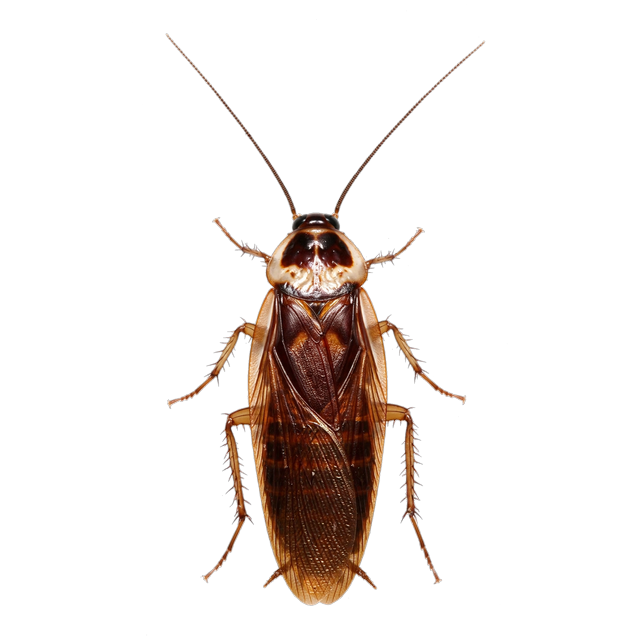
 Pennsylvania wood cockroach
Parcoblatta pennsylvanica (De Geer, 1773)
Pennsylvania wood cockroach
A native outdoor cockroach that wanders inside by accident, especially males flying to lights at night.
- Order
- Blattodea
- Family
- Ectobiidae
- Group
- Cockroaches
- Ontario status
- Native outdoor species; accidental indoor invader, does not breed indoors
Why it matters
Mostly a nuisance, not a health threat, it does not infest homes or contaminate food the way indoor cockroaches do. Its presence usually means a door was left open near the woods.
Origin
Native to eastern North American woodlands, it belongs outdoors, under bark and in woodpiles.
Behavior
Males are strong fliers attracted to lights; females are short-winged and stay near the ground. Active on warm summer evenings.
Living conditions
Lives outdoors in leaf litter, hollow trees, stumps and firewood. Comes inside only by accident, usually on summer nights when males fly toward porch lights.
Signs of presence
- Single large brown cockroaches near doors or windows on summer nights
- Found near firewood brought indoors
- No droppings clusters, no egg cases, no nymphs, the telltale sign of a non-breeding visitor
Weaknesses
- Cannot breed indoors, indoor sightings are lone wanderers
- Needs outdoor leaf litter and decaying wood
- Attracted to lights, so light management keeps them out
Myths and facts
Myth Any cockroach indoors means an infestation.
Reality Wood cockroaches cannot breed indoors; one inside is an accidental visitor, not an infestation.
Research notes
Morphology
Males ~20-25 mm, fully winged, chestnut brown, strong fliers. Females ~18-20 mm, brachypterous (short wings), darker. Nymphs dark brown.
Diagnostics
Confirm by fully-winged flying male + outdoor summer context + absence of indoor breeding signs (no oothecae, no nymph aggregations).
Easily confused with
- American cockroach, Periplaneta americana American is much larger (35-50 mm) with a pale pronotal margin and breeds indoors; wood cockroach males are smaller with no pale margin and do not breed indoors.
Life cycle
- Adult
- Adults active in summer; males fly to lights.
- Egg
- Ootheca deposited outdoors in leaf litter and decaying wood.
- Egg to adult
- ~1 year (univoltine)
- Generations per year
- 1
- Nymph or larva
- Nymphs develop outdoors under bark and in litter.
Development
Incomplete metamorphosis: egg → nymph → adult.
Reproduction
One generation per year; oothecae deposited in outdoor organic debris.
Distribution
- Global
- Eastern North America only
- Native range
- Eastern North America
- Ontario
- Native and common in wooded areas; accidental indoor records in summer
Ecology
Sylvatic, leaf litter, hollow trees, stumps, woodpiles. Males disperse by flight, positively phototactic. Females and nymphs ground-dwelling.
Resistance
No data, non-target native species with no insecticide selection pressure.
IPM implications
No indoor treatment logic applies, this is an exclusion and lighting-management matter: door seals, window screens, yellow 'bug lights' or motion lighting, and storing firewood away from the house. Finding one indoors warrants inspection for entry points, not for breeding sites.
Chemical ecology
Not well characterized; aggregation in outdoor refugia presumed pheromone-mediated as in related Ectobiidae.
Genetics and DNA
No reference genome published as of 2026.
Taxonomy
Order Blattodea, family Ectobiidae, genus Parcoblatta (the wood cockroaches). Described by De Geer, 1773. Native North American fauna.
Open questions
Population trends at the urban, woodland interface in the GTA.
References
- Ebeling, W. Urban Entomology, UC Riverside
- Mallis Handbook of Pest Control