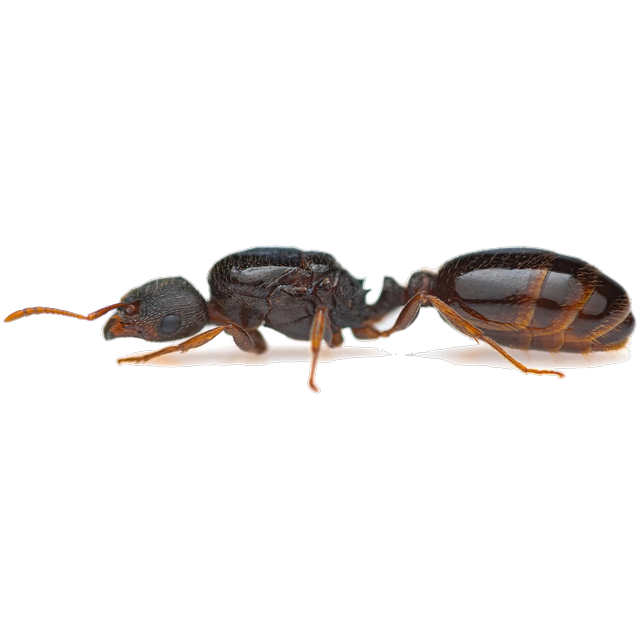
 Pavement ant
Tetramorium immigrans Santschi, 1927
Pavement ant
The sidewalk ant, tiny, dark, and famous for springtime turf wars between rival colonies.
- Order
- Hymenoptera
- Family
- Formicidae
- Group
- Ants
- Ontario status
- Introduced, established provincewide
Why it matters
Mostly a nuisance, it contaminates food and is persistent indoors, but it does not damage structures or sting. Its sheer numbers make it the most complained-about ant in Ontario homes.
Origin
Introduced from Europe centuries ago; now one of the most common ants in North American cities.
Behavior
Forages in trails day and night. In spring, neighboring colonies fight spectacular battles on sidewalks, thousands of ants locked in combat.
Living conditions
Nests under sidewalks, driveways, patios, stones and building foundations, anywhere with sun-warmed pavement or soil. Enters homes through cracks in slabs and foundations.
Signs of presence
- Small dark ants trailing along baseboards, especially in spring
- Tiny soil mounds pushed up between patio stones or along foundations
- Mass battles of ants on sidewalks in spring
Weaknesses
- Nests are shallow and accessible under pavement edges
- Foraging trails are visible and traceable to the nest
- Colonies fight each other, limiting unchecked spread
Myths and facts
Myth The spring ant wars mean there is one giant colony.
Reality The battles are rival colonies fighting, pavement ants are fiercely territorial between nests.
Research notes
Morphology
Workers 2.5-4 mm, dark brown to black. Head and thorax with fine parallel grooves (rugae). Two-segmented waist (petiole + postpetiole). 12-segmented antennae with 3-segmented club. Propodeum with a pair of small spines.
Diagnostics
Confirm by small size + grooved head/thorax + two-segmented waist + nesting under pavement with soil excavations.
Easily confused with
- Little black ant, Monomorium minimum Little black ant is smaller (~1.5 mm), shinier, and lacks the grooved sculpturing on the head and thorax.
- Odorous house ant, Tapinoma sessile Odorous house ant has a single flat waist node and smells of rotten coconut when crushed; pavement ant has two waist segments and no odor.
Life cycle
- Adult
- Workers live several months; queens live for years.
- Egg
- Eggs hatch in ~2-3 weeks at warm temperatures.
- Egg to adult
- ~6-10 weeks at warm temperatures
- Generations per year
- Continuous brood through the warm season
- Nymph or larva
- Legless larvae reared in the nest; pupae naked (no cocoons) in Myrmicinae.
Development
Complete metamorphosis: egg → larva → pupa → adult.
Reproduction
Multiple queens per colony (polygynous); mature colonies hold 3,000-10,000+ workers. Nuptial flights in early summer.
Distribution
- Global
- Temperate North America and Europe
- Native range
- Europe
- Ontario
- Introduced; established provincewide in urban and suburban habitats
Ecology
Nests in soil under pavement, stones and foundations; excavated soil forms characteristic crater mounds. Omnivorous, seeds, insects, sweets, grease. Inter-colony aggression ('wars') in spring structures local populations.
Resistance
Limited published data.
IPM implications
Nest location is usually obvious (soil mounds at pavement edges), monitoring should map nest entrances, not just indoor trails. Because colonies are polygynous and long-lived, queen survival determines outcomes; forager-only suppression rebounds. Sealing slab and foundation cracks addresses the indoor interface.
Chemical ecology
Trail and alarm pheromones typical of Myrmicinae; inter-colony recognition via cuticular hydrocarbons drives territorial aggression.
Genetics and DNA
No reference genome published as of 2026.
Taxonomy
Order Hymenoptera, family Formicidae, subfamily Myrmicinae. Described by Santschi, 1927. Introduced from Europe. North American pavement ants were long called Tetramorium caespitum until the 2017 revision of that species complex (Wagner et al.) assigned them to T. immigrans.
Open questions
Whether other members of the Tetramorium caespitum complex occur in North America; colony lifespan in urban heat islands.
References
- Hölldobler, B. & Wilson, E.O. 1990, The Ants, Harvard University Press
- Mallis Handbook of Pest Control