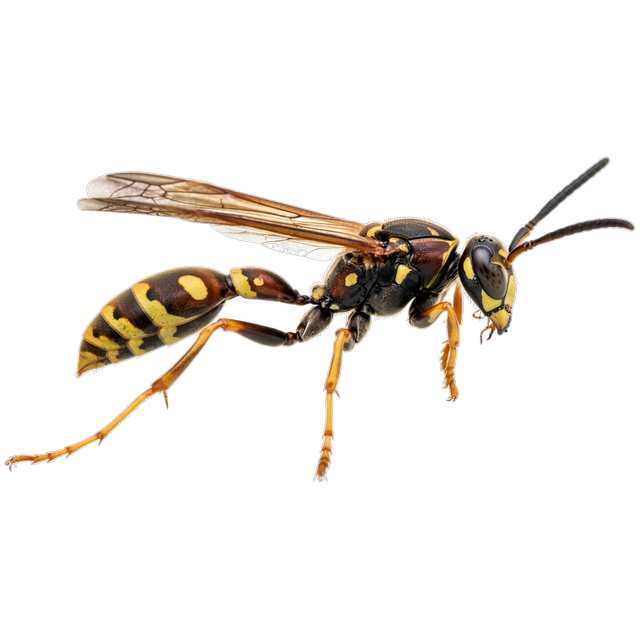
 Paper wasp
Polistes spp. Latreille, 1802
Paper wasp
Slender wasps with open umbrella nests under your eaves, docile neighbours and caterpillar hunters.
- Order
- Hymenoptera
- Family
- Vespidae
- Group
- Wasps, hornets & bees
- Ontario status
- Established, native (several species)
Why it matters
Low sting risk, high garden value, each colony removes large numbers of caterpillars. Nests directly over doorways are the main conflict; elsewhere they are allies.
Origin
Native; several species across Ontario, including the common Polistes fuscatus.
Behavior
Hunts caterpillars to feed its young, genuinely useful in gardens. Relatively docile; stings usually only when the nest is grabbed or bumped. Legs dangle distinctively in flight.
Living conditions
Builds small open paper combs, the classic umbrella shape, under eaves, deck railings, window frames and shrubs.
Signs of presence
- Umbrella-shaped open paper nests under eaves and railings
- Slender wasps with dangling legs visiting gardens
- Chewed wood fibres on weathered deck rails (nest-building material collection)
Weaknesses
- Small colonies (dozens, not thousands), low sting risk
- Open nests are visible and easy to assess
- Single-season; winter ends the colony
- Nests in predictable spots, early-season removal of starter nests prevents the colony
Myths and facts
Myth All wasp nests must be destroyed.
Reality Paper wasp colonies are small, seasonal and beneficial. A nest under a high eave away from doors is free caterpillar control, removal is only warranted at conflict points.
Research notes
Morphology
Workers 13-17 mm; slender, long-waisted, reddish-brown to black with yellow markings (variable). Long legs dangle in flight, the field diagnostic. Nests: open comb without an envelope, umbrella-shaped, suspended by a stalk.
Diagnostics
Confirm by: slender build, dangling legs in flight, open umbrella comb nest, relatively calm behavior.
Easily confused with
- Mud dauber, Sceliphron caementarium Mud daubers have an extremely thread-like waist and build mud tubes, not paper combs; they never defend a colony.
- Yellowjackets, Vespula spp. Yellowjackets are stocky, fast, and nest in enclosed cavities; paper wasps are slender with visible open nests.
Life cycle
- Egg
- Foundress builds the stalk and first cells in spring, laying eggs as she builds
- Nymph or larva
- Larvae in open cells, fed chewed caterpillars by the foundress, then by workers
- Adult
- Colonies of a few dozen; males and new foundresses in autumn; mated foundresses overwinter in sheltered cracks
- Egg to adult
- Approximately 4-6 weeks per generation
- Generations per year
- One colony cycle; overlapping worker broods through summer
Development
Complete metamorphosis: egg → larva → pupa → adult. Primitively eusocial: foundress starts alone, daughters become workers.
Reproduction
Foundress (sometimes small cooperative groups) initiates; workers are daughters; autumn produces the next year's foundresses.
Distribution
- Native range
- North America (native species); P. dominula introduced from Europe
- Ontario
- Common; P. fuscatus widespread, P. dominula expanding
- Global
- Worldwide genus
Ecology
Open-nesting makes colonies vulnerable to weather and predators, the trade-off for low construction cost. Important caterpillar predators in gardens and old fields. P. dominula (European) competes with native P. fuscatus where ranges overlap.
Resistance
Not applicable, no insecticide resistance documented.
IPM implications
Tolerance-first biology: small, seasonal, beneficial colonies at non-conflict sites need no action, a defensible professional recommendation. Conflict nests (doorways, play areas) are removed mechanically or treated at night by operators. Prevention is early-season: knocking down starter combs in spring (when the foundress is alone) prevents the colony at near-zero risk. Client education, 'this nest is an asset', is part of the service.
Chemical ecology
Nestmate recognition via cuticular hydrocarbons; foundress dominance maintained behaviorally and chemically; caterpillar prey located visually.
Genetics and DNA
No reference genome published as of 2026.
Taxonomy
Hymenoptera: Vespidae. Genus Polistes Latreille, 1802. Ontario species include P. fuscatus (northern paper wasp); the European P. dominula is established in parts of eastern North America and expanding.
Open questions
Competitive displacement of native P. fuscatus by invasive P. dominula in Ontario; foundress overwintering site ecology.
References
- Evans & Eberhard (1970), The Wasps (Univ. Michigan Press)
- Reeve (1991 onward), Polistes social biology, primary literature
- Penn State Extension, paper wasps