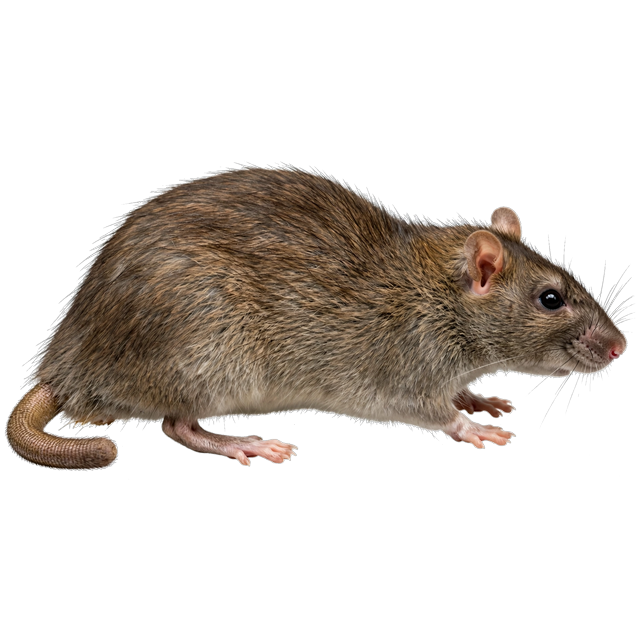
 Norway rat
Rattus norvegicus (Berkenhout, 1769)
Norway rat
The burrowing city rat, heavy, wary, and built for sewers and foundations.
- Order
- Rodentia
- Family
- Muridae
- Group
- Rodents
- Ontario status
- Established, urban
Why it matters
Contaminates food; gnaws structures and wiring; vector of leptospirosis and salmonellosis, and historically plague, via its fleas.
Origin
Native to northern China and Mongolia; spread worldwide with shipping, despite the name, it is not from Norway.
Behavior
Nocturnal; strongly neophobic, avoids new objects for days, unlike mice. Home range 15-30 m; an excellent swimmer and burrower.
Living conditions
Burrows along foundations, under debris, in sewers and basements. Needs daily water and 15-30 g of food; rarely travels far from the burrow.
Signs of presence
- Blunt-ended droppings 12-18 mm near burrows and runs
- Burrow openings ~8-10 cm along foundations and under debris
- Greasy rub marks along walls and pipes
- Gnaw marks ~4 mm wide on wood, plastic, and wiring
Weaknesses
- Neophobia is predictable, it avoids new objects, so monitoring takes days to read
- Burrow-bound: burrows along foundations reveal the whole colony
- Needs daily water, removing water sources stresses the colony
Myths and facts
Myth A clean building can't have rats.
Reality Rats live in sewers and alleys, but a single broken drain or food spill sustains a colony. Sanitation lowers carrying capacity; it does not grant immunity.
Research notes
Morphology
Body 200-270 mm, tail 160-200 mm (shorter than head+body), weight 200-500 g. Blunt muzzle, small ears, thick scaly tail. Droppings 12-18 mm, capsule-shaped, blunt ends.
Diagnostics
Droppings blunt-ended and ≥12 mm; tail shorter than body; burrows rather than climbing. The blunt-vs-pointed droppings test separates it from roof rat.
Easily confused with
- Roof rat (Rattus rattus) Roof rat: tail longer than body, pointed droppings 10-12 mm, climbs. Norway rat: tail shorter than body, blunt droppings 12-18 mm, burrows.
- Muskrat (Ondatra zibethicus) Muskrat is semi-aquatic with a laterally flattened tail; rarely in structures.
Life cycle
- Adult
- Lifespan ~12 months in the wild; 2-3 years in captivity
- Egg
- N/A, viviparous
- Egg to adult
- Gestation 21-23 days; maturity at 8-12 weeks
- Generations per year
- 4-7 (year-round breeding indoors)
- Nymph or larva
- Pups weaned at ~21 days; sexually mature at 8-12 weeks
Development
Viviparous; altricial.
Reproduction
6-12 pups per litter × 4-7 litters/year.
Distribution
- Global
- Cosmopolitan
- Native range
- Northern China and Mongolia
- Ontario
- Established, the dominant urban rat province-wide
Ecology
Fossorial commensal; colonial burrow systems with dominance hierarchies; thigmotactic travel along walls, pipes, and edges; strong swimmers.
Resistance
VKORC1-mediated anticoagulant resistance documented in multiple populations worldwide, including North America.
IPM implications
Neophobia dictates monitoring duration, allow days of acclimation before reading results. Burrow mapping defines colony extent; exclusion targets burrow-adjacent entries; sanitation of food waste and standing water removes carrying capacity. Thigmotactic travel along walls and pipes dictates device placement.
Chemical ecology
Urine marking, plantar gland secretions, colony odor; pheromonal regulation of reproduction and hierarchy.
Genetics and DNA
Mammalian model organism, genome published 2004 (Rat Genome Sequencing Project Consortium, Nature).
Taxonomy
Order Rodentia › family Muridae › genus Rattus › R. norvegicus (Berkenhout, 1769). Also called the brown rat or sewer rat.
Open questions
VKORC1 resistance allele distribution across Ontario urban rat populations is unmapped.
References
- UC IPM, Norway Rat (ipm.ucanr.edu)
- Internet Center for Wildlife Damage Management, Norway Rat