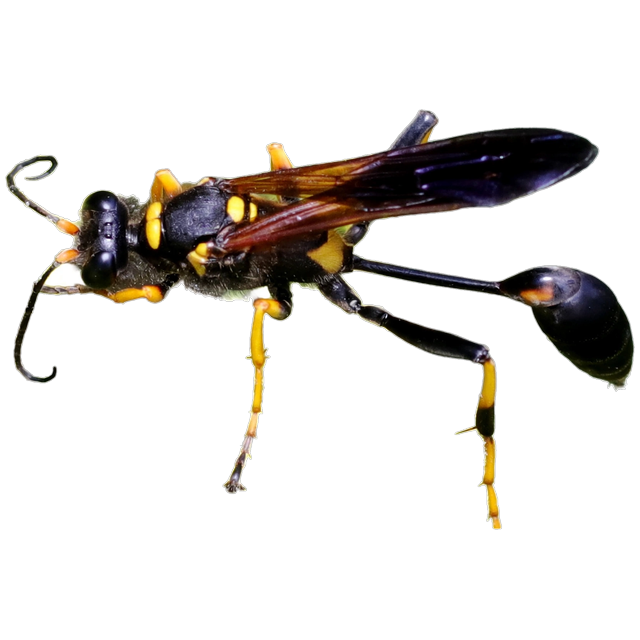
 Mud dauber
Sceliphron caementarium Drury, 1773
Mud dauber
Solitary wasps that build mud tubes and stock them with paralyzed spiders, they never defend a nest.
- Order
- Hymenoptera
- Family
- Sphecidae
- Group
- Wasps, hornets & bees
- Ontario status
- Established, native
Why it matters
Beneficial spider predators; essentially stingless in practice. The 'problem' is cosmetic mud on buildings, and even that washes off.
Origin
Native to North America; now also introduced to many parts of the world.
Behavior
Hunts spiders, stings them into paralysis, and packs them into mud cells as living food for one larva per cell. Solitary, no colony, no nest defence, almost never stings people.
Living conditions
Builds mud cells in sheltered spots: under eaves, in sheds, on walls, inside attics. Needs a mud source nearby, puddles, pond edges.
Signs of presence
- Lumpy mud tubes or organ-pipe clusters under eaves and on walls
- Long-waisted black wasps carrying mud balls
- Spiders disappearing around the property (a good thing)
Weaknesses
- No colony to defend, they are harmless by design
- Mud nests are cosmetic; scraping them off ends the issue
- Sealing entry to sheds and attics prevents indoor nesting
- Removing mud sources nearby discourages building
Myths and facts
Myth Mud dauber nests mean a wasp infestation.
Reality Each nest is one mother's work, not a colony. There is no swarm coming, just a solitary hunter that also happens to be free spider control.
Research notes
Morphology
Adult 15-20 mm; black with yellow markings; petiole (waist) extremely long and thread-like, the instant diagnostic. Builds cylindrical mud cells, often clustered in 'organ pipe' rows.
Diagnostics
Confirm by: thread-waist, mud tube nests, spider-hunting behavior, complete lack of colony defence.
Easily confused with
- Paper wasp, Polistes spp. Paper wasps build paper combs and defend them; mud daubers build mud tubes and never defend anything, plus the thread waist is unmistakable.
Life cycle
- Egg
- Single egg laid in each mud cell on the first paralyzed spider
- Nymph or larva
- Larva consumes the provisioned spiders, then spins a cocoon in the cell
- Adult
- Emerges the following season; females build and provision new cells through summer
- Egg to adult
- About one year; overwinters as a prepupa in the mud cell
- Generations per year
- One (partial second in warm years)
Development
Complete metamorphosis: egg → larva (feeding on paralyzed spiders in the sealed cell) → pupa → adult. Solitary.
Reproduction
Each female builds and provisions her own cells, no workers, no queen. Fecundity is limited by her hunting success.
Distribution
- Native range
- North America
- Ontario
- Common; mud nests a familiar sight on rural and suburban buildings
- Global
- Introduced to Europe, Australia, Pacific islands
Ecology
Spider specialist: each cell holds a dozen or more paralyzed spiders. Nests in sheltered human structures are common. The blue mud dauber (Chalybion californicum) often reuses Sceliphron cells and hunts black widows, a beneficial cascade.
Resistance
Not applicable, no insecticide resistance documented; never a spray target.
IPM implications
Reassurance is the service: identification alone resolves most 'wasp nest' calls, no treatment warranted. Nests are removed mechanically (scraping) for cosmetics. Prevention is exclusion of sheltered building voids and reducing mud sources. A textbook case where the professional value is knowing what NOT to treat.
Chemical ecology
Spider location is visual and vibratory; nest-site selection follows shelter and mud availability.
Genetics and DNA
No reference genome published as of 2026.
Taxonomy
Hymenoptera: Sphecidae. Sceliphron caementarium (Drury, 1773). A solitary sphecid wasp; related Ontario genera include Chalybion (blue mud dauber).
Open questions
Spider prey spectra in Ontario; interactions with the blue mud dauber at shared nest sites.
References
- Evans & Eberhard (1970), The Wasps (Univ. Michigan Press)
- Bohart & Menke (1976), Sphecid Wasps of the World, taxonomic foundation
- UF/IFAS Extension, mud daubers