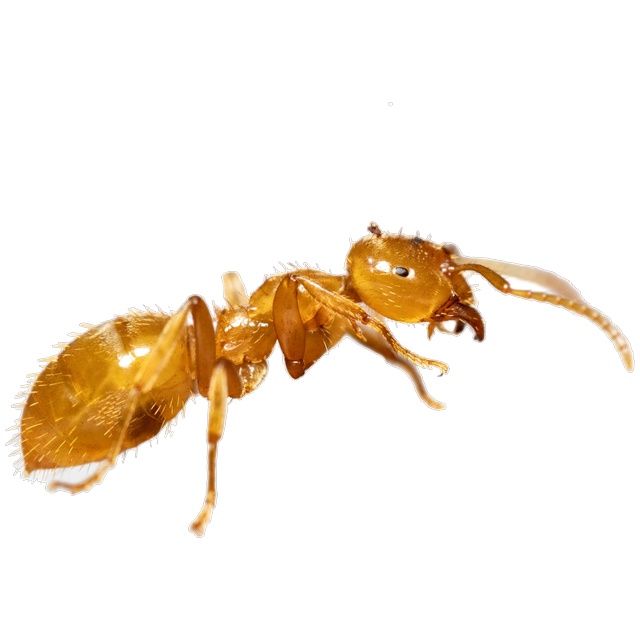
 Moisture ant
Lasius spp. Fabricius, 1804
Moisture ant
The yellow ant that smells like lemons, and only nests where wood is wet and rotting.
- Order
- Hymenoptera
- Family
- Formicidae
- Group
- Ants
- Ontario status
- Native, established provincewide
Why it matters
A moisture indicator species, its presence means wood is wet enough to rot, which is the real problem. Does not sting; damage is limited to already-decayed wood.
Origin
Native to North American woodlands, where it nests in rotting logs, the original damp-wood specialist.
Behavior
Mostly subterranean and nocturnal; rarely seen foraging in the open. When their wood is disturbed, they release a lemony citronella smell.
Living conditions
Nests only in wet, decaying wood: rotting sills, damp basement timbers, logs and stumps. Where moisture ants are, there is a water problem.
Signs of presence
- Small yellow ants emerging from damp or rotting wood
- Lemon/citronella smell when the nest area is disturbed
- Winged swarmers indoors in late summer from damp timbers
Weaknesses
- Cannot nest in dry wood at all, drying the wood eliminates them
- Colonies die if the moisture source is fixed
- Poor competitors in dry environments
Myths and facts
Myth Moisture ants cause rot in sound wood.
Reality They colonize wood that is already wet and decaying, they are the symptom, not the cause.
Research notes
Morphology
Workers 3-4.5 mm, yellow to amber. Single node; 12-segmented antennae, no club; acidopore present. Citronella odor (citronellal) when crushed, diagnostic.
Diagnostics
Confirm by yellow coloration + citronella odor + nesting in wet decayed wood. The lemon smell is diagnostic in the field.
Easily confused with
- Pharaoh ant, Monomorium pharaonis Pharaoh ant is smaller (1.5-2 mm) with two waist segments and no citronella odor; moisture ants are larger with one node and the lemon smell.
- Carpenter ant, Camponotus pennsylvanicus Carpenter ants are much larger (6-13 mm), black, and excavate galleries; moisture ants are small, yellow, and confined to already-rotted wood.
Life cycle
- Adult
- Workers live a season; colonies perennial while wood stays wet.
- Egg
- Eggs hatch in ~2-3 weeks at warm temperatures.
- Egg to adult
- ~6-8 weeks at warm temperatures
- Generations per year
- One main brood cycle per season
- Nymph or larva
- Legless larvae; pupae in cocoons.
Development
Complete metamorphosis: egg → larva → pupa → adult.
Reproduction
Single or few queens; nuptial flights in late summer; new colonies found in moist wood.
Distribution
- Global
- Holarctic genus
- Native range
- North America (varies by species)
- Ontario
- Native; common provincewide wherever wood stays wet
Ecology
Subterranean and wood-nesting in permanently moist microhabitats; tends root aphids and mealybugs for honeydew. Strictly tied to moisture, the colony's range is the wet wood's range.
Resistance
No published data.
IPM implications
This is a moisture-management case, not an ant-control case: find and fix the water intrusion, and the colony collapses as the wood dries. Inspection should map moisture (meters, staining) rather than just ant trails. Treating ants without drying the wood guarantees reinfestation.
Chemical ecology
Citronellal-based defensive secretion produces the diagnostic lemon odor; subterranean foraging guided by trail pheromones.
Genetics and DNA
No reference genome for Ontario Lasius species published as of 2026; Lasius niger genome published (European species).
Taxonomy
Order Hymenoptera, family Formicidae, subfamily Formicinae, genus Lasius (includes the yellow citronella ants formerly in Acanthomyops). Treated at genus level.
Open questions
Species-level identification of structural records in Ontario; moisture thresholds for colony persistence.
References
- Hölldobler, B. & Wilson, E.O. 1990, The Ants, Harvard University Press
- Mallis Handbook of Pest Control