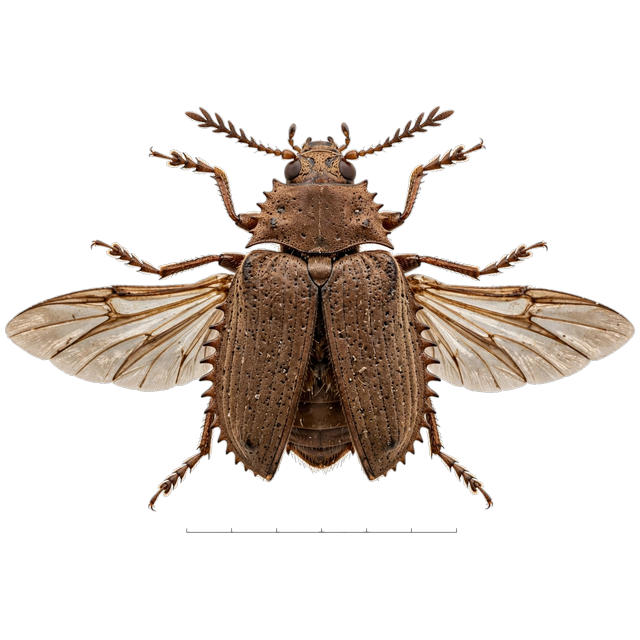
 Merchant grain beetle
Oryzaephilus mercator (Fauvel, 1889)
Merchant grain beetle
The sawtoothed grain beetle's flying twin, slightly pickier about food, and it can cross the room on its own wings.
- Order
- Coleoptera
- Family
- Silvanidae
- Group
- Stored-product beetles
- Ontario status
- Established, cosmopolitan in Ontario food storage and retail; prefers oilseeds, nuts, and higher-fat commodities
Why it matters
A frequent contaminant of higher-value grocery products (nuts, baking mixes). Flight makes infestations spread faster between cupboard items than the sawtoothed beetle manages.
Origin
Tropical origins like its cousin; spread worldwide through trade in oilseeds, nuts, and dried fruit.
Behavior
Can fly, so it disperses between products and rooms on its own. Otherwise the same crawling, seam-squeezing habits.
Living conditions
Prefers higher-fat, higher-oil foods, nuts, oilseeds, coconut, dried fruit, cake mixes, more than plain flour. Same package-seam entry as the sawtoothed.
Signs of presence
- Small brown beetles that take flight when disturbed, the flying is the tell
- Beetles in nuts, trail mix, cake mix, coconut
Weaknesses
- Killed by freezing
- Cannot penetrate truly sealed packaging
- Needs warmth, inactive and non-breeding in cold storage
Myths and facts
Myth If it flies, it can't be a grain beetle.
Reality The merchant grain beetle flies readily, flight is exactly how you tell it from the sawtoothed grain beetle.
Research notes
Morphology
2.5-3 mm, flattened, brown, six pronotal teeth per side as in surinamensis. Fully winged and capable of flight. Temple (behind eye) longer relative to eye diameter than in surinamensis, the microscopic separator.
Diagnostics
Flight + pronotal teeth = merchant grain beetle in practice. Microscopic confirmation via temple-to-eye ratio.
Easily confused with
- Sawtoothed grain beetle, Oryzaephilus surinamensis Flight: merchant flies, sawtoothed cannot. In the hand, temple length behind the eye.
Life cycle
- Adult
- Long-lived, 6+ months; strong fliers
- Egg
- Laid in food crevices; hatch in ~1 week at 30 °C
- Egg to adult
- 4-7 weeks at 27-30 °C
- Generations per year
- 3-6 indoors
- Nymph or larva
- Flattened larvae feed 2-4 weeks, pupate in food-particle cocoons
Development
Complete metamorphosis: egg → larva → pupa → adult.
Reproduction
~200+ eggs per female lifetime, laid into food.
Distribution
- Global
- Cosmopolitan in trade
- Native range
- Tropical Old World
- Ontario
- Established in heated storage; cannot overwinter outdoors
Ecology
Prefers oil-rich commodities; aggregation pheromones concentrate populations. Flight enables colonization of new food patches without human transport.
Resistance
Phosphine resistance reported in some populations; generally similar profile to sawtoothed grain beetle.
IPM implications
Flight changes the monitoring geometry: traps must account for aerial dispersal, and inspection must extend beyond the single infested product to adjacent goods. Otherwise the same sanitation-first logic applies, remove the food, remove the beetle.
Chemical ecology
Macrolide aggregation pheromones shared with O. surinamensis chemistry; flight-dispersal mediated by temperature and crowding.
Genetics and DNA
No reference genome published as of 2026.
Taxonomy
Order Coleoptera, family Silvanidae. Sister species to O. surinamensis; the pair is the textbook example of cryptic stored-product species separated by flight.
Open questions
Ecological partitioning between the two Oryzaephilus species in shared facilities.
References
- Hagstrum, D.W. & Subramanyam, B. (2006). Fundamentals of Stored-Product Entomology. AACC International.