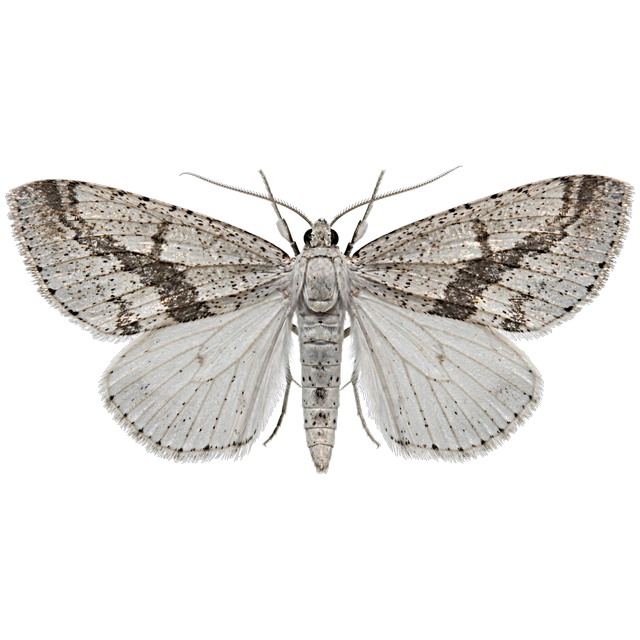
 Mediterranean flour moth
Ephestia kuehniella Zeller, 1879
Mediterranean flour moth
A pale pantry moth common in flour mills, bakeries, and home kitchens.
- Order
- Lepidoptera
- Family
- Pyralidae
- Group
- Moths
- Ontario status
- Established, flour mills, bakeries, and home pantries
Why it matters
A premier pest of flour mills, larval webbing mats flour and fouls machinery, causing major economic losses. In homes it ruins flour, cereal and dry mixes.
Origin
Named for the Mediterranean but now worldwide, spread through the global flour trade.
Behavior
Adults rest on walls and ceilings by day and fly at dusk. Larvae stay hidden inside the food, webbing flour into clumps that can clog mill machinery, in homes you'll find webbing inside the flour bag itself.
Living conditions
Flour mills, bakeries, and home kitchens. Larvae live inside flour and grain products, spinning silken tubes as they feed.
Signs of presence
- Silken webbing and clumping inside flour bags
- Small pale caterpillars (~15 mm) in flour or cereal
- Gray moths resting on pantry walls
- Musty odor in heavily infested flour
Weaknesses
- Adults don't feed and live only 1-2 weeks
- Needs dry milled products, sealed containers break the cycle
- Silken webbing betrays its presence early
- Cold stops development
Myths and facts
Myth It's the same as the pantry moth with bronze wings.
Reality That bronze-tipped one is the Indianmeal moth; this one is uniformly pale gray, different species, similar habits.
Myth Sifting the flour makes it safe.
Reality Webbing, frass and eggs remain behind; infested flour should be discarded.
Research notes
Morphology
Adults 10-14 mm body, wingspan 20-25 mm, noticeably larger than the Indianmeal moth. Forewings pale gray with dark transverse zigzag markings; no bronze coloring. Larvae creamy white, ~15-20 mm at maturity.
Diagnostics
Confirm by size plus gray zigzag forewings without bronze tips. In mills: silken webbing matting flour, larvae in machinery.
Easily confused with
- Indianmeal moth, Plodia interpunctella Smaller, with a bronze/copper outer third on the forewing; Mediterranean flour moth is larger and uniformly gray.
Life cycle
- Adult
- Lives ~1-2 weeks; does not feed.
- Egg
- Laid on milled products; hatch in ~3-9 days depending on temperature.
- Egg to adult
- ~8-10 weeks at 25 °C; ~5-6 weeks at 30 °C
- Generations per year
- 3-5 per year in heated mills; continuous where warm
- Nymph or larva
- 5-6 instars over 4-8 weeks; spins silken feeding tubes in flour.
Development
Complete metamorphosis: egg → larva (5-6 instars) → pupa → adult.
Reproduction
Females lay 100-300 eggs.
Distribution
- Global
- Cosmopolitan in milled products
- Native range
- Mediterranean region (probable)
- Ontario
- Established, flour mills, bakeries, and home pantries
Ecology
Larvae are flour specialists; silk production mats the food mass and provides pupation shelter. A long-standing model organism for insect development and population ecology.
Resistance
Phosphine resistance reported in some mill populations.
IPM implications
In mills, pheromone traps map adult activity back to breeding foci in machinery, the silk-matting biology means infestations concentrate where flour accumulates undisturbed. Sanitation of dead flour spots matters more than treating open product.
Chemical ecology
Female sex pheromone based on tetradecadienyl acetates, used in monitoring traps; males also produce courtship signals.
Genetics and DNA
No chromosome-level reference genome published as of 2026; draft genome and transcriptome data published in 2022 (Kuenstner et al., Data in Brief).
Taxonomy
Order Lepidoptera, family Pyralidae. Described by Zeller, 1879. A classic laboratory model in genetics and developmental biology.
Open questions
Genetic basis of mill-adapted life-history traits.
References
- Hagstrum & Subramanyam 2006, Fundamentals of Stored-Product Entomology
- Phillips & Throne 2010, Annu. Rev. Entomol.
- Mallis Handbook of Pest Control