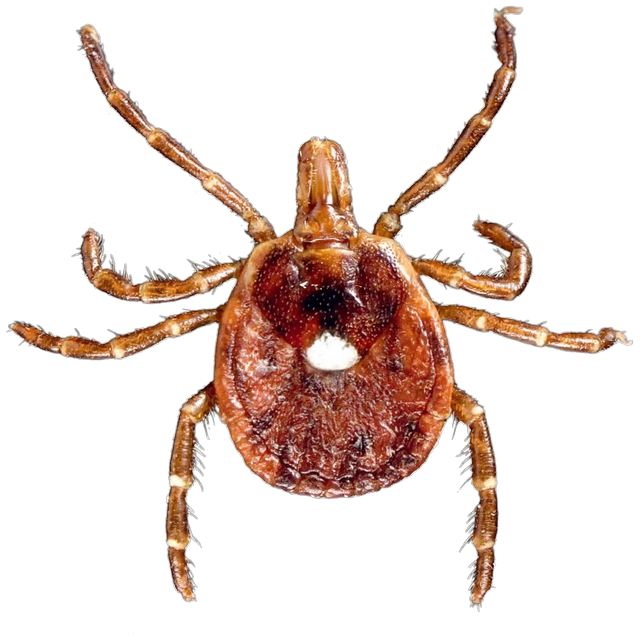
 Lone star tick
Amblyomma americanum (Linnaeus, 1758)
Lone star tick
An aggressive eastern US tick, the female carries a single white spot on her back.
- Order
- Ixodida
- Family
- Ixodidae
- Group
- Ticks & mites
- Ontario status
- Not officially documented as established in Ontario, aggressive tick expanding across the eastern and central US; possible local reproduction emerging (2026 reports)
Why it matters
Transmits ehrlichiosis and tularemia, and its bite is documented in association with alpha-gal syndrome, a delayed allergy to red meat. Aggressive biting makes encounters common where it's established.
Origin
Native to the eastern and central US; its range is expanding northward with warmer winters and growing deer populations.
Behavior
Unusually aggressive for a tick, it actively moves toward hosts rather than just waiting. Most active spring through fall.
Living conditions
Woodlands, brushy edges and tall grass where deer and other hosts pass. All three life stages quest for hosts, larvae, nymphs and adults all bite people.
Signs of presence
- Ticks with a single white spot (females) found on people or pets after time in brush
- Multiple attached ticks after one outing, they quest aggressively
- Red, itchy bite sites that linger for days
Weaknesses
- Not established in Ontario, a US species for now
- Needs leaf litter and humidity to survive off-host; dry, sunny lawns are hostile
- Must attach and feed for hours to transmit most pathogens, prompt removal matters
- All stages are visible to the naked eye, unlike nymphal deer ticks
Myths and facts
Myth The white spot means it's a deer tick.
Reality Deer ticks have no white spot, the lone star's spot is its own mark.
Myth A tick bite gives you a meat allergy.
Reality Alpha-gal syndrome is a documented association with lone star bites, but most bites do not cause it, the mechanism is still being studied.
Research notes
Morphology
Unfed adults 4-6 mm (females larger); reddish-brown. Female: single white spot on the posterior scutum, the diagnostic mark. Males: white streaks along the scutal margin. Long mouthparts; festoons present.
Diagnostics
Confirm by the female's single central white scutal spot plus aggressive questing behavior. Males show white marginal streaks, not a central spot.
Easily confused with
- American dog tick, Dermacentor variabilis Ornate white patterning across the whole scutum, not a single central spot; shorter mouthparts.
Life cycle
- Adult
- Adults feed once (females engorge massively), mate on the host; females lay one large egg mass and die.
- Egg
- Thousands laid in leaf litter; hatch in weeks depending on warmth.
- Egg to adult
- ~2 years typical, with overwintering between stages
- Generations per year
- One every ~2 years
- Nymph or larva
- Larva ('seed tick') feeds once and molts to nymph; nymph feeds once and molts to adult. Each stage quests separately.
Development
Egg → six-legged larva → eight-legged nymph → adult; one blood meal per stage.
Reproduction
Females lay 3,000-8,000 eggs in a single mass.
Distribution
- Global
- Eastern and central US, expanding north
- Native range
- Eastern and central North America
- Ontario
- Not established, adventive specimens possible via migratory birds
Ecology
Three-host generalist, larvae and nymphs on birds and small mammals, adults on deer and larger mammals. Expanding northward with climate warming and deer density. Host detection via Haller's organ (CO2, heat, odor).
Resistance
Unknown, resistance not well characterized.
IPM implications
Because all three stages bite humans, monitoring can't rely on adult season alone, nymphal activity (late spring/summer) drives most bites. Habitat logic rules: leaf-litter and brush management at woodland edges reduces questing pressure.
Chemical ecology
Assembly/aggregation pheromones (guanine, xanthine) concentrate ticks at questing sites; Haller's organ detects host CO2 and odors.
Genetics and DNA
Draft genome assembly publicly released 2023 (Arcadia Science; GenBank GCA_030143305; annotated proteins in UniProt UP001321473); no peer-reviewed reference-genome publication yet.
Taxonomy
Order Ixodida, family Ixodidae (hard ticks). Described by Linnaeus, 1758. A three-host tick, each stage feeds on a different host individual.
Open questions
Mechanistic link between bite and alpha-gal sensitization; northern establishment thresholds.
References
- Childs & Paddock 2003, Annu. Rev. Entomol. (tick-borne rickettsioses)
- Sonenshine & Roe 2014, Biology of Ticks
- CDC, Tick-borne disease resources