 Lesser grain borer
Rhyzopertha dominica (Fabricius, 1792)
Lesser grain borer
A tiny cylindrical borer that drills straight into whole wheat kernels, and carries some of the strongest pesticide resistance in the insect world.
- Order
- Coleoptera
- Family
- Bostrichidae
- Group
- Stored-product beetles
- Ontario status
- Established, a grain-elevator and farm-storage pest in Ontario; less common in homes
Why it matters
A primary pest of stored wheat, it attacks the kernel itself, not just the flour. Its claim to fame in science is extraordinary phosphine resistance, among the strongest known in any insect.
Origin
Tropical origins; now a global grain pest moved by the wheat trade.
Behavior
Strong fliers that disperse between grain storages. Adults chew into kernels and lay eggs inside; larvae develop entirely within the grain.
Living conditions
Whole stored grain, wheat, barley, corn, in elevators, farm bins, and mills. Unlike flour beetles, both adults and larvae bore directly into intact kernels.
Signs of presence
- Tiny (2-3 mm) dark beetles in stored grain
- Grain with round bore holes and internal feeding damage
- Heating and mustiness in grain bins from heavy infestation
Weaknesses
- Needs whole grain, absent from milled flour and home pantries
- Killed by freezing and by properly aerated cool grain
- Populations are monitored and managed at the elevator level, not the household level
Myths and facts
Myth Fumigation always works on grain pests.
Reality This species evolved some of the strongest fumigant resistance known, grain managers now test for resistance before fumigating.
Research notes
Morphology
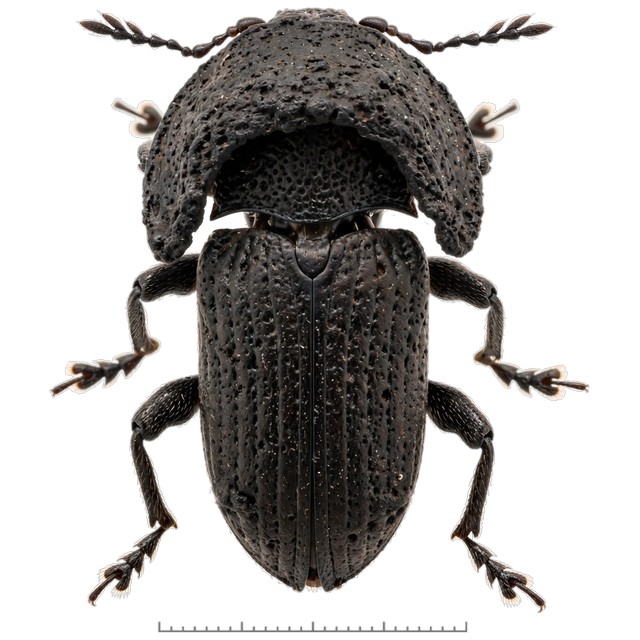
2-3 mm, cylindrical, dark brown to black. Pronotum rasp-like with tubercles, covering the head from above. Elytra with rows of pits. Strong fliers.
Diagnostics
Cylindrical body + hooded rough pronotum + boring in whole kernels = lesser grain borer. Distinct from weevils (no snout).
Easily confused with
- Granary weevil, Sitophilus granarius Weevils have a long snout (rostrum); the lesser grain borer has no snout and a rough hooded pronotum.
Life cycle
- Adult
- Bore out, feed, fly, and reinfest; live several months
- Egg
- Laid on or in kernels; hatch in ~1 week at 30 °C
- Egg to adult
- 4-8 weeks at 30 °C
- Generations per year
- 3-5 in warm storage
- Nymph or larva
- Larvae bore and feed inside the kernel for 3-5 weeks
Development
Complete metamorphosis: egg → larva → pupa → adult, largely inside the kernel.
Reproduction
Females lay ~200-400 eggs on grain surfaces and in cracks.
Distribution
- Global
- Cosmopolitan in the grain trade; dominant in warm regions
- Native range
- Tropics (likely South Asia)
- Ontario
- Established in grain handling; farm bins and elevators rather than homes
Ecology
Primary pest, attacks intact grain. Flight disperses populations between storages; aggregation mediated by male pheromones (dominicalure).
Resistance
Among the strongest phosphine resistance documented in any insect, highly resistant strains survive doses hundreds of times the normal lethal concentration, mediated by rph1/rph2 genes (dihydrolipoamide dehydrogenase). A textbook case of fumigant resistance evolution.
IPM implications
Resistance testing before phosphine fumigation is standard practice where this species occurs, fumigating a resistant population selects harder. Non-chemical levers (grain cooling/aeration, sanitation of bins) carry more weight precisely because the chemistry is compromised.
Chemical ecology
Male aggregation pheromone dominicalure; responds to grain volatiles.
Genetics and DNA
No reference genome published as of 2026 (resistance-gene genetics well studied at the locus level).
Taxonomy
Order Coleoptera, family Bostrichidae (auger/horned powderpost beetles). The head is tucked under a rough, hood-like pronotum, the family signature.
Open questions
Fitness costs of extreme resistance alleles; spread dynamics of resistant genotypes through global grain movement.
References
- Hagstrum, D.W. & Subramanyam, B. (2006). Fundamentals of Stored-Product Entomology. AACC International.
- Phillips, T.W. & Throne, J.E. (2010). Biorational approaches to managing stored-product insects. Annual Review of Entomology, 55:375-397.