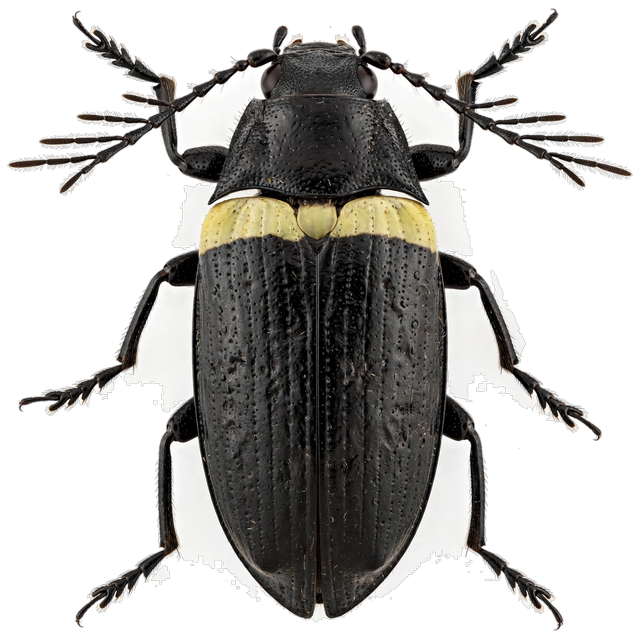
 Larder beetle
Dermestes lardarius (Linnaeus, 1758)
Larder beetle
A 7-9 mm beetle with a pale yellow band across its back that raids pet food, cured meats, and the dead flies in your attic.
- Order
- Coleoptera
- Family
- Dermestidae
- Group
- Fabric & structural beetles
- Ontario status
- Established, common in Ontario homes, especially where pet food, cured meats, or dead insects accumulate
Why it matters
A frequent Ontario pantry pest via pet food, and the classic 'attic beetle', most infestations trace to dead insects in voids, not to the kitchen at all.
Origin
Eurasian; followed cured meats and stored protein around the world, lardarius means 'of bacon.'
Behavior
Adults and larvae both feed. Larvae are hairy and wander before pupating, sometimes boring into wood or insulation to make a pupal chamber, which alarms homeowners unnecessarily.
Living conditions
High-protein dry foods: pet food, cured meats, cheese, dried fish. Also, and commonly in Ontario, the accumulations of dead cluster flies, wasps, and lady beetles in attics and wall voids.
Signs of presence
- Dark beetles (7-9 mm) with a pale yellowish band, in pantries or near pet food
- Hairy larvae wandering on walls (seeking pupation sites)
- Damage to dry pet food, jerky, or cheese
Weaknesses
- Depends on protein accumulations, remove the pet food spill or the dead insects and it leaves
- Larvae wandering to pupate are conspicuous and easy to track back to the source
- Killed by freezing
Myths and facts
Myth The larvae boring into wood means they're eating my house.
Reality They bore pupation chambers, not food tunnels, the wood damage is cosmetic and the beetle leaves. The real food was the dead flies in the attic.
Research notes
Morphology
Adult 7-9 mm, dark brown to black with a broad pale yellow band across the basal third of the elytra (often with dark spots within the band). Underside pale. Larva hairy, up to ~12 mm, brown with pale bands.
Diagnostics
The pale elytral band is diagnostic among Ontario dermestids. Larval wandering behavior plus banded adults confirms.
Easily confused with
- Hide beetle, Dermestes maculatus Hide beetle lacks the pale elytral band and has white hairs on the underside of the abdomen tip; larder beetle has the band.
Life cycle
- Adult
- Live several months; feed and reproduce
- Egg
- Laid on protein food; hatch in ~1 week at warm temperatures
- Egg to adult
- 2-3 months in warmth
- Generations per year
- 2-3 indoors
- Nymph or larva
- Larvae feed 1-2 months, then wander and bore pupal chambers
Development
Complete metamorphosis; larvae bore pupal chambers into wood, cork, or insulation.
Reproduction
Females lay ~200 eggs on protein substrates.
Distribution
- Global
- Cosmopolitan
- Native range
- Eurasia
- Ontario
- Established; homes, pet-food storage, attics provincewide
Ecology
Carrion and stored-protein scavenger; the attic-cluster-fly association is the dominant Ontario reservoir. Pupation boring is a shelter behavior, not feeding.
Resistance
Unknown, no significant documented resistance.
IPM implications
Find the protein, not the beetle: inspect pet-food storage, then attics and wall voids for dead-insect accumulations. Removing the reservoir (including old cluster-fly carcasses) ends the infestation; the wandering larvae are the map to the source.
Chemical ecology
Carrion and protein-degradation volatiles guide oviposition; defensive chemistry unremarkable.
Genetics and DNA
No reference genome published as of 2026.
Taxonomy
Order Coleoptera, family Dermestidae. Genus Dermestes; lardarius = 'of bacon/lard.'
Open questions
Quantifying the attic-carcass reservoir's contribution to household infestations.
References
- Hinton, H.E. (1945). A Monograph of the Beetles Associated with Stored Products, Vol. 1. British Museum (Natural History).