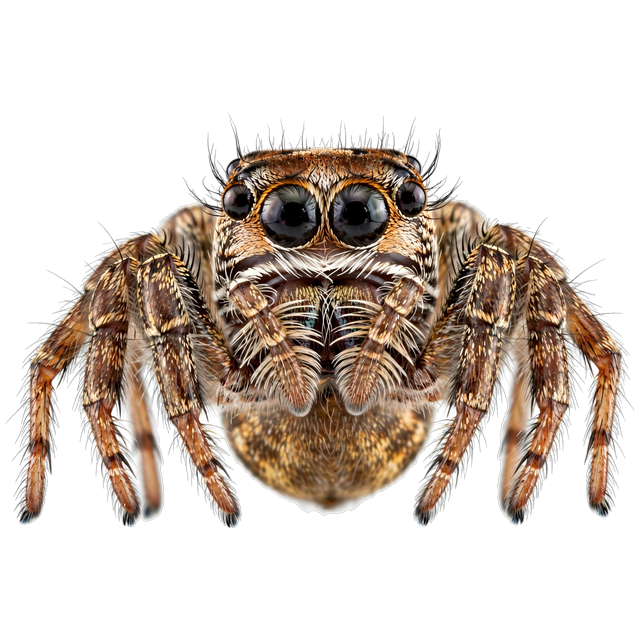
 Jumping spider
Salticidae
Jumping spider
The tiny curious spider that watches you back, the friendliest spider in your house.
- Order
- Araneae
- Family
- Salticidae
- Group
- Spiders
- Ontario status
- Native, many species; common on windows, walls, and gardens
Why it matters
Jumping spiders are the ambassadors of the spider world, intelligent, harmless, and excellent pest control. A house with jumping spiders has fewer flies. There is no reason to kill one, ever.
Origin
Native to Ontario, these are wild spiders that have lived here far longer than our houses have.
Behavior
Daytime hunters with the best vision of any spider, those big front eyes are watching you. They stalk prey like cats, then pounce, trailing a safety silk line. Curious and completely harmless.
Living conditions
Sunny windowsills, walls, fences, and garden plants. Anywhere with light and small insects to hunt.
Signs of presence
- Small compact spiders on sunny windows that turn to look at you
- Short quick jumps instead of running
- Tiny silk retreats in window corners (not prey-catching webs)
- Stalk-and-pounce hunting behavior in daylight
Weaknesses
- Tiny and diurnal, easy to see, catch in a cup, and relocate
- Do not infest or breed indoors in numbers; each is an individual visitor
- Dependent on daylight and small flying insects
- Fragile to desiccation; cannot persist in dry, prey-free rooms
Myths and facts
Myth Jumping spiders will jump on me and bite.
Reality They jump toward prey a few millimeters long, not people. Bites are essentially unheard of, their first instinct is to jump away from you.
Research notes
Morphology
Compact body 3-15 mm (Ontario species mostly 5-10 mm). Enormous anterior median eyes dominate the face; short stout legs; often boldly patterned or iridescent. Salticus scenicus (zebra jumper) is the classic Ontario indoor species: black-and-white banded, 5-7 mm.
Diagnostics
Big front eyes + compact body + jumping locomotion is diagnostic at family level anywhere in the world. Silk used only for safety lines and retreats, never prey webs.
Easily confused with
- Lynx spiders (Oxyopidae) Lynx spiders are spiny, longer-legged, and lack the giant front eyes; they live on vegetation, rarely indoors.
Life cycle
- Adult
- Most live about 1 year; overwinter as subadults in retreats
- Egg
- 20-200 eggs per sac depending on species, guarded in a silk retreat
- Egg to adult
- One season in Ontario
- Generations per year
- One
- Nymph or larva
- Spiderlings disperse after a few days; multiple molts over the season
Development
Egg to spiderling to adult through successive molts. Females guard egg sacs in silk retreats.
Reproduction
Males perform elaborate visual courtship dances, leg waving, abdomen vibrations, iridescent displays. Among the most complex courtship in arthropods; a research model for animal communication.
Distribution
- Global
- Every continent except Antarctica; most diverse in the tropics
- Native range
- Worldwide; many species native to Ontario
- Ontario
- Native and common outdoors and as indoor visitors; the zebra jumper is a familiar windowsill species
Ecology
Diurnal visual predators; major regulators of flies and other small insects in gardens and homes. Prey for birds and wasps. Salticids are a model system in behavioral ecology and vision science.
Resistance
Unknown, not a pesticide target; no documented resistance.
IPM implications
No management indicated, ever. The professional move is client education: identify it, admire it, relocate it. Killing jumping spiders is pure loss; they are the highest-value indoor predators per gram in Ontario homes.
Chemical ecology
Hunting is vision-driven, not chemical; venom is insect-specific and trivial to mammals. Silk chemistry is standard major-ampullate dragline silk used as a safety tether during jumps.
Genetics and DNA
No reference genome published as of 2026.
Taxonomy
Order Araneae, family Salticidae, the largest spider family (>6,000 species). Ontario fauna includes Phidippus, Salticus, Habronattus and others; species ID needs genitalia or expert review.
Open questions
Ontario salticid diversity incompletely catalogued; visual cognition research ongoing.
References
- Foelix, R.F. (2011). Biology of Spiders, 3rd ed., Oxford University Press.
- Ebeling, W. (1978). Urban Entomology, University of California, Riverside.