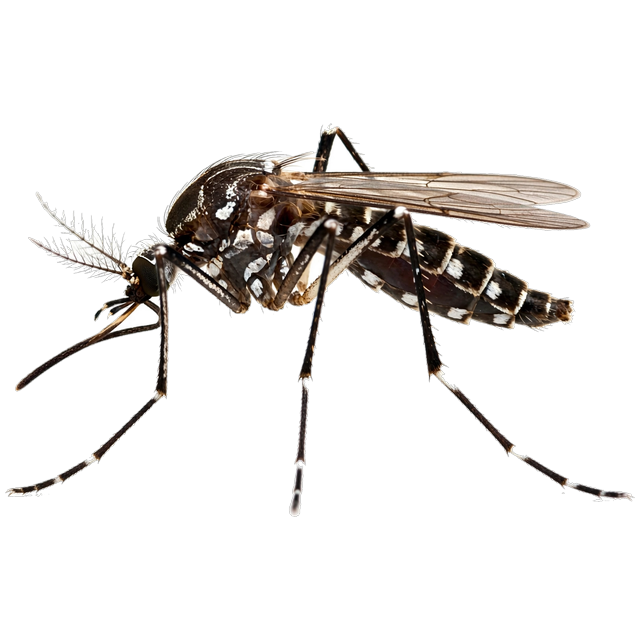
 Inland floodwater mosquito
Aedes vexans (Meigen, 1830)
Inland floodwater mosquito
The 'after-the-rain' mosquito, floods hatch its eggs by the million and evenings become miserable.
- Order
- Diptera
- Family
- Culicidae
- Group
- Mosquitoes
- Ontario status
- Established, abundant after rains
Why it matters
Primarily a severe nuisance biter; a minor vector of some viruses (including West Nile and dog heartworm) but far behind Culex in Ontario's disease picture. Its importance is misery, in volume.
Origin
Native across the northern hemisphere; one of the most widespread floodwater mosquitoes on earth.
Behavior
Fierce evening biter after rains and floods. Flies considerable distances from breeding sites. A single flood can produce a miserable week of biting.
Living conditions
Lays eggs in moist soil of ditches, floodplains and low fields. The eggs wait, sometimes for years, until flooding hatches them all at once.
Signs of presence
- Sudden intense evening biting 7-10 days after heavy rain or flooding
- Clouds of mosquitoes over low fields and ditches
- Bites concentrated at dusk
Weaknesses
- Needs flooding to hatch, no flood, no brood
- Larvae develop fast but are confined to the flooded area for about a week
- Evening biter: screens, timing and repellents cover the exposure window
- Drainage and water management of low areas reduce broods
Myths and facts
Myth Spraying the air will stop the next flood brood.
Reality The brood is already programmed in the soil as eggs. Only water management or timed larval control at flooding reaches them; adult spraying just trims the cloud temporarily.
Research notes
Morphology
Adult 4-6 mm; brown with narrow pale bands on the abdominal segments and legs, banding much narrower and less contrasting than the bold black-and-white of Aedes albopictus. Abdomen pointed at the tip.
Diagnostics
Confirm by: 4-6 mm brown mosquito with narrow pale abdominal bands, vicious dusk biting, emergence synchronized 7-10 days after flooding.
Easily confused with
- Northern house mosquito, Culex pipiens Culex has a blunt-tipped abdomen and breeds continuously in stagnant containers; Aedes vexans has a pointed abdomen and erupts in broods after floods.
Life cycle
- Egg
- Laid in moist soil depressions; survive drying for years; hatch synchronously when flooded
- Nymph or larva
- Rapid development in warm floodwater; 4 instars in as little as 5-7 days
- Adult
- Long-lived for a mosquito (weeks to months); strong fliers, dispersing 10+ km
- Egg to adult
- Approximately 7-10 days in warm floodwater
- Generations per year
- Multiple broods, each tied to a flooding event
Development
Complete metamorphosis: egg (in moist soil, flood-triggered) → larva (4 instars) → pupa → adult.
Reproduction
The egg bank strategy: enormous numbers of desiccation-proof eggs accumulate in soil, converting each flood into a synchronized brood.
Distribution
- Native range
- Holarctic
- Ontario
- Abundant wherever floodplains, ditches and low fields flood; the post-rain biter
- Global
- Northern hemisphere worldwide
Ecology
Floodwater ecology in its purest form. Adults disperse far from breeding sites, biting pressure often peaks kilometres from the floodplain. Overwinters as eggs. Minor vector (West Nile, dog heartworm Dirofilaria immitis) but primarily a nuisance species.
Resistance
Limited documentation; managed by water management and timed larviciding, not adulticiding programs.
IPM implications
The biology demands event-based management: water-level management of impoundments and ditches prevents the flood; where flooding is inevitable, larval surveillance timed to the flood (dip counts at days 2-4) targets the single vulnerable week before emergence. Adulticiding after emergence is damage control only. The egg bank means one missed brood seeds the next flood, consistency across years matters.
Chemical ecology
Hatching triggered by reduced dissolved oxygen on flooding (the physical flood cue); host-seeking via CO2 and odour plumes over long distances.
Genetics and DNA
No reference genome published as of 2026.
Taxonomy
Diptera: Culicidae. Aedes vexans (Meigen, 1830). The archetypal floodwater mosquito of the Holarctic.
Open questions
Egg-bank longevity in Ontario soils; dispersal distances from specific floodplain sources.
References
- Service (2012), Medical Entomology for Students (Cambridge UP)
- Wood, Dang & Ellis (1979), The Mosquitoes of Canada, taxonomic foundation
- Ontario public health, floodwater mosquito surveillance