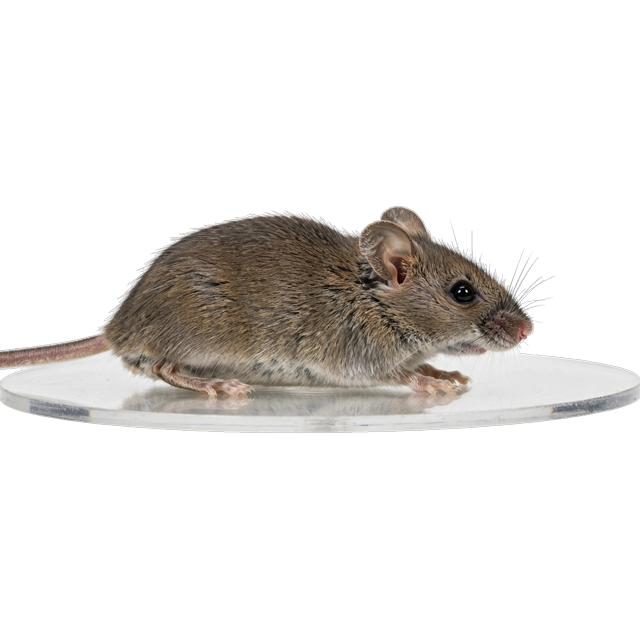
 House mouse
Mus musculus Linnaeus, 1758
House mouse
The small, curious rodent that lives inside our walls and pantries.
- Order
- Rodentia
- Family
- Muridae
- Group
- Rodents
- Ontario status
- Established, ubiquitous commensal
Why it matters
Contaminates food and surfaces with droppings and urine; gnaws wiring (fire risk); can carry Salmonella and leptospirosis.
Origin
Native to the steppes of Central Asia; spread worldwide with agriculture and shipping, now the most widespread wild mammal on Earth.
Behavior
Nocturnal; curious rather than fearful, unlike rats, it investigates new objects quickly. Home range just 3-10 m indoors; an excellent climber and gnawer.
Living conditions
Indoors wherever food meets shelter: wall voids, pantries, attics, basements, clutter. Needs only ~3 g of food per day and nests within a few metres of it.
Signs of presence
- Rod-shaped droppings 3-6 mm with pointed ends, along walls and in cupboards
- Gnaw marks on food packaging, wood, and wiring
- Musky urine odor and rub marks in heavy infestations
- Squeaks and scurrying in wall voids at night
Weaknesses
- Curiosity defeats it, it investigates new objects fast, which is why monitoring works
- Tiny home range: control the 10 m around the nest and you control the mouse
- Must eat daily, removing the 3 g/day food base starves it out
Myths and facts
Myth Mice only enter dirty homes.
Reality Mice enter any home with a gap ≥6 mm and nearby food. Cleanliness reduces attraction, but a mouse fits through a hole the width of a pencil.
Research notes
Morphology
Body 70-100 mm, tail 70-100 mm (about equal to body), weight 12-30 g. Grey-brown above, paler below; large ears, pointed muzzle. Droppings 3-6 mm, rod-shaped, pointed ends, the key field diagnostic.
Diagnostics
Droppings shape and size; gnaw marks ~1-2 mm wide; tracks in dust. Separated from deer mouse by uniformly grey-brown fur (no white underparts) and unicolored tail.
Easily confused with
- Deer mouse (Peromyscus maniculatus) Deer mouse has sharply contrasting white underparts and a distinctly bicolored tail; house mouse is uniformly grey-brown.
- Juvenile Norway rat Young rats have blunter muzzles, thicker tails, and droppings ≥10 mm even as juveniles.
Life cycle
- Adult
- Lifespan ~12 months in the wild; up to 2-3 years in captivity
- Egg
- N/A, viviparous
- Egg to adult
- Gestation 19-21 days; birth to breeding maturity 5-8 weeks
- Generations per year
- 5-10+ indoors (year-round breeding)
- Nymph or larva
- Pups weaned at ~21 days; sexually mature at 5-8 weeks
Development
Viviparous; altricial young, born blind and hairless.
Reproduction
5-6 pups per litter × up to 8-10 litters/year indoors.
Distribution
- Global
- Cosmopolitan; most widespread wild mammal
- Native range
- Central Asian steppes
- Ontario
- Established, ubiquitous in and around structures province-wide
Ecology
Commensal obligate in temperate climates; polygynous family groups with male territoriality; thigmotactic, travels along walls and edges.
Resistance
Anticoagulant resistance documented via VKORC1 mutations in multiple global populations.
IPM implications
Curiosity plus a tiny home range means monitoring along wall edges within 3-10 m of signs gives fast answers. Exclusion at ≥6 mm gaps removes entry; sanitation removes the food base. Thigmotaxis dictates placement along perimeters, never mid-room.
Chemical ecology
Urine marking with major urinary proteins (MUPs); scent trails guide foraging; male territorial marking.
Genetics and DNA
The mammalian model organism, genome published 2002 (Mouse Genome Sequencing Consortium, Nature); the most genetically characterized mammal on Earth.
Taxonomy
Order Rodentia › family Muridae › genus Mus › M. musculus (Linnaeus, 1758). The laboratory mouse is the domesticated form of this species.
Open questions
VKORC1 resistance allele frequency in Ontario commensal populations is unmapped.
References
- UC IPM, House Mouse (ipm.ucanr.edu)
- Penn State Extension, House Mouse Biology and Management