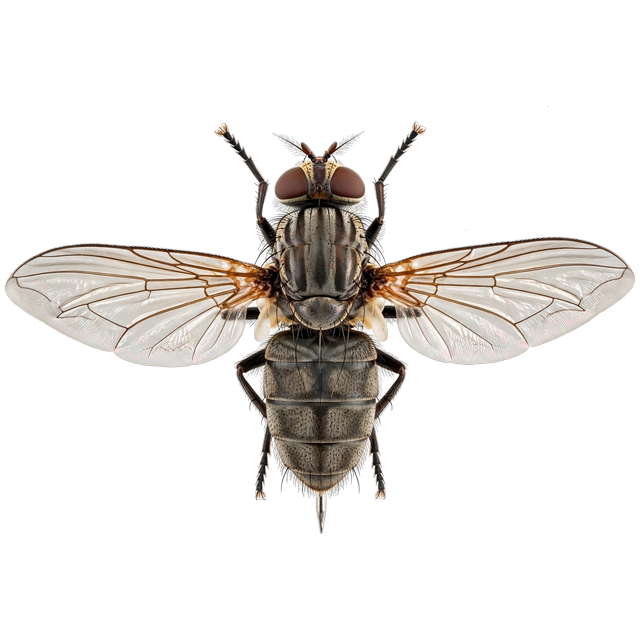
 House fly
Musca domestica Linnaeus, 1758
House fly
The familiar grey fly that breeds in garbage and can carry germs from waste to your food.
- Order
- Diptera
- Family
- Muscidae
- Group
- Flies
- Ontario status
- Established, ubiquitous
Why it matters
A mechanical carrier of germs, it walks on garbage and manure, then on food, moving bacteria like Salmonella, E. coli and Shigella on its feet and in its vomit spots. It does not bite and does not inject disease.
Origin
Probably originated in central Asia alongside humans and livestock; now follows people everywhere on earth.
Behavior
Active by day; feeds on almost any moist food or waste. Rests on warm walls and ceilings at night. Does not bite, it sponges up liquids.
Living conditions
Breeds in moist, decaying organic matter: garbage, manure, compost, pet waste. Needs warmth and wet waste, dry, well-managed garbage does not breed flies.
Signs of presence
- Fly specks (tiny dark regurgitation/vomit spots) on surfaces and light fixtures
- Maggots in garbage bins or organic waste
- Flies clustered on warm walls or ceilings at night
- A loud, steady buzzing around waste areas by day
Weaknesses
- Cannot breed without moist decaying organic matter, remove the breeding site and the flies disappear
- Larvae drown or dry out easily; they need constantly moist waste
- Adults are weak against exclusion: intact window screens stop them completely
- Cold stops development; no indoor breeding happens without warmth
Myths and facts
Myth House flies bite.
Reality They cannot bite. Their mouthparts only sponge up liquids. Biting 'house flies' are almost always stable flies.
Myth One fly in the house means a dirty home.
Reality A single fly usually just wandered in. Dozens appearing daily means something is breeding nearby, garbage, a dead animal in a wall void, or pet waste.
Research notes
Morphology
Adult 6-8 mm, dull grey thorax with 4 dark longitudinal stripes; abdomen yellowish-grey. Fourth longitudinal wing vein (M) bends sharply forward toward the wing margin, diagnostic for the family. Arista plumose on basal half only, bare toward the tip. Sponging (lapping) mouthparts, non-piercing.
Diagnostics
Confirm by: 6-8 mm grey fly, 4 thoracic stripes, vein M bent forward, arista feathered only at the base. Non-biting mouthparts separate it from the stable fly on sight.
Easily confused with
- Stable fly, Stomoxys calcitrans Stable fly has a stiff, bayonet-like piercing proboscis projecting forward from the head; the house fly's mouthparts are soft and sponge-like.
- Cluster fly, Pollenia rudis Cluster fly is larger (8-10 mm) with dense golden-yellow hairs on the thorax; the house fly's thorax is bare grey with stripes.
Life cycle
- Egg
- White, ~1 mm; female lays 75-150 per batch in moist organic matter, 500+ in a lifetime
- Nymph or larva
- Cream maggot, legless, tapered; 3 instars feeding in decaying matter; full-grown ~12 mm
- Adult
- Lives 2-4 weeks in the wild; feeds on liquids, regurgitating digestive enzymes onto solids
- Egg to adult
- 7-10 days at 30 °C; 3+ weeks below 20 °C
- Generations per year
- 10-12+ in warm climates; continuous breeding indoors year-round
Development
Complete metamorphosis: egg → larva (maggot, 3 instars) → pupa (inside a barrel-shaped puparium) → adult.
Reproduction
Female lays 500+ eggs lifetime in batches; populations can explode from a single overlooked breeding site within two weeks in summer.
Distribution
- Native range
- Probably central Asia; commensal with humans since agriculture
- Ontario
- Ubiquitous wherever people and waste coexist; year-round indoors
- Global
- Cosmopolitan, every inhabited continent
Ecology
Breeding media: manure, garbage, compost, carrion, pet waste. Dispersal: typically 1-3 km, recorded over 20 km. Overwinters as larvae/pupae in warm manure piles or as sluggish adults inside buildings.
Resistance
Extensively documented worldwide: pyrethroid resistance via kdr (knockdown resistance) target-site mutations, plus organophosphate, carbamate and neonicotinoid resistance in many populations. A textbook case of insecticide resistance evolution.
IPM implications
Source reduction is decisive: the biology says no moist organic breeding medium, no flies. Sanitation (sealed, emptied waste containers; manure management) eliminates breeding; exclusion (screens, air curtains, closed doors) blocks entry; sticky and UV light traps monitor adult pressure. Larval habitat removal outranks any adult-targeted measure.
Chemical ecology
Oviposition attracted to ammonia and volatile fatty acids from decaying matter. Aggregation pheromone (Z)-9-tricosene (muscalure) draws flies to resting and feeding sites.
Genetics and DNA
Genome published 2014 (~900 Mb); expanded detoxification gene families linked to resistance (Scott et al., Genome Biology).
Taxonomy
Diptera: Muscidae. Musca domestica (Linnaeus, 1758). The type species of its genus; among the most studied insects on earth.
Open questions
Fine-scale dispersal behavior in dense urban cores; the relative contribution of house flies vs. other filth flies to pathogen transmission in specific settings.
References
- Scott et al. (2014), Genome Biology, house fly genome sequence
- Sanchez-Arroyo & Capinera, UF/IFAS Extension, house fly biology and management
- Keiding (1999), WHO, insecticide resistance in house flies