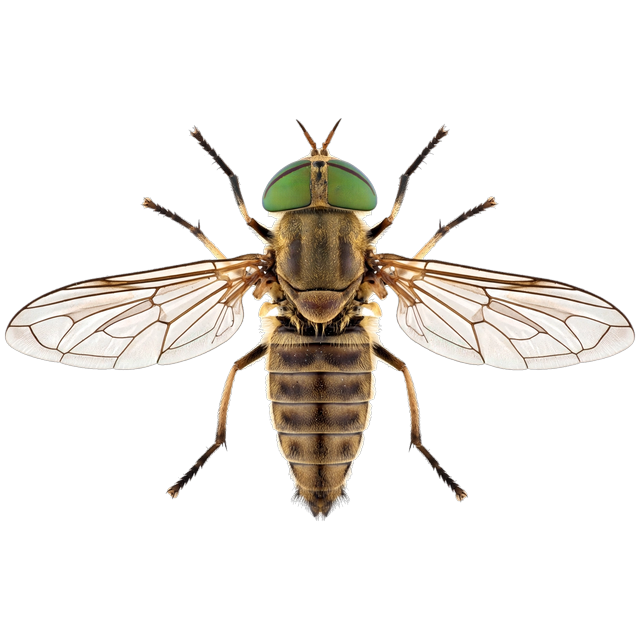
 Horse fly
Tabanus spp. Linnaeus, 1758
Horse fly
Big, fast, painful biters the size of a thumbnail, the females need blood to make eggs.
- Order
- Diptera
- Family
- Tabanidae
- Group
- Flies
- Ontario status
- Established, seasonal (near water)
Why it matters
Painful biters that can ruin outdoor work and recreation. They can mechanically carry germs between animals, including the agents of tularemia and equine infectious anemia in livestock.
Origin
Native worldwide; Ontario has many native species, most active in early to mid-summer.
Behavior
Females deliver a painful slash-and-sponge bite, they cut the skin and lap the blood. Persistent: swatting rarely deters them. Males never bite (they drink nectar).
Living conditions
Larvae grow in wet mud and shallow water at pond and stream edges. Adults hunt on hot, sunny days, especially near water, livestock, and woodland trails.
Signs of presence
- Large flies circling persistently on hot sunny days
- Painful bites that bleed slightly, near water or livestock
- A loud, deep buzzing unlike smaller flies
Weaknesses
- Only females bite, and only by day, evening activities avoid them
- They need wet mud for larvae; drained, managed shorelines reduce breeding
- Dark moving targets attract them; light clothing and stillness help
- They cannot bite through tightly woven fabric
Myths and facts
Myth They're attracted to you because you're dirty or sweet.
Reality They hunt by sight, movement, CO2 and heat, any large mammal, clean or not, is a target. Only egg-making females bite.
Research notes
Morphology
Adult 10-25+ mm, among the largest flies. Huge compound eyes, often iridescent green/purple, meeting at the top of the head in males, separated in females. Third antennal segment stout with annuli (rings). Wings clear (vs. deer flies' patterned wings). Females: blade-like mouthparts for slashing.
Diagnostics
Confirm by: very large size, huge eyes, clear wings, painful daytime bite. Larvae: tapered, segmented, predatory, in wet mud.
Easily confused with
- Deer fly, Chrysops spp. Deer flies are smaller (8-12 mm) with dark-patterned wings; horse flies are larger with clear wings.
Life cycle
- Egg
- Laid in masses on vegetation overhanging water or wet mud
- Nymph or larva
- Aquatic predators of worms and small invertebrates in mud; the long stage, months to over a year
- Adult
- Males feed on nectar/pollen; females take blood meals for egg development; live a few weeks
- Egg to adult
- Typically about one year in Ontario; the larval stage dominates the timeline
- Generations per year
- One in Ontario; adults peak June, August
Development
Complete metamorphosis: egg → larva (aquatic/semi-aquatic predator, many instars) → pupa → adult.
Reproduction
Females need one or more blood meals per egg batch; lay several hundred eggs per mass over water.
Distribution
- Native range
- Worldwide family; Holarctic species in Ontario
- Ontario
- Common near water, wetlands and livestock country; strictly seasonal
- Global
- Worldwide except extreme polar regions
Ecology
Larval habitat: wet mud, pond and stream margins. Adults are strong fliers (several km). Only females blood-feed. Seasonal: adults in summer, larvae year-round in mud. Mechanical vectors of tularemia, anaplasmosis and equine infectious anemia among animals.
Resistance
Unknown, not subject to insecticide programs; managed by avoidance and barriers.
IPM implications
No indoor or structural relevance, an outdoor avoidance pest. The biology says: manage the interface (timing of outdoor work, protective clothing, head nets, repellents on exposed skin) because the larval habitat (wetlands) is not treatable and should not be. Visual canopy traps exploit host-seeking for monitoring and local relief around high-use areas.
Chemical ecology
Host location is primarily visual (large dark moving objects) supplemented by CO2 and heat; oviposition follows wet-mud cues at water margins.
Genetics and DNA
No reference genome published as of 2026.
Taxonomy
Diptera: Tabanidae. Genus Tabanus Linnaeus, 1758. Ontario species include T. similis and T. sulcifrons.
Open questions
Species-level adult activity calendars for Ontario; larval ecology of the common species in the province's wetlands.
References
- Teskey (1990), The Horse Flies and Deer Flies of Canada, Agriculture Canada monograph
- Foil (1989), Annual Review of Entomology, tabanid biology and disease links
- UF/IFAS Extension, horse fly and deer fly biology