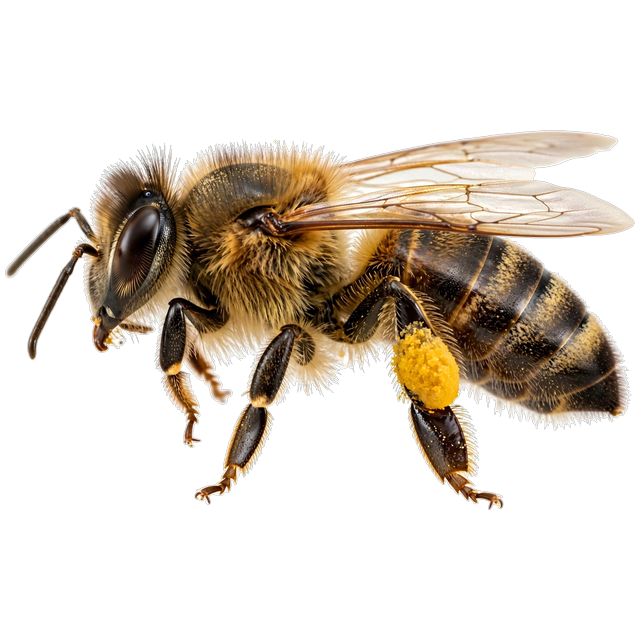
 Honeybee
Apis mellifera Linnaeus, 1758
Honeybee
The managed pollinator behind a third of our crops, a swarm is a beekeeper's call, never an extermination.
- Order
- Hymenoptera
- Family
- Apidae
- Group
- Wasps, hornets & bees
- Ontario status
- Managed + feral, valued pollinator
Why it matters
Pollinates roughly a third of agricultural crops; Ontario's fruit industry depends on managed hives. A swarm is valuable livestock, not a pest, extermination is the wrong response economically and ecologically.
Origin
Native to Europe, Africa and the Middle East; brought to North America by colonists in the 1600s.
Behavior
Forages on flowers by day; communicates food locations with the waggle dance. Defensive at the hive; docile away from it. Workers sting once (the barbed stinger stays) and die.
Living conditions
Lives in managed hives and feral colonies in hollow trees and wall voids. A colony needs flowers within a few kilometres and a dry cavity.
Signs of presence
- A humming cluster of thousands of bees hanging from a branch (swarm)
- Steady bee traffic at a hole in a wall or soffit
- Honeycomb odour and staining on interior walls (established wall colony)
Weaknesses
- Swarms are temporary, a clustered swarm usually leaves within a day or two
- A swarm or colony is a beekeeper's asset: local associations relocate them free or cheap
- They want cavities, not your living room, exclusion keeps them out of walls
- Colonies need beekeeper-level management against mites; feral colonies often fail without it
Myths and facts
Myth A bee swarm in my yard is about to attack.
Reality Swarms are at their most docile, they have no hive, no brood and no honey to defend. They are house-hunting, and beekeepers collect them routinely.
Myth All stinging insects should be sprayed.
Reality Honeybees are managed agricultural animals. Spraying a swarm destroys thousands of dollars of pollinator value and is opposed by every beekeeping body.
Research notes
Morphology
Workers 12-15 mm; golden-brown with black abdominal bands; hind legs with corbiculae (pollen baskets). Barbed stingers in workers (single-use); dense branched hairs for pollen collection. Queens and drones morphologically distinct castes.
Diagnostics
Confirm by: 12-15 mm golden-brown bee, pollen baskets on hind legs, waggle-dance foragers, wax comb colonies. Swarm clusters in spring are definitive.
Easily confused with
- Bumblebee, Bombus spp. Bumblebees are larger, rounder and fuzzier with annual colonies; honeybees are slimmer, live in perennial managed hives, and communicate with dances.
Life cycle
- Egg
- Queen lays up to 2,000 eggs/day in season, in wax cells
- Nymph or larva
- Larvae fed by nurse bees; queen-destined larvae get royal jelly throughout
- Adult
- Workers live ~6 weeks in summer, months overwintering; queens live years; drones seasonal
- Egg to adult
- 21 days for workers; 16 for queens; 24 for drones
- Generations per year
- Continuous brood-rearing in season; the colony is perennial, it does not die in winter
Development
Complete metamorphosis: egg → larva (in wax cells, fed royal jelly/brood food) → pupa → adult. Caste determined by larval nutrition.
Reproduction
Swarming: the old queen leaves with half the colony to found a new nest, the 'swarm' the public sees. New queens mate on nuptial flights.
Distribution
- Native range
- Europe, Africa, Middle East
- Ontario
- Managed hives province-wide; feral colonies in the south
- Global
- Worldwide with beekeeping (except Antarctica)
Ecology
Generalist pollinators with flower constancy per foraging trip; waggle-dance recruitment makes them super-efficient. Feral colonies in tree hollows; managed colonies in hives. Key threats: Varroa destructor mites, viruses, pesticides, habitat loss.
Resistance
Varroa mites (their parasite) show widespread acaricide resistance, the resistance story here belongs to the mite, and it drives beekeeping practice. No insecticide resistance in the bees themselves relevant to management.
IPM implications
The professional protocol is relocation, not control: swarms go to beekeeper associations (most collect free); established wall-void colonies require beekeeper removal plus structural repair, spraying a wall colony leaves honey, comb and dead bees to rot and attract new pests. Exclusion (sealing cavities) prevents colonization. Any operator encountering honeybees should have a beekeeper referral contact, it is the industry standard of care.
Chemical ecology
Queen mandibular pheromone regulates colony cohesion and suppresses worker reproduction; Nasonov pheromone marks the nest; alarm pheromone (isopentyl acetate, banana-like) recruits defenders.
Genetics and DNA
Genome published 2006 (~236 Mb; Honeybee Genome Sequencing Consortium, Nature), a landmark in social-insect genomics.
Taxonomy
Hymenoptera: Apidae. Apis mellifera Linnaeus, 1758. Eusocial, perennial colonies; many managed subspecies and hybrids in Ontario.
Open questions
Feral colony genetics and Varroa tolerance in Ontario; winter loss drivers at the northern range edge.
References
- Honeybee Genome Sequencing Consortium (2006), Nature, the honeybee genome
- Winston (1987), The Biology of the Honey Bee (Harvard UP)
- Ontario Beekeepers' Association, swarm collection and best practices