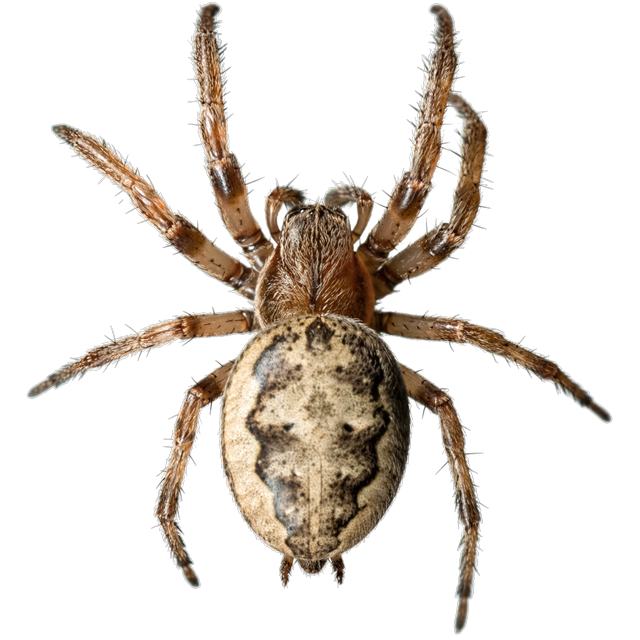
 Hobo spider
Eratigena agrestis (Walckenaer, 1802)
Hobo spider
A Pacific Northwest spider wrongly famous for dangerous bites, not found in Ontario.
- Order
- Araneae
- Family
- Agelenidae
- Group
- Spiders
- Ontario status
- Not established in Ontario, Pacific Northwest reference species
Why it matters
It matters as a lesson in how spider myths are made: the hobo spider was declared dangerously venomous in the 1980s on thin evidence, and decades of follow-up research found nothing. It is included here so Ontario readers can stop worrying about it.
Origin
Europe; introduced to the Pacific Northwest of North America, where it is common in and around houses.
Behavior
Fast-running funnel-weaver. Males wander in late summer searching for females, which is when most indoor sightings happen, again, in the Pacific Northwest.
Living conditions
Builds funnel-shaped webs in basements, window wells, and foundation cracks, in the Pacific Northwest, not Ontario.
Signs of presence
- In Ontario: essentially none, a 'hobo spider' here is almost certainly a giant house spider or grass spider
- In the Pacific Northwest: flat funnel webs at floor-wall junctions, fast brown spiders
Weaknesses
- Does not occur in Ontario, which resolves most concerns immediately
- Where it does occur, it is managed by sealing foundation gaps and removing ground-level clutter
- Funnel webs are conspicuous and easy to vacuum
- Males wander only briefly in late summer
Myths and facts
Myth Hobo spiders cause necrotic flesh wounds and are spreading across Canada.
Reality Controlled studies and poison-center data found no evidence of medically significant bites. It is not established in Ontario and is not spreading here.
Research notes
Morphology
Body 7-15 mm; brown with chevron pattern on abdomen; long legs; prominent posterior spinnerets (agelenid 'twin tails'). Males have enlarged pedipalps in late summer.
Diagnostics
Reliable species separation from E. atrica/duellica requires genitalia examination by an arachnologist, field ID to species is unreliable, which is part of why bite attributions were worthless.
Easily confused with
- Giant house spiders (Eratigena atrica and E. duellica, separate species) Larger on average and genuinely present in Ontario; separable only by genitalia, treat any Ontario 'hobo' as this instead.
- Grass spiders (Agelenopsis spp.) Build outdoor funnel webs in grass; longer spinnerets; not indoor species.
Life cycle
- Adult
- Annual; males mature and wander in late summer
- Egg
- 50-100+ eggs per sac in the retreat
- Egg to adult
- One season
- Generations per year
- One
- Nymph or larva
- Spiderlings remain in the maternal web briefly
Development
Egg to spiderling to adult through successive molts; egg sacs guarded in the funnel retreat.
Reproduction
Males abandon webs in late summer to find females; mating in the female's funnel.
Distribution
- Global
- Europe; introduced Pacific Northwest North America
- Native range
- Europe and western Asia
- Ontario
- Not established; no confirmed breeding populations. Any Ontario report should be treated as a misidentification pending voucher specimen.
Ecology
Ground-level funnel-web predator. In its introduced PNW range it occupies the same niche as native agelenids. Absent from Ontario's fauna.
Resistance
Unknown, no documented resistance.
IPM implications
None in Ontario. Included in this library as a reference and myth-buster: when a client reports a 'hobo spider,' the professional response is identification first, it will be something else, and education about how the myth was debunked.
Chemical ecology
Venom studied specifically because of the necrosis claims: assays show no unusual cytotoxicity, and the medical literature contains no verified necrotic bite. A textbook case of venom myth outrunning data.
Genetics and DNA
No reference genome published as of 2026.
Taxonomy
Order Araneae, family Agelenidae. Authority (Walckenaer, 1802). Formerly Tegenaria agrestis; moved to Eratigena on molecular evidence. Very close to E. atrica/duellica (giant house spider).
Open questions
Precise PNW range dynamics; the original misattribution chain is itself a case study in science communication failure.
References
- Foelix, R.F. (2011). Biology of Spiders, 3rd ed., Oxford University Press.
- Vetter, R.S., UC Riverside spider-bite myth research (various publications).