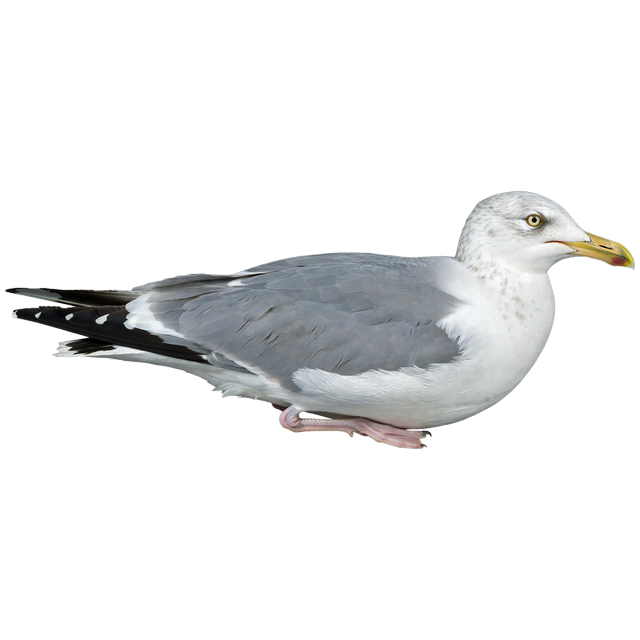
 Gull
Larus spp. Linnaeus, 1758
Gull
The 'seagull' that nests on flat rooftops and commutes to landfills.
- Order
- Charadriiformes
- Family
- Laridae
- Group
- Birds
- Ontario status
- Native, nuisance at landfills/rooftops
Why it matters
Rooftop colonies foul membranes and clog drains; aggressive nest defense endangers rooftop workers; landfill foraging spreads waste.
Origin
Native coastal and inland waterbirds; several species learned that flat rooftops are cliffs and landfills are shorelines.
Behavior
Diurnal; highly social and intelligent; aggressively defends nests, dive-bombing intruders. Long-lived and site-faithful.
Living conditions
Colonial nesters on flat rooftops, islands, and industrial sites; forage at landfills, parking lots, and waterfronts.
Signs of presence
- Scrape nests of grass and debris on flat rooftops
- Whitewash and feather accumulation on roof membranes
- Aggressive dive-bombing near rooftop access points in spring
- Flocks commuting between rooftops and landfills
Weaknesses
- Colonial: the whole problem is one rooftop, exclude it and the colony relocates
- Nesting is seasonal, exclusion installed before spring prevents the season
- Food-driven: waste management at the source shrinks the local population
Myths and facts
Myth Gulls only live at the sea.
Reality Many gull species nest on flat rooftops and feed at landfills far inland, the 'seagull' is a city bird now.
Research notes
Morphology
Herring gull exemplar: body 55-65 cm, wingspan 120-140 cm, weight 800-1300 g. White-grey plumage, yellow bill with red spot, pink legs. Juveniles mottled brown, maturing over 4 years.
Diagnostics
Large white-grey gull with yellow bill; raucous calls; webbed feet; colonial rooftop scrapes in season.
Easily confused with
- Ring-billed gull (Larus delawarensis) Smaller with a black ring on a yellow bill; the commonest inland Ontario gull, management approach is the same.
Life cycle
- Adult
- Lifespan 15-30+ years; breeding from age 4
- Egg
- Clutch 2-3; incubation 26-28 days
- Egg to adult
- Hatch to fledging ~40 days; maturity at 4 years
- Generations per year
- 1 brood/year
- Nymph or larva
- Chicks fledge at ~35-40 days; dependent for weeks after
Development
Oviparous; semi-precocial chicks.
Reproduction
2-3 eggs per clutch × 1 brood/year.
Distribution
- Global
- Worldwide (genus)
- Native range
- Coastal and inland North America (species-dependent)
- Ontario
- Native, nuisance colonies on flat rooftops and at landfills
Ecology
Colonial ground-nesters; opportunistic omnivores; extreme site fidelity, colonies reuse rooftops for decades; long-lived K-selected life history.
Resistance
Unknown.
IPM implications
Rooftop exclusion (netting, wire systems) installed before nesting season; nest management where permitted; waste management at the source. Colonial nesting means site-level work, and timing is everything, many gull species are protected under migratory bird conventions, so species ID and permits come before action.
Chemical ecology
Limited; vocal and visual communication dominate. Preen-gland secretions for waterproofing.
Genetics and DNA
No reference genome published as of 2026.
Taxonomy
Order Charadriiformes › family Laridae › genus Larus spp. Genus-level entry; American herring gull (L. smithsonianus) used as the Ontario exemplar.
Open questions
Species-level rooftop colony dynamics in the GTA are undocumented.
References
- Cornell Lab of Ornithology, Herring Gull (All About Birds)
- Internet Center for Wildlife Damage Management, Gulls