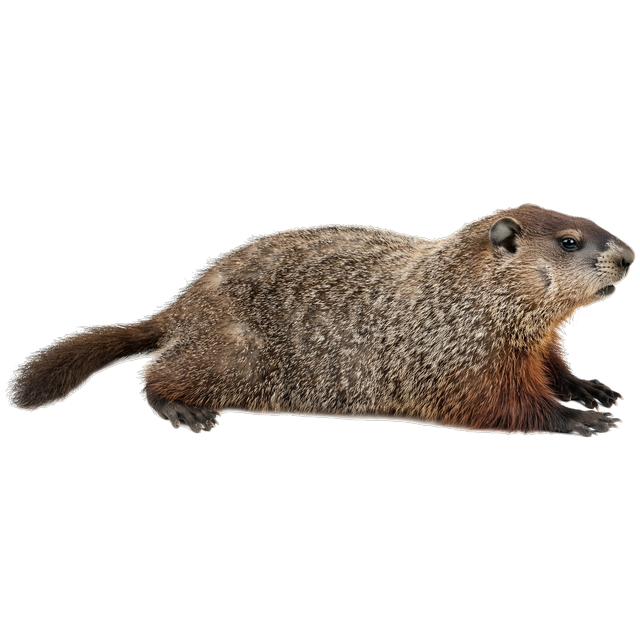
 Groundhog
Marmota monax (Linnaeus, 1758)
Groundhog
The true hibernator, sleeps half the year, digs the other half.
- Order
- Rodentia
- Family
- Sciuridae
- Group
- Wildlife
- Ontario status
- Native, common
Why it matters
Burrows undermine sheds, decks, and foundations; garden and crop damage; burrow-collapse hazards for livestock and equipment.
Origin
Native to eastern North America; common in Ontario fields, ravines, and suburban edges.
Behavior
Diurnal; whistles shrilly at danger (hence 'whistle-pig'); a true hibernator, body temperature drops to about 4 °C.
Living conditions
Deep burrow systems with multiple entrances in well-drained soil; needs open foraging nearby; hibernates roughly October to March.
Signs of presence
- Mounded burrow entrances about 25 cm wide with excavated soil fans
- Clipped vegetation and garden damage in arcs from the burrow
- Shrill whistle alarm calls
- Trampled runways through grass
Weaknesses
- Hibernates half the year, absent October to March
- Burrow entrances are conspicuous (mounded excavated soil)
- Diurnal, visible and predictable
Myths and facts
Myth Groundhogs predict the weather.
Reality Groundhog Day is folklore, but the grain of truth is phenology: emergence timing genuinely tracks spring temperatures.
Research notes
Morphology
Body 40-65 cm, short tail 10-15 cm; weight 2-6 kg (heaviest pre-hibernation). Grizzled brown fur, stout digging claws.
Diagnostics
Large burrowing rodent with mounded multi-entrance burrows; whistling alarm call.
Easily confused with
- Muskrat (Ondatra zibethicus) Muskrat is semi-aquatic with a flattened tail and builds lodges in water; groundhog burrows in dry soil, never lodges.
- Beaver (Castor canadensis) Beaver is much larger with a paddle tail and builds dams and lodges in water.
Life cycle
- Egg
- N/A, viviparous (placental mammal)
- Nymph or larva
- Pups: burrow-bound about 6 weeks
- Adult
- Sexual maturity about 2 years; lifespan about 3 years wild, longer in captivity
- Egg to adult
- Gestation about 32 days; weaning about 6 weeks
- Generations per year
- One litter per year (spring, post-emergence breeding)
Development
Altricial pups; emerge from the burrow at about 6 weeks.
Reproduction
4-6 pups × 1 litter/year.
Distribution
- Native range
- Eastern North America
- Ontario
- Native, common across southern and central Ontario
- Global
- North America only
Ecology
Among the deepest hibernators known; burrow systems 10+ m long with chambers; herbivore, grasses, clover, garden crops.
Resistance
Unknown, not applicable.
IPM implications
The burrow system is the territory, burrow location dictates everything. Exclude structures near active burrows; time any work to avoid hibernation and dependent young. Licensed wildlife-control rules apply (Fish and Wildlife Conservation Act).
Chemical ecology
Scent-marks via cheek and anal glands at burrow entrances; the whistle is the primary alarm signal, acoustic, not chemical.
Genetics and DNA
Reference genome published: Alioto et al. 2019 (G3); Puiu et al. 2020 (F1000Research), 2.74 Gbp, BioProject PRJNA587092.
Taxonomy
Order Rodentia, family Sciuridae (marmots). Marmota monax (Linnaeus, 1758).
Open questions
Hibernation physiology of Marmota monax remains a model system, arousal triggers and metabolic suppression are active research.
References
- Animal Diversity Web, Marmota monax species account (University of Michigan)
- Kwiecinski (1998), Marmota monax, Mammalian Species