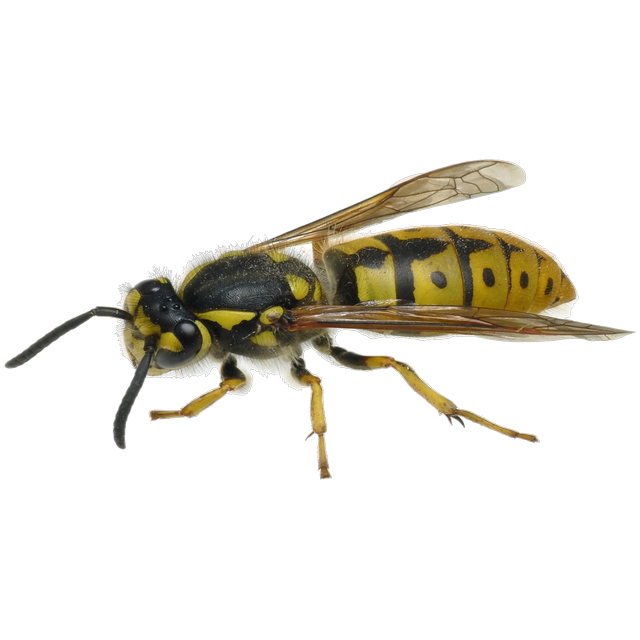
 German yellowjacket
Vespula germanica Fabricius, 1793
German yellowjacket
The picnic-crashing wasp of late summer, an aggressive scavenger that nests underground and in wall voids.
- Order
- Hymenoptera
- Family
- Vespidae
- Group
- Wasps, hornets & bees
- Ontario status
- Established, invasive, abundant
Why it matters
The main stinging pest of Ontario's late summer, painful stings, dangerous to allergic individuals. Also a food contaminator at outdoor events. Ecologically, an invasive predator and scavenger.
Origin
Native to Europe and temperate Asia; introduced to North America and now one of the commonest late-summer wasps.
Behavior
In spring, workers hunt insects to feed the colony. By August, September the colony shifts to scavenging, meat, sweets, garbage, your picnic. Defensive around the nest; can sting repeatedly without losing the stinger.
Living conditions
Nests in soil cavities, wall voids, attics and hollow trees. Colonies need sheltered cavities and abundant late-summer food, which is why suburbs suit them perfectly.
Signs of presence
- Wasps streaming in and out of a hole in the ground, a wall vent, or under siding
- Heavy wasp traffic around garbage bins in late summer
- A papery rustling inside a wall void on warm days
Weaknesses
- The colony dies every autumn, only the queen overwinters, so nests never persist two years
- Foraging follows food odours; sealed garbage and covered food deny the late-summer frenzy
- Nest entrances are findable by watching flight paths at dusk
- Queens founding nests in spring are solitary and vulnerable
Myths and facts
Myth They're bees, and the nest will survive winter.
Reality They are wasps, and the entire worker colony dies each autumn. Only mated queens overwinter, the nest is single-season.
Myth Swatting them away from food works.
Reality Crushed yellowjackets release alarm pheromone that recruits nestmates. Calmly covering food and leaving works better than combat.
Research notes
Morphology
Workers 12-16 mm; queens to ~20 mm. Bright yellow and black banded abdomen; thorax black with yellow markings. Diagnostic face pattern: three small black dots on the yellow clypeus, separates V. germanica from V. maculifrons (anchor-shaped mark). Short-waisted, robust; wings fold longitudinally at rest.
Diagnostics
Confirm by: 12-16 mm yellow-and-black wasp, three facial dots, underground or cavity nesting, late-summer scavenging frenzy.
Easily confused with
- Eastern yellowjacket, Vespula maculifrons V. maculifrons has an anchor-shaped black mark on the face instead of three dots; otherwise nearly identical in habits.
- Paper wasp, Polistes spp. Paper wasps are slender with long dangling legs and open umbrella nests; yellowjackets are stocky with enclosed nests.
Life cycle
- Egg
- Queen lays eggs in paper cells through spring and summer
- Nymph or larva
- Grub-like larvae fed chewed insects by workers in spring, increasingly scavenged protein later
- Adult
- Workers live weeks; colony grows from a single queen to several thousand workers by September; males and new queens produced in autumn
- Egg to adult
- Approximately 3-4 weeks per worker generation in summer
- Generations per year
- One colony cycle per year; only mated queens overwinter
Development
Complete metamorphosis: egg → larva (grub-like, in paper cells) → pupa → adult. Eusocial: queen, workers, males.
Reproduction
Single queen founds the colony in spring; by autumn the colony rears males and new queens, which mate before winter. Old queen, workers and males die with the frosts.
Distribution
- Native range
- Europe and temperate Asia
- Ontario
- Abundant across the province; the dominant late-summer pest wasp
- Global
- Holarctic; invasive in New Zealand, Australia, South America, South Africa
Ecology
Nests in pre-existing cavities: rodent burrows, wall voids, attics. Spring diet is predatory (caterpillars, flies, beneficial); late-summer diet shifts to scavenging carbohydrates and protein. Invasive in many regions; displaces native wasps and preys on native insects.
Resistance
Not applicable in the insecticide-resistance sense, managed by nest treatment; no insecticide resistance documented in Vespula.
IPM implications
Nest-centred biology: locate the entrance by flight-path observation at dusk, then treat the nest directly (a licensed operator task, nests in wall voids need professional handling). Sanitation (sealed waste, covered food) suppresses the late-summer scavenging phase but never the colony. Spring queen trapping has limited evidence. The single-season colony means every autumn ends the problem naturally, management is about the current season's nest.
Chemical ecology
Alarm pheromone from crushed workers recruits defenders; foraging guided by food odours; queens use pheromones to suppress worker reproduction.
Genetics and DNA
No reference genome published as of 2026.
Taxonomy
Hymenoptera: Vespidae. Vespula germanica (Fabricius, 1793). First collected in North America in 1891 (Ithaca, New York); remained rare until rapid range expansion from the late 1960s; now Holarctic in distribution.
Open questions
Invasion genetics of North American populations; competitive effects on native Vespula and Dolichovespula in Ontario.
References
- Akre et al., yellowjacket biology, primary literature (Washington State)
- Evans & Eberhard (1970), The Wasps (Univ. Michigan Press)
- Penn State Extension, yellowjackets and hornets