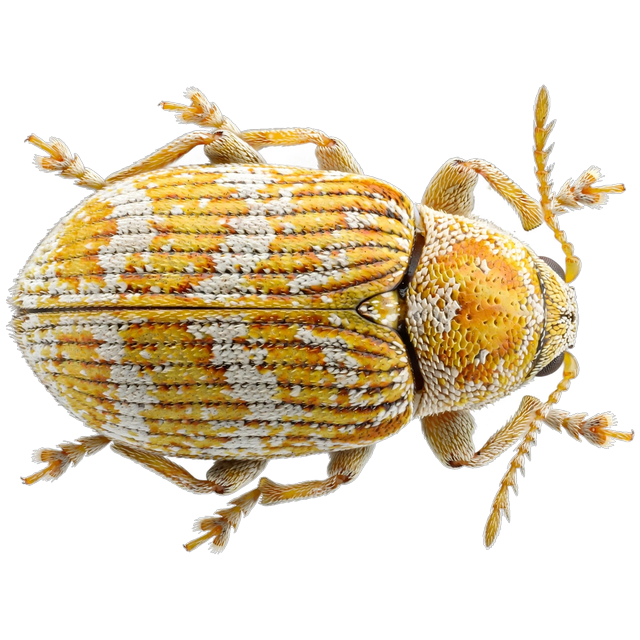
 Furniture carpet beetle
Anthrenus flavipes (LeConte, 1854)
Furniture carpet beetle
The varied carpet beetle's yellower cousin, same wool-eating larvae, more orange in the wardrobe.
- Order
- Coleoptera
- Family
- Dermestidae
- Group
- Fabric & structural beetles
- Ontario status
- Established, present in Ontario but less common than the varied carpet beetle; more southern in distribution
Why it matters
A secondary fabric pest in Ontario, worth knowing because it is the standard exam contrast with the varied carpet beetle.
Origin
North American native that adapted to homes; now found in houses across the continent.
Behavior
Adults on flowers in spring; larvae hidden and hairy. Slightly more warmth-loving than the varied carpet beetle.
Living conditions
Same as the varied carpet beetle, woolens, furs, feathers, dead insects in wall voids, upholstered furniture (hence the name).
Signs of presence
- Mottled yellowish beetles (2-3.5 mm) on windowsills
- Hairy larvae and damage concentrated in upholstered furniture
Weaknesses
- Same keratin dependence and sanitation vulnerability as other Anthrenus
- Less cold-tolerant, less competitive in Ontario than the varied carpet beetle
Myths and facts
Myth All mottled carpet beetles are the same species.
Reality The yellow-orange mottling marks the furniture carpet beetle; the bolder white patches mark the varied carpet beetle, and the distinction is an exam question.
Research notes
Morphology
Adult 2-3.5 mm, oval, mottled with yellow-orange and white scales on a dark ground; underside paler. Larva hairy, ~4-5 mm, similar to A. verbasci.
Diagnostics
Extensive yellow-orange mottling + paler underside = furniture carpet beetle. Compare scale pattern directly with A. verbasci.
Easily confused with
- Varied carpet beetle, Anthrenus verbasci Furniture: more yellow-orange, paler beneath. Varied: bolder white scale patches on a darker ground.
Life cycle
- Adult
- Pollen-feeding, 2-6 weeks
- Egg
- Laid in keratinous material; ~2 weeks to hatch
- Egg to adult
- ~1 year in temperate homes
- Generations per year
- 1
- Nymph or larva
- Hairy larvae feed several months
Development
Complete metamorphosis; larval diapause possible.
Reproduction
~40-100 eggs per female.
Distribution
- Global
- North America; introduced elsewhere
- Native range
- North America
- Ontario
- Established but patchy; more common southward
Ecology
Bird-nest scavenger by origin; upholstery and furniture stuffing are the indoor analog.
Resistance
Unknown, no documented resistance.
IPM implications
Same reservoir-removal logic as the varied carpet beetle, with attention to upholstered furniture as the favored larval site.
Chemical ecology
As in Anthrenus generally; unstudied specifically.
Genetics and DNA
No reference genome published as of 2026.
Taxonomy
Order Coleoptera, family Dermestidae. Described by John Lawrence LeConte, the father of American beetle taxonomy.
Open questions
Northern range limits and competition with A. verbasci in heated buildings.
References
- Hinton, H.E. (1945). A Monograph of the Beetles Associated with Stored Products, Vol. 1. British Museum (Natural History).