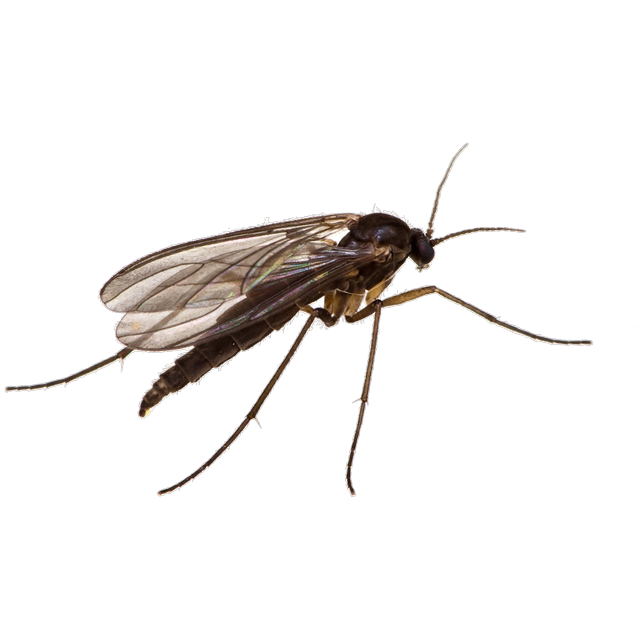
 Fungus gnat
Bradysia spp. Winnertz, 1867
Fungus gnat
Tiny dark flies hovering over houseplant soil, their larvae feed on fungi in damp potting mix.
- Order
- Diptera
- Family
- Sciaridae
- Group
- Flies
- Ontario status
- Established, common (greenhouses, houseplants)
Why it matters
Mostly a houseplant nuisance. In greenhouses and nurseries, heavy larval feeding damages seedlings and spreads plant pathogens, an economic pest of horticulture, not of homes.
Origin
A worldwide family of soil-dwelling flies; the houseplant species arrived with the potted-plant trade.
Behavior
Adults hover weakly over soil and run across the surface. Harmless to people, they don't bite, they just annoy.
Living conditions
Larvae live in damp potting soil, feeding on fungi, algae and fine root hairs. Overwatered plants are the entire problem.
Signs of presence
- Tiny dark flies rising when you water or disturb a plant
- Flies stuck to nearby windows
- Seedlings wilting for no clear reason (heavy larval root feeding)
Weaknesses
- Larvae need constantly moist soil, letting the top centimetres dry between waterings kills them
- Bottom-watering and good drainage deny them habitat
- Yellow sticky traps catch the flying adults and show whether numbers are falling
- Sterile, fresh potting mix starts clean
Myths and facts
Myth They bite like mosquitoes.
Reality Adult fungus gnats have no biting mouthparts at all. Anything biting near your plants is something else.
Research notes
Morphology
Adult 2-4 mm; slender, dark grey-black, mosquito-like with long legs and long beaded antennae. Wing venation distinctive: the media and cubitus form a Y-shaped fork, the family field character. Larvae: translucent white worms ~5 mm with a shiny black head capsule, in soil.
Diagnostics
Confirm by: 2-4 mm dark delicate flies over moist soil, Y-forked wing veins, black-headed translucent larvae in the top layer of potting mix.
Easily confused with
- Drain fly, Psychoda spp. Drain flies are moth-like and furry with broad wings; fungus gnats are slender and mosquito-like with narrow wings.
- Fruit fly, Drosophila melanogaster Fruit flies are tan with red eyes and hover over fermenting matter; fungus gnats are dark and stay over soil.
Life cycle
- Egg
- Laid in moist organic soil; hatch in days
- Nymph or larva
- Translucent larvae with black head capsules graze fungi, algae and root hairs in the top 2-3 cm of soil; 4 instars
- Adult
- Lives about a week; does not feed significantly
- Egg to adult
- Approximately 3-4 weeks at 20-25 °C
- Generations per year
- Continuous in greenhouses and homes; overlapping generations
Development
Complete metamorphosis: egg → larva (4 instars, in soil) → pupa (in soil) → adult.
Reproduction
Females lay 100-200 eggs in moist soil; populations track watering frequency directly.
Distribution
- Native range
- Cosmopolitan family
- Ontario
- Common in greenhouses, nurseries and homes year-round
- Global
- Worldwide
Ecology
Breeding media: moist, organically rich soil and soilless media. Larvae are primarily fungivores, the fungi, not the plant, are the attractant; root damage is secondary. Greenhouse and interior-plantscape pest; vectors of plant pathogens (Pythium, Fusarium) on their bodies.
Resistance
Unknown, managed culturally and biologically; no significant resistance documented.
IPM implications
Cultural control is decisive because the larvae are moisture-obligate: allow the soil surface to dry between waterings, improve drainage, remove algae from surfaces. Yellow sticky traps monitor adult trends. Biological controls (the predatory mite Stratiolaelaps scimitus, the nematode Steinernema feltiae) target larvae in the soil, the biology says treat the medium, not the air.
Chemical ecology
Adults attracted to moist organic media volatiles; larvae follow fungal growth in the soil profile.
Genetics and DNA
No reference genome published as of 2026.
Taxonomy
Diptera: Sciaridae (dark-winged fungus gnats). Genus Bradysia Winnertz, 1867; B. impatiens and B. difformis are the common greenhouse species.
Open questions
Species boundaries among the common greenhouse Bradysia (morphologically cryptic); quantitative thresholds for economic damage in ornamentals.
References
- Cloyd, Kansas State Extension, fungus gnat biology and management
- Mead & Fasulo, UF/IFAS Extension, dark-winged fungus gnats
- Hungerford et al., Sciaridae larval ecology, primary literature