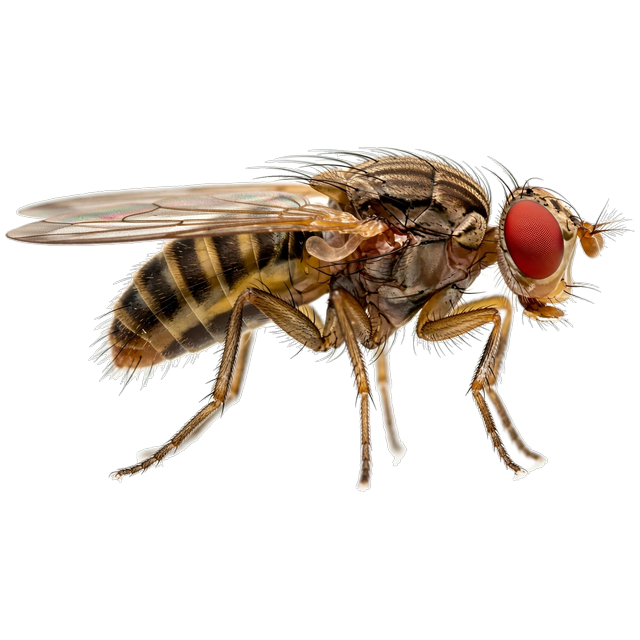
 Fruit fly
Drosophila melanogaster Meigen, 1830
Fruit fly
Tiny red-eyed flies over ripening fruit, and the most studied animal in the history of genetics.
- Order
- Diptera
- Family
- Drosophilidae
- Group
- Flies
- Ontario status
- Established, ubiquitous indoors
Why it matters
Mostly a nuisance and a food-contamination indicator, their presence says something is fermenting. They do not bite and are not significant disease vectors. Their fame is scientific, not medical.
Origin
Native to sub-Saharan Africa; spread worldwide with human fruit trade centuries ago.
Behavior
Hover in small clouds over the breeding site. Weak fliers, most active by day. Attracted to fermentation smells, wine, vinegar, bananas.
Living conditions
Breeds in moist, fermenting organic matter: overripe fruit, garbage disposals, mop heads, recycling bins, the slime under bar mats, floor drains with organic buildup.
Signs of presence
- Tiny flies hovering over fruit bowls, drains, or garbage areas
- Flies emerging when you disturb a drain, mop, or recycling bin
- Larvae (tiny white worms) in the slime of a drain or disposal
Weaknesses
- Cannot breed without a moist fermentation site, find it and remove it
- Vinegar traps catch adults but never solve the problem; only source removal does
- Drying out a drain or mop head ends that breeding site
- Short adult life, a week without breeding ends the infestation
Myths and facts
Myth Fruit flies come from the fruit itself, spontaneously.
Reality They arrive as adults attracted by fermentation odours, or as eggs already laid on the fruit at the store. Nothing appears spontaneously, there is always a breeding site.
Myth A vinegar trap will get rid of them.
Reality Traps only catch flying adults. As long as the breeding slime remains, new flies keep emerging. Traps monitor; source removal cures.
Research notes
Morphology
Adult 2-3 mm; tan thorax, banded abdomen, brick-red eyes. Arista with dorsal and ventral feathery branches (plumose), the family diagnostic. Males smaller with darkened posterior abdomen and sex combs on forelegs.
Diagnostics
Confirm by: 2-3 mm, red eyes, hovering flight over fermentation sources, feathery arista. Fermentation-site association separates it from phorid flies (which run) and drain flies (moth-like).
Easily confused with
- Phorid fly, Megaselia scalaris Phorids are humpbacked and run in short bursts instead of hovering; fruit flies hover and fly in small clouds.
- Spotted-wing drosophila, Drosophila suzukii Males have a dark spot on each wing; females have a serrated ovipositor. D. melanogaster attacks only damaged/fermenting fruit; D. suzukii attacks ripening fruit.
Life cycle
- Egg
- Laid in fermenting matter; ~400-500 per female lifetime
- Nymph or larva
- White maggots feeding on yeast and bacteria in ferment; 3 instars
- Adult
- Lives 2-4 weeks; sexually mature within ~12 hours of emergence
- Egg to adult
- 8-10 days at 25 °C; ~7 days at 28 °C; 3+ weeks at 18 °C
- Generations per year
- Dozens indoors; continuous where fermentation sites persist
Development
Complete metamorphosis: egg → larva (3 instars) → pupa → adult. The textbook example taught in every biology course.
Reproduction
Explosive: one female's ~500 eggs become a visible cloud within two weeks at room temperature.
Distribution
- Native range
- Sub-Saharan Africa
- Ontario
- Ubiquitous indoors; seasonal outdoors
- Global
- Cosmopolitan with human commerce
Ecology
Breeding media: any moist fermenting organic matter. Human-commensal worldwide; outdoors on fallen fruit, indoors in drains, disposals, mops, bins. Overwinters indoors in heated buildings in Ontario.
Resistance
Insecticide resistance readily evolves in laboratory selection (a research tool); field control rarely relies on insecticides.
IPM implications
The biology is the entire strategy: locate every fermentation site (drains, disposals, drip trays, recycling residue, mop storage) and eliminate the moist organic layer, mechanically, not chemically. Adult traps (vinegar/fermentation) are monitoring tools that confirm the source is gone when catches fall to zero. No breeding site, no flies, guaranteed by the life cycle.
Chemical ecology
Attracted to acetic acid, ethanol, CO2 and yeast volatiles, the chemical signature of fermentation. Oviposition follows yeast presence, which the larvae require.
Genetics and DNA
The model organism: genome sequenced 2000 (~180 Mb, ~13,600 genes; Adams et al., Science). Six Nobel Prizes trace to work in this fly. The best-annotated insect genome on earth.
Taxonomy
Diptera: Drosophilidae. Drosophila melanogaster Meigen, 1830. The model organism of modern genetics, more is known about this fly's biology than any other insect.
Open questions
Microbiome-mediated differences in attraction between wild populations; overwintering refugia in Ontario's urban core.
References
- Adams et al. (2000), Science, the Drosophila genome sequence
- Jennings (2011), Nature Education, Drosophila as a model organism
- FlyBase (flybase.org), the community genome database