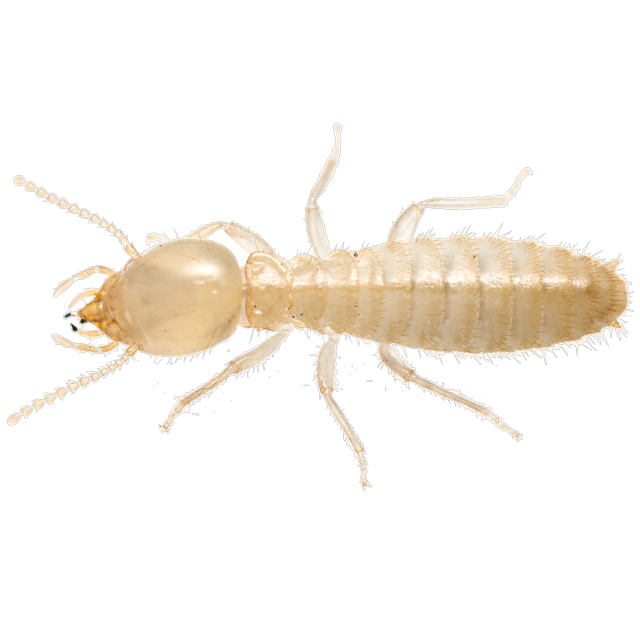
 Formosan subterranean termite
Coptotermes formosanus Shiraki, 1909
Formosan subterranean termite
An aggressive subterranean termite of the southeastern US, not established in Canada.
- Order
- Blattodea
- Family
- Heterotermitidae
- Group
- Termites
- Ontario status
- Not established in Ontario, destructive subterranean termite of the southeastern US
Why it matters
The most destructive termite in the US, a single mature colony holds millions of workers and can cause severe structural damage far faster than native species. Listed here for reference and awareness, not as an Ontario threat.
Origin
Native to southern China and Taiwan (Formosa); reached the US via military shipping after WWII, first Hawaii, then the Gulf Coast.
Behavior
Forages aggressively through mud tubes and inside wood. Swarms in huge numbers on warm, humid spring and summer evenings, thousands of winged termites around lights.
Living conditions
Warm, humid climates. Like other subterranean termites it needs moisture, but mature colonies build carton nests inside walls and can survive with little or no soil contact.
Signs of presence
- Thick mud tubes on foundations and walls
- Massive spring swarms of winged termites at lights
- Carton (cardboard-like) nest material inside wall voids
- Wood that sounds hollow with a papery surface left intact
Weaknesses
- Not established in Ontario, our winters are the barrier
- Needs constant moisture; drying a structure out hurts the colony
- Swarmers are weak and short-lived, most never found a colony
- Colonies are centralized around the carton nest, find the nest, find the colony
Myths and facts
Myth It's heading for Ontario.
Reality It is not established in Canada; cold winters remain a hard barrier.
Myth All termites are the same.
Reality Formosan colonies are 10-100× larger than native subterranean termite colonies, with correspondingly greater damage potential.
Research notes
Morphology
Workers ~5-6 mm, pale, blind. Soldiers ~5-6 mm with oval/teardrop heads bearing a fontanelle (frontal pore) that secretes defensive fluid, vs. the rectangular heads of Reticulitermes soldiers. Alates ~12-15 mm body, yellowish-brown, with ~20 mm wings shed after swarming.
Diagnostics
Confirm by soldier head shape (oval with fontanelle) + carton nest material + massive swarm size.
Easily confused with
- Eastern subterranean termite, Reticulitermes flavipes Soldiers have rectangular heads with a small, inconspicuous fontanelle (vs. the large prominent fontanelle on the oval/teardrop Coptotermes head); colonies far smaller; no carton nests.
Life cycle
- Adult
- Queen may live 15+ years, laying thousands of eggs daily at maturity; workers live 1-2 years.
- Egg
- Laid by the queen in the carton nest; hatch in ~2-4 weeks.
- Egg to adult
- ~2-3 months for workers
- Generations per year
- Continuous, colonies persist for decades
- Nymph or larva
- Nymphs differentiate into workers, soldiers or reproductives based on colony needs.
Development
Hemimetabolous with caste polyphenism: egg → nymph → worker/soldier/neotenic or alate pathways.
Reproduction
Mature colonies contain millions of individuals; a single queen produces thousands of eggs per day. Alate swarms number in the thousands.
Distribution
- Global
- Southeastern US, Hawaii, parts of Asia; invasive where warm and humid
- Native range
- Southern China and Taiwan
- Ontario
- Not established, winters too cold
Ecology
Forages up to ~100 m from the nest through underground tunnels. Builds carton nests of chewed wood, soil and saliva above ground, freeing mature colonies from soil dependence. Cellulose digested with hindgut protists and bacteria.
Resistance
Unknown, not a well-characterized resistance subject.
IPM implications
Carton-nest biology means inspection must look inside structures, not just at soil lines, above-ground nests are the colony's center of gravity. Swarm monitoring (light traps in season) detects new incursions early in at-risk regions.
Chemical ecology
Trail pheromone (dodecatrienol-type) recruits foragers; soldier frontal-gland secretions (terpenoids) are defensive and toxic to ants.
Genetics and DNA
Short-read reference genome published (GCA_013340265.1; contig N50 ~106.6 kb; ~25,958 genes in the 2025 reannotation).
Taxonomy
Order Blattodea, family Heterotermitidae (revised from Rhinotermitidae, Hellemans et al. 2024). Described by Shiraki, 1909. Eusocial with sterile worker/soldier castes and a single reproductive pair.
Open questions
Northern range-limit physiology; colony fusion dynamics.
References
- Bignell et al. 2011, Biology of Termites
- Su, N.-Y. & Scheffrahn, R.H., Univ. of Florida termite research
- Mallis Handbook of Pest Control