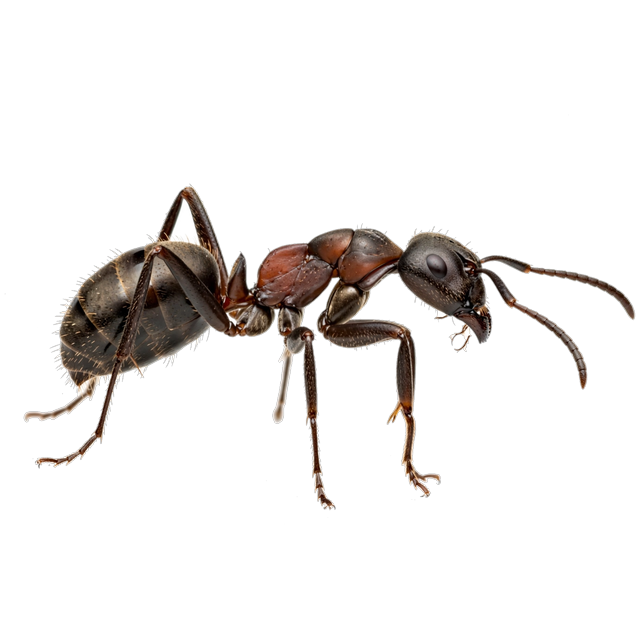
 Field ant
Formica spp. Linnaeus, 1758
Field ant
The mound-builders of lawns and fields, big, fast, and armed with formic acid spray.
- Order
- Hymenoptera
- Family
- Formicidae
- Group
- Ants
- Ontario status
- Native, established provincewide
Why it matters
Mostly a lawn and landscape nuisance; mounds damage turf and mowers. Bites are painful but not medically significant. Occasionally forages indoors without nesting.
Origin
Native to North American meadows and open woods; the classic 'ant hill' ant.
Behavior
Fast, aggressive foragers active by day. When threatened, they bite and spray formic acid, you can smell it as a sharp vinegar odor.
Living conditions
Builds soil mounds in lawns, fields and sunny spots. Rarely nests inside houses, indoor sightings are foragers wandering in.
Signs of presence
- Large soil mounds (up to 30 cm+) in lawns
- Fast-moving ants, often reddish or bicolored, on the mound
- Sharp vinegar smell when the mound is disturbed
Weaknesses
- Mound nests are large, obvious and outdoors
- Rarely establishes indoors, exclusion solves most cases
- Colonies are tied to their mound; the nest does not move
Myths and facts
Myth Field ants in the kitchen mean the house is infested.
Reality They almost never nest indoors, indoor field ants are foragers from the lawn mound.
Research notes
Morphology
Workers 4-8 mm, often bicolored (reddish thorax, dark gaster). Single node; 12-segmented antennae, no club; acidopore (circular nozzle) at gaster tip for formic acid spraying.
Diagnostics
Confirm by mound nesting + formic acid odor when disturbed + single node + acidopore.
Easily confused with
- Carpenter ant, Camponotus pennsylvanicus Carpenter ants nest in wood (not soil mounds), are uniformly black, and do not spray formic acid with the same vinegar odor.
Life cycle
- Adult
- Workers live a season; queens live for years; colonies perennial.
- Egg
- Eggs hatch in ~2-3 weeks.
- Egg to adult
- ~6-10 weeks depending on temperature
- Generations per year
- One main brood cycle per season; colony persists for years
- Nymph or larva
- Legless larvae; pupae in silk cocoons (formicine character).
Development
Complete metamorphosis: egg → larva → pupa → adult.
Reproduction
Single or multiple queens depending on species; nuptial flights in summer.
Distribution
- Global
- Holarctic genus
- Native range
- North America (varies by species)
- Ontario
- Native; common provincewide in lawns and fields
Ecology
Mound-building in open sunny habitats; important predators and scavengers; tend honeydew producers; formic acid defense. Ecologically beneficial in natural settings.
Resistance
No published data, non-target beneficial genus.
IPM implications
Identify the mound before acting, indoor sightings resolve to an outdoor source. Mound drenching or baiting at the mound is the target; indoor treatment alone is pointless. In landscapes, weigh their beneficial predatory role before intervention.
Chemical ecology
Formic acid sprayed from the acidopore is the defining defensive chemistry; alarm pheromones coordinate mound defense.
Genetics and DNA
No reference genome for Ontario Formica species published as of 2026; genomic resources for the European Formica selysi date to Purcell et al. (2014) and the social-supergene studies.
Taxonomy
Order Hymenoptera, family Formicidae, subfamily Formicinae, genus Formica. Multiple species in Ontario; treated at genus level.
Open questions
Species-level mapping of mound-building Formica across GTA land uses.
References
- Hölldobler, B. & Wilson, E.O. 1990, The Ants, Harvard University Press
- Mallis Handbook of Pest Control