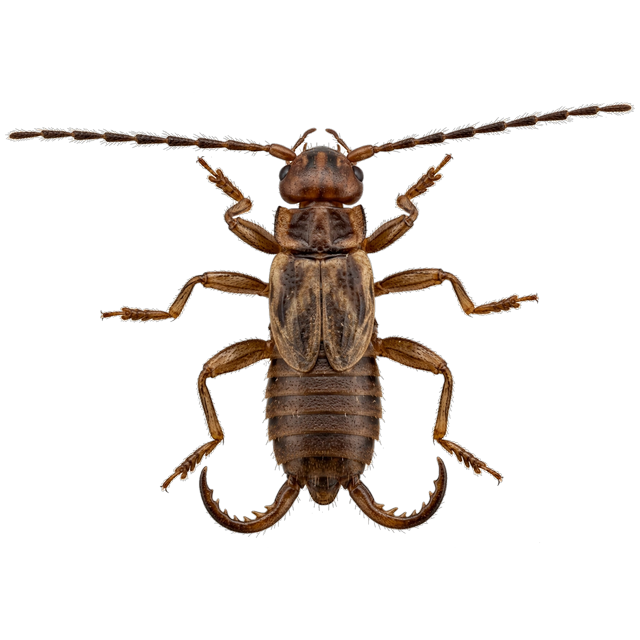
 European earwig
Forficula auricularia Linnaeus, 1758
European earwig
The pincer-tailed garden visitor, it won't crawl in your ear, whatever the name suggests.
- Order
- Dermaptera
- Family
- Forficulidae
- Group
- Occasional invaders
- Ontario status
- Established, introduced; common in gardens and damp ground-floor rooms
Why it matters
Mostly a garden nuisance and an indoor accidental, it damages seedlings and startles people, but it also eats aphids and decaying matter. Indoors it neither bites, stings, nor damages anything; it just followed the damp in.
Origin
Europe and western Asia; now wherever there are damp gardens in the temperate world.
Behavior
Nocturnal scavenger that hides under things by day and forages at night. The pincers are for defense and mating wrestling, not for attacking people. Mothers guard their eggs, unusual and rather touching for a bug.
Living conditions
Damp ground-level spots, under mulch, stones, and debris against the house; in basements and ground-floor bathrooms after rain. Follows moisture indoors.
Signs of presence
- Brown pincer-tailed insects under doormats, planters, and mulch
- Indoor sightings in ground-floor rooms after wet weather
- Clustered in damp rolled newspapers or cardboard left outside
- Chewed seedlings and soft fruit in the garden (their outdoor mischief)
Weaknesses
- Needs constant moisture, dry perimeters and pulled-back mulch collapse local populations
- Cannot establish breeding colonies indoors; every indoor earwig wandered in
- Trapped easily with simple damp-newspaper roll traps (non-chemical monitoring)
- Maternal nests are in soil, remove ground-level debris and you remove the nursery
Myths and facts
Myth Earwigs crawl into people's ears and burrow into their brains.
Reality The name comes from an Old English folk tale, not from behavior. There is no documented case of an earwig deliberately entering a human ear to burrow anywhere.
Myth The pincers are venomous stingers.
Reality They are just pincers, no venom, no sting. A large male might give a harmless pinch if handled roughly.
Research notes
Morphology
Body 12-15 mm; dark brown; short truncated wing covers (tegmina) hiding folded flight wings; the cerci form the famous pincers, strongly curved in males, nearly straight in females. Thread-like antennae.
Diagnostics
Terminal cerci forceps (curved in males, straighter in females) + short wing covers + 12-15 mm brown body. Maternal egg-guarding in soil nests confirms the species in spring.
Easily confused with
- Rove beetles (Staphylinidae) Rove beetles are smaller, lack cerci pincers, and raise their abdomen like a scorpion; earwigs have the unmistakable terminal forceps.
Life cycle
- Adult
- Adults overwinter in soil nests; active spring through fall
- Egg
- 20-60 eggs laid in soil nests in fall/spring; female guards and cleans them
- Egg to adult
- About 2-3 months in warm weather
- Generations per year
- One in Ontario
- Nymph or larva
- Nymphs resemble small pale adults; 4-5 molts; tended by the mother early on
Development
Hemimetabolous, egg to nymph to adult. Notable maternal care: the female guards and cleans her eggs and young nymphs, rare among insects.
Reproduction
One of few insects with true maternal care: the female stays with her eggs through winter, cleaning them against fungus, and tends the first-instar nymphs. Males use curved cerci in combat over females.
Distribution
- Global
- Temperate regions worldwide
- Native range
- Europe, western Asia
- Ontario
- Established province-wide; abundant in gardens, enters ground-floor rooms in damp weather
Ecology
Omnivorous detritivore and opportunistic predator, eats decaying matter, aphids, and also seedlings and soft fruit. Moisture-dependent; aggregates under debris. Maternal care is a research model for the evolution of parental behavior.
Resistance
Unknown, managed physically; no documented resistance of note.
IPM implications
Monitoring: rolled damp newspaper traps or oil-baited traps index activity. Management is habitat-based, remove ground-level debris and mulch against foundations, fix damp, seal ground-level entry. Beneficial predation on aphids outdoors argues against broadcast treatment; this is an exclusion and sanitation insect.
Chemical ecology
Cerci are mechanical, not venomous, the 'pincers' are for defense, prey handling, and male combat. Some species eject defensive quinones; F. auricularia relies on the cerci and thanatosis (playing dead).
Genetics and DNA
A high-quality genome assembly was published in 2022 (Bhattarai et al., G3): 1.06 Gb, 919 scaffolds, N50 12.55 Mb, 12,876 protein-coding genes; the sequenced isolate was identified as subspecies B of the species complex.
Taxonomy
Order Dermaptera, family Forficulidae. Authority Linnaeus, 1758 (no parentheses, originally described in Forficula). The archetypal earwig of the Northern Hemisphere.
Open questions
Maternal-care neurobiology; why some gardens erupt while identical neighbors stay clear.
References
- Ebeling, W. (1978). Urban Entomology, University of California, Riverside.