 Eastern yellowjacket
Vespula maculifrons Buysson, 1905
Eastern yellowjacket
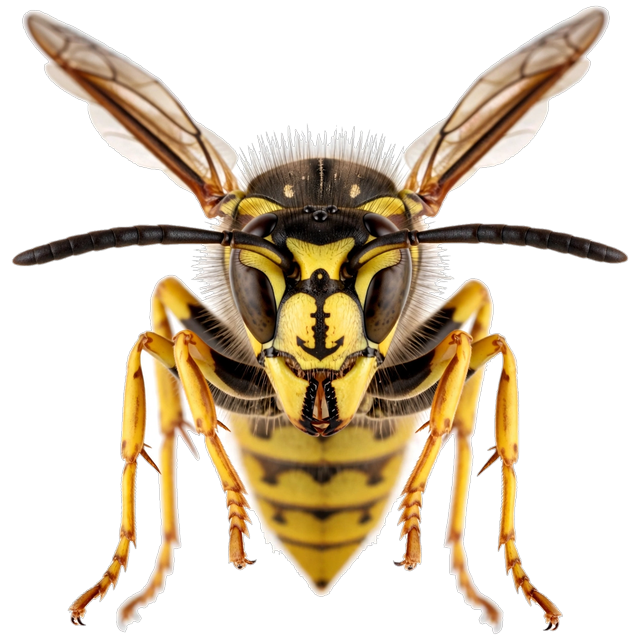
Ontario's native picnic wasp, nearly identical to the German yellowjacket, with an anchor mark on its face.
- Order
- Hymenoptera
- Family
- Vespidae
- Group
- Wasps, hornets & bees
- Ontario status
- Established, native, abundant
Why it matters
Co-headliner with the German yellowjacket for Ontario's late-summer stinging complaints. Painful stings; allergy risk. A native species doing the same job as the invader.
Origin
Native to eastern North America, from Ontario to the Gulf Coast.
Behavior
Same seasonal script: spring predator, late-summer scavenger. Defensive at the nest; bold around food in September.
Living conditions
Nests underground in old rodent burrows and in wall voids, the same cavities as its German cousin.
Signs of presence
- Wasp traffic at a ground hole or wall vent
- Late-summer swarms at garbage and picnics
- Papery sounds in wall voids
Weaknesses
- Single-season colonies, winter ends every nest
- Sealed garbage and covered food starve the scavenging phase
- Nest entrances traceable by dusk flight-watching
- Spring queens are solitary and exposed
Myths and facts
Myth All yellowjackets are the invasive German kind.
Reality This native species is just as common in Ontario. The face mark tells them apart: anchor (native) vs. three dots (German).
Research notes
Morphology
Workers 12-16 mm; yellow and black. Diagnostic: anchor-shaped black mark on the yellow face (vs. three dots in V. germanica). Otherwise nearly identical in build and habits.
Diagnostics
Confirm by: 12-16 mm, anchor facial mark, cavity/ground nesting, late-summer scavenging.
Easily confused with
- German yellowjacket, Vespula germanica Face mark: anchor-shaped in maculifrons, three separate dots in germanica. Habits are interchangeable.
Life cycle
- Egg
- Queen-laid in paper cells from spring
- Nymph or larva
- Grub-like larvae fed insects, then scavenged protein
- Adult
- Colony to thousands of workers by autumn; only mated queens overwinter
- Egg to adult
- Approximately 3-4 weeks per worker generation
- Generations per year
- One colony cycle per year
Development
Complete metamorphosis: egg → larva → pupa → adult. Annual eusocial colony.
Reproduction
As in V. germanica: single foundress queen, autumn production of males and new queens, winter kills the colony.
Distribution
- Native range
- Eastern North America
- Ontario
- Abundant; co-dominant with V. germanica in late summer
- Global
- Eastern North America only
Ecology
Native cavity nester; spring predator of caterpillars and flies; late-summer scavenger. Competes directly with the invasive V. germanica for cavities and food.
Resistance
Not applicable, no insecticide resistance documented.
IPM implications
Identical management logic to the German yellowjacket: nest location and direct nest treatment by licensed operators; sanitation for the scavenging phase; single-season colonies make autumn the natural endpoint.
Chemical ecology
Alarm and recruitment pheromones as in V. germanica; foraging odour-guided.
Genetics and DNA
No reference genome published as of 2026.
Taxonomy
Hymenoptera: Vespidae. Vespula maculifrons (Buysson, 1905). Native eastern North American; the ecological counterpart of V. germanica.
Open questions
Competitive outcomes between native maculifrons and invasive germanica in Ontario suburbs; nesting-site partitioning.
References
- Akre et al., Vespula biology, primary literature
- Evans & Eberhard (1970), The Wasps (Univ. Michigan Press)
- Penn State Extension, yellowjackets