 Eastern subterranean termite
Reticulitermes flavipes (Kollar, 1837)
Eastern subterranean termite
A pale, blind, wood-eating insect that lives in huge underground colonies and quietly hollows out the wood in your home.
- Order
- Blattodea
- Family
- Heterotermitidae
- Group
- Termites
- Ontario status
- Established, the termite species of Ontario; long-standing infestations in Toronto (notably the east end), expanding with urban heat islands
Why it matters
The most economically destructive structural pest in Ontario. A mature colony of hundreds of thousands can compromise floor joists, sill plates, and framing silently over years, damage is usually found, not seen coming.
Origin
Native to eastern North America, from southern Ontario down through the eastern United States. It did not arrive from somewhere else, this is its home range.
Behavior
Forages at night and year-round underground, even in winter below the frost line. In spring (April, June in Ontario) winged swarmers emerge on warm humid days to start new colonies. Workers are blind and avoid light and open air, exposure dries them out and kills them.
Living conditions
Needs constant moisture, the colony lives in soil and reaches wood through mud shelter tubes. In Ontario homes: basements, crawlspaces, and anywhere wood touches soil or stays damp. It eats the soft springwood of lumber, leaving the hard grain behind.
Signs of presence
- Mud shelter tubes (pencil-width) climbing foundation walls or posts
- Piles of shed wings near windows in spring, swarmers discard wings after landing
- Wood that sounds hollow when tapped, with soil-colored mud inside the galleries
- No sawdust piles, unlike carpenter ants, termites leave no frass outside the wood
Weaknesses
- Soft, unarmored cuticle, dries out and dies within minutes in open dry air
- Cannot survive without constant moisture or soil contact
- The whole colony depends on the queen; eliminate reproduction and the colony collapses
- Winged swarmers are weak fliers and most die before founding a colony
Myths and facts
Myth Termites eat concrete.
Reality They cannot digest concrete. They build mud tubes over concrete to reach wood, the tube is a highway, not food.
Myth Seeing swarmers means your house is infested.
Reality Swarmers may come from a colony outdoors or next door. But swarmers indoors, emerging from inside the structure, almost always mean an established colony in the building.
Research notes
Morphology
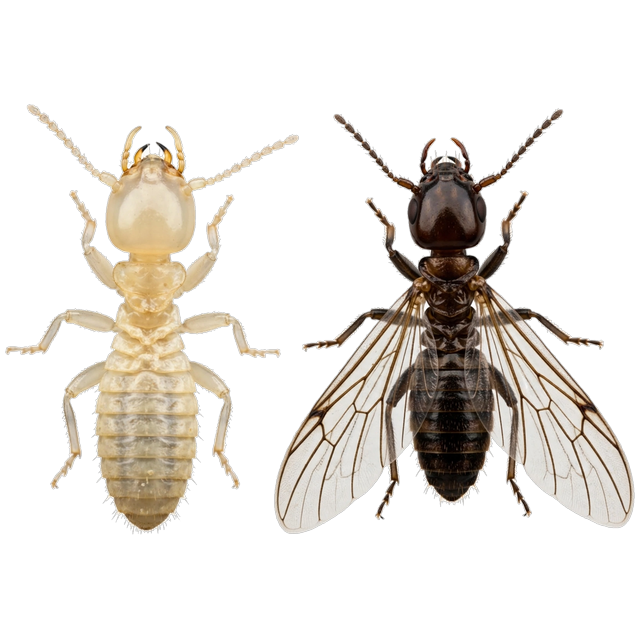
Workers 6 mm, pale cream, blind, soft-bodied. Soldiers slightly larger with rectangular darkened heads and prominent mandibles. Alates (swarmers) ~8.5-10 mm to the wing tips (body ~6-7 mm), dark brown to black, with two pairs of equal-length membranous wings extending well past the abdomen; wings shed along a basal fracture line after the nuptial flight.
Diagnostics
Confirm by caste morphology and shelter tubes: equal-length wings on alates (vs. unequal in ants), broad waist (vs. pinched ant waist), straight bead-like antennae (vs. elbowed in ants). Mud tubes with soil texture on foundations are diagnostic of subterranean activity.
Easily confused with
- Carpenter ant, Camponotus pennsylvanicus Ants have a pinched waist, elbowed antennae, and unequal wing pairs; termites have a broad waist, straight antennae, equal wings.
- Western subterranean termite, Reticulitermes hesperus Essentially identical in the field; separated by geography (western North America) and soldier morphometrics, not reliably distinguished by eye.
Life cycle
- Adult
- Workers and soldiers are sterile and functionally adult after several molts; alates are the only winged, dispersing caste
- Egg
- Laid by the queen deep in the royal chamber; ~1 mm, pale; hatch in ~2 weeks under warm conditions
- Egg to adult
- Several months for workers; alates are produced seasonally and may take a year or more to mature
- Generations per year
- Colonies are perennial, a single colony persists for many years, growing to hundreds of thousands of individuals
- Nymph or larva
- Nymphs pass through several instars; development path (worker, soldier, neotenic, alate) is regulated by pheromones and colony needs
Development
Hemimetabolous (incomplete metamorphosis) with caste polyphenism: egg → nymph → pseudergate/worker or soldier or neotenic/alate. No pupal stage.
Reproduction
A mature queen lays on the order of ~1,000 eggs per day at peak; colonies grow over 3-5+ years to maturity. Swarming produces alate pairs; only a tiny fraction successfully found new colonies (most are eaten or desiccate).
Distribution
- Global
- Introduced populations reported in parts of Europe (e.g., France, Germany); otherwise native-range plus human-assisted spread
- Native range
- Eastern North America, from southern Ontario to the Gulf states
- Ontario
- The only termite established in Ontario; long-standing infestations in Toronto (east end), with spread tracking urban heat islands and human movement of infested wood/soil
Ecology
Obligate symbiosis with gut flagellate protozoa (e.g., Trichonympha relatives) that digest cellulose, termites cannot digest wood without them, and the symbionts are transmitted colony-wide by trophallaxis. Foraging range up to ~100 m from the nest via shelter tubes; strongly moisture-dependent.
Resistance
Limited documented insecticide resistance compared with cockroaches or stored-product beetles; colony-level control via baits (chitin synthesis inhibitors) remains broadly effective. Some reduced susceptibility to pyrethroids reported in isolated populations, not a widespread control failure.
IPM implications
Biology dictates strategy: the colony, not the foraging workers, is the target, so monitoring (in-ground stations) must precede and verify any intervention. Moisture management (grading, leaks, wood-soil contact) removes the ecological precondition. Swarmers indoors = inspect for the colony, not the swarmers. Bait logic follows from trophallaxis: slow-acting agents distributed through the colony food network.
Chemical ecology
Trail-following pheromones laid by workers guide foragers to food (dodecatrienol-type compounds documented in Reticulitermes); soldier frontal-gland secretions are defensive; queen and king pheromones suppress worker reproduction and regulate caste ratios.
Genetics and DNA
High-resolution host genome assembly published 2025 (47-genome termite comparative study, Nature Communications s41467-025-65969-5); gut symbiont metagenomes also well studied.
Taxonomy
Order Blattodea (termites are now classified with cockroaches), family Heterotermitidae (revised from Rhinotermitidae, Hellemans et al. 2024). Eusocial: colonies have reproductive (queen/king), worker, and soldier castes, caste is determined environmentally/nutritionally (polyphenism), not genetically.
Open questions
Exact colony boundaries and foraging territories in dense urban neighborhoods; the role of urban heat islands in northern range expansion; long-term colony age structure in established Toronto infestations.
References
- Bignell, D.E., Roisin, Y. & Lo, N. (eds.) (2011). Biology of Termites: A Modern Synthesis. Springer.
- Vargo, E.L. & Husseneder, C. (2009). Biology of subterranean termites: insights from molecular studies. In Bignell et al. (eds.), Biology of Termites.