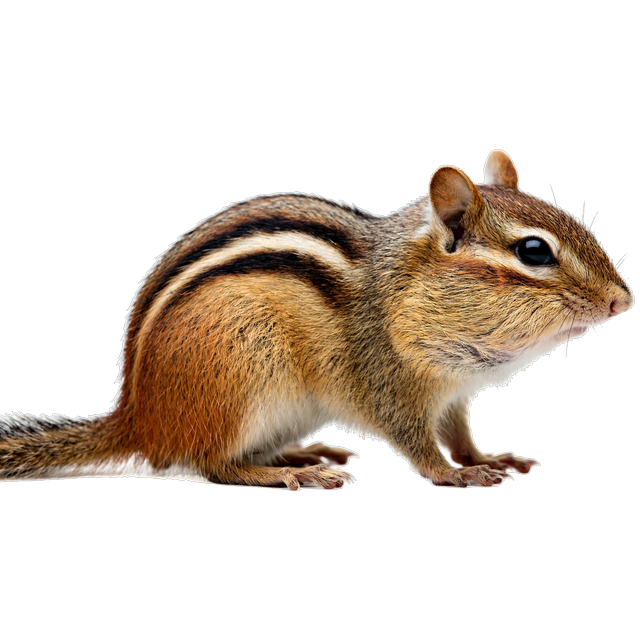
 Eastern chipmunk
Tamias striatus (Linnaeus, 1758)
Eastern chipmunk
A striped ground squirrel that burrows under patios and raids gardens.
- Order
- Rodentia
- Family
- Sciuridae
- Group
- Rodents
- Ontario status
- Established, common provincewide; burrows under patios and raids gardens
Why it matters
Burrows under patios, stairs, and foundations can undermine paving; garden and bulb raiding is the main complaint. Also a reservoir host for Lyme disease spirochetes in some regions. Beloved by most homeowners, control is rarely wanted.
Origin
Native to eastern North America's deciduous forests, a true local, at home in Ontario's ravines, woodlots, and suburban gardens.
Behavior
Diurnal and famously busy, stuffs cheek pouches with seeds and nuts, then vanishes down a burrow entrance you'd never notice. Scatter-hoards food in shallow caches. Spends winter in torpor, waking every few days to eat from its stores.
Living conditions
Woodland edges with cover and loose soil for burrowing: ravines, parks, gardens, and cottage country. Burrows have hidden entrances and separate chambers for nesting, food storage, and waste.
Signs of presence
- Neat round burrow entrances ~50 mm wide with no excavated soil fan (it carries soil away in its pouches)
- Half-eaten seeds and small droppings on patios and walls
- Rapid 'chip-chip' alarm calls from cover
- Bulb and garden raiding in spring and autumn
Weaknesses
- Tied to its burrow and caches, rarely ranges more than 100 m from home
- Winter torpor with periodic waking burns its cached food; a poor mast year means a hard winter
- Diurnal and noisy, easy to watch, which makes its habits an open book
- Small size puts it on every predator's menu: hawks, foxes, cats, snakes
Myths and facts
Myth Chipmunks are just small squirrels and hibernate all winter.
Reality They're ground squirrels, but they don't truly hibernate, they sleep in torpor bouts and wake to snack from their food stores all winter.
Research notes
Morphology
Head-body 130-160 mm, tail 75-110 mm, weight 70-130 g. Five dark stripes on a reddish-brown back (the middle stripe continues onto the head); pale belly. Internal cheek pouches extend to the shoulders.
Diagnostics
Confirm by: five back stripes + internal cheek pouches + burrow entrances with no spoil heap. The thirteen-lined ground squirrel has thirteen stripes and prefers open prairie, not Ontario woodlots.
Easily confused with
- Red squirrel, Tamiasciurus hudsonicus Red squirrel is larger, uniformly reddish with no stripes, and nests in trees, chipmunks are striped and live in burrows.
- Thirteen-lined ground squirrel, Ictidomys tridecemlineatus Thirteen stripes (count them) vs five, and a prairie species rare in Ontario.
Life cycle
- Egg
- N/A, viviparous
- Nymph or larva
- Pups blind and hairless; emerge at ~6 weeks; independent by 8 weeks
- Adult
- Lifespan 2-3 years in the wild; breeds the spring after birth
- Egg to adult
- Gestation ~31 days
- Generations per year
- 1-2 litters per year (spring, sometimes late summer)
Development
Viviparous; altricial young born in the burrow nest chamber.
Reproduction
3-5 pups per litter × 1-2 litters/year.
Distribution
- Native range
- Eastern North America, Nova Scotia to Manitoba, south to the Gulf states
- Ontario
- Established provincewide wherever deciduous or mixed woods meet open ground
- Global
- Eastern North America only
Ecology
Scatter-hoarder: buries seeds singly across its ~0.5 ha range, an important forest regenerator. Torpor bouts through winter with periodic arousals to feed from caches. Vocal: distinct 'chip' alarm and trill calls.
Resistance
N/A, not a pesticide target species.
IPM implications
Monitoring: burrow-entrance mapping (no spoil heap is diagnostic) and cache-raiding patterns locate the territory. Exclusion of garden beds and bulb plantings is by buried mesh; the animal's small range means local exclusion works. Live-trapping is regulated, FWCA licensing applies.
Chemical ecology
Scent glands on the cheeks and flanks mark burrow entrances and routes; urine marking of caches reported.
Genetics and DNA
No reference genome published as of 2026.
Taxonomy
Rodentia: Sciuridae. Tamias striatus (Linnaeus, 1758), 'tamias' is Greek for 'storer', for the cheek pouches.
Open questions
Cache pilferage rates and their effect on overwinter survival in suburban vs forest populations.
References
- Naughton, D. (2012) The Natural History of Canadian Mammals, Univ. of Toronto Press
- Snyder, D.P. (1982) Tamias striatus, Mammalian Species No. 168