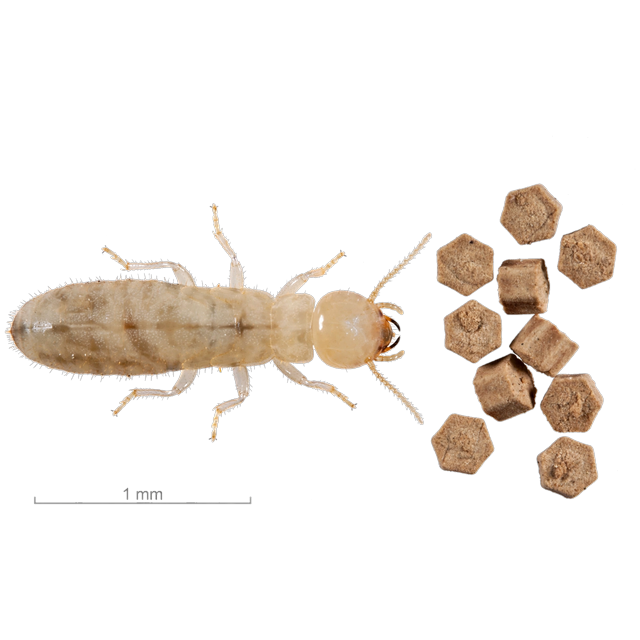
 Drywood termite
Incisitermes spp. Krishna, 1961
Drywood termite
A termite that needs no soil at all, the whole colony lives inside a single piece of dry wood.
- Order
- Blattodea
- Family
- Kalotermitidae
- Group
- Termites
- Ontario status
- Not established in Ontario, warm-climate genus; occasional interceptions in imported furniture or lumber; reference species
Why it matters
Not an Ontario problem, but the classic exam contrast: the termite that breaks every subterranean rule, no mud tubes, no soil, no moisture dependence. Frequently intercepted in imported furniture.
Origin
Warm regions worldwide, the southern US, the tropics, and subtropics. The genus Incisitermes is most diverse in the Americas.
Behavior
Colonies are small (a few thousand at most) and cryptic; a single piece of furniture can house a whole colony. Swarmers emerge on warm evenings, often in late summer and fall.
Living conditions
Lives entirely inside dry wood, furniture, hardwood floors, window frames, structural timbers, with no contact with soil. Gets all its moisture from the wood itself and metabolic water.
Signs of presence
- Tiny hexagonal frass pellets (like miniature barrels) piling below kick-out holes in wood
- Small round kick-out holes (~1 mm) in wood surfaces
- Shed wings on windowsills after evening swarms
- Hollow blistered wood surfaces
Weaknesses
- Small colonies, eliminating one piece of infested wood can eliminate the colony
- Cannot survive prolonged freezing; cold is lethal
- Frass pellets are diagnostic and betray the colony's location
Myths and facts
Myth All termites come from the ground.
Reality Drywood termites never touch soil. Finding no mud tubes does not rule out termites.
Research notes
Morphology
Pseudergates pale, ~10-12 mm; soldiers with large darkened, plug-shaped (phragmotic) heads used to block gallery entrances. Alates ~12 mm with smoky wings. Frass pellets are distinctively hexagonal in cross-section with six flattened sides.
Diagnostics
Hexagonal frass pellets are diagnostic at the genus/family level. Kick-out holes ~1 mm. Soldier head plug-shape confirms Kalotermitidae.
Easily confused with
- Powderpost beetle, Lyctus spp. Beetle frass is fine flour-like powder, not hexagonal pellets; beetle exit holes are round and clean-cut.
Life cycle
- Adult
- Alates swarm seasonally; soldiers are terminal
- Egg
- Laid in batches within galleries; ~1 mm
- Egg to adult
- Often 1-2 years to produce alates; colonies grow slowly
- Generations per year
- Colonies persist many years; a few thousand individuals at maturity
- Nymph or larva
- Pseudergates perform all colony labor and may differentiate into soldiers or neotenics
Development
Hemimetabolous; pseudergates are developmentally flexible immatures, not a terminal sterile caste.
Reproduction
Low fecundity relative to subterranean termites, small colonies founded by a single pair; growth is slow.
Distribution
- Global
- Tropical and subtropical regions worldwide
- Native range
- Warm Americas; Incisitermes minor is the western US structural species, I. snyderi southeastern
- Ontario
- Not established; interceptions in imported wood products only
Ecology
Extracts metabolic water from dry wood; tolerates wood moisture as low as ~10%. Gut symbionts digest cellulose. Limited dispersal, colonies stay within one wood member for years.
Resistance
Unknown, no significant documented resistance.
IPM implications
Biology implies localized treatment logic: the colony is confined to the infested wood member, so detection (frass, acoustic, thermal) defines the target precisely. Whole-structure approaches designed for subterranean foragers do not map onto this genus.
Chemical ecology
Limited trail pheromone use compared with subterranean termites (no foraging trails needed inside wood); soldier defensive secretions documented in Kalotermitidae.
Genetics and DNA
No reference genome for the structural pest species; a high-resolution assembly of congener Incisitermes schwarzi was published in the 2025 47-genome termite study.
Taxonomy
Order Blattodea, family Kalotermitidae (the drywood/wetwood termite family). No true worker caste, immatures serve as pseudergates (false workers) that can molt into soldiers or reproductives.
Open questions
Moisture thresholds for colony establishment in marginal climates; interception frequency in Canadian imports.
References
- Bignell, D.E., Roisin, Y. & Lo, N. (eds.) (2011). Biology of Termites: A Modern Synthesis. Springer.