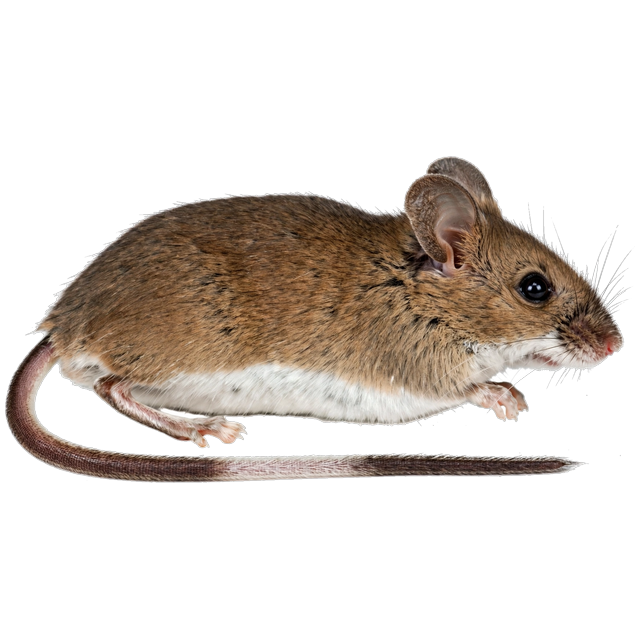
 Deer mouse
Peromyscus maniculatus (Wagner, 1845)
Deer mouse
The white-bellied woodland mouse that carries hantavirus into cabins and sheds.
- Order
- Rodentia
- Family
- Cricetidae
- Group
- Rodents
- Ontario status
- Established, hantavirus vector; rural/suburban
Why it matters
Primary North American reservoir of Sin Nombre hantavirus, shed in urine and droppings; the risk is inhaling aerosolized dust during cleanouts, not bites.
Origin
Native to North America, a woodland species that moved into cabins, sheds, and rural homes as humans built into its habitat.
Behavior
Nocturnal; an agile climber and strong jumper. Caches seeds; less dependent on human food waste than the house mouse.
Living conditions
Forest edges, fields, and rural/suburban structures; nests in wall voids, attics, woodpiles, and abandoned burrows. Enters buildings in autumn seeking winter shelter.
Signs of presence
- Small pointed droppings 3-6 mm, often in attics, sheds, and cabins
- Seed caches in drawers, boxes, and wall voids
- Nests of shredded paper, insulation, or plant fibre
- Musky odor in enclosed cabins after winter
Weaknesses
- Autumn entry is seasonal, exclusion before fall shuts the door
- Seed-cacher: removing birdseed and pet food removes the draw
- Nests are discrete and findable, droppings lead back to them
Myths and facts
Myth You can tell a deer mouse by size alone.
Reality Size overlaps with the house mouse; the reliable field marks are the sharply white underparts and the distinctly two-toned tail.
Research notes
Morphology
Body 80-100 mm, tail 45-105 mm (bicolored: dark above, white below), weight 15-30 g. Reddish-brown to grey-brown above, sharply white below; large eyes and ears. Droppings 3-6 mm, pointed ends.
Diagnostics
Bicolored tail, white underparts, and large ears separate it from house mouse; droppings similar in size to house mouse but typically deposited in cabins, attics, and sheds rather than kitchens.
Easily confused with
- White-footed mouse (Peromyscus leucopus) Nearly identical in the field; white-footed mouse averages slightly larger with a proportionately longer tail, definitive separation needs dental or DNA characters.
- House mouse (Mus musculus) House mouse lacks white underparts and the bicolored tail.
Life cycle
- Adult
- Lifespan ~12 months wild; 5+ years in captivity
- Egg
- N/A, viviparous
- Egg to adult
- Gestation 22-25 days; maturity at 6-9 weeks
- Generations per year
- 2-4 (seasonal breeding, spring, autumn)
- Nymph or larva
- Pups weaned at ~25-35 days; mature at 6-9 weeks
Development
Viviparous; altricial.
Reproduction
3-4 pups per litter × 3-4 litters/year.
Distribution
- Global
- North America only
- Native range
- North America
- Ontario
- Established, common in rural and suburban areas; the province's hantavirus vector
Ecology
Woodland/edge omnivore; seed caching; a key prey base for owls, foxes, and snakes. Hantavirus reservoir with no apparent illness to the mouse itself.
Resistance
No documented anticoagulant resistance in Ontario populations as of 2026.
IPM implications
Autumn exclusion is the highest-leverage action: seal ≥6 mm gaps before fall ingress. Sanitize seed sources (birdseed, pet food, woodpiles near structures). Cleanouts of infested cabins require dust suppression and respiratory protection, the hantavirus risk is aerosol, so dry sweeping is the specific behavior to eliminate.
Chemical ecology
Scent marking via urine and plantar glands; used in mate assessment and territorial signaling.
Genetics and DNA
Reference genome published: chromosome-level assembly HU_Pman_2.1 (Harvard/HHMI, 2018; in Ensembl); annotated RefSeq GCF_049852395.1 (2025).
Taxonomy
Order Rodentia › family Cricetidae › genus Peromyscus › P. maniculatus (Wagner, 1845). Part of the P. maniculatus species complex.
Open questions
Sin Nombre virus prevalence in southern Ontario deer mouse populations is poorly surveyed.
References
- CDC, Hantavirus: About Deer Mice
- Penn State Extension, Deer Mouse