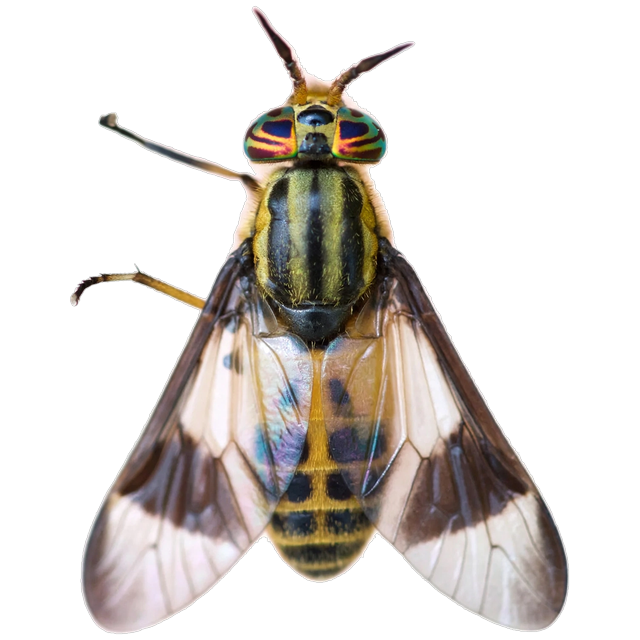
 Deer fly
Chrysops spp. Meigen, 1803
Deer fly
Smaller cousins of horse flies with patterned wings, the classic early-summer woodland biter.
- Order
- Diptera
- Family
- Tabanidae
- Group
- Flies
- Ontario status
- Established, seasonal (woodlands/wetlands)
Why it matters
Among the most aggressive human-biting flies in Ontario's outdoors. They can carry the bacteria causing tularemia (rabbit fever) between rabbits and, rarely, to people.
Origin
Native across North America; Ontario's woodlands and wetlands host many species.
Behavior
Fast, persistent daytime biters, most intense in June and July. They circle the head and bite the neck and scalp. Only females bite.
Living conditions
Larvae in wet mud and shallow wetland edges, like horse flies. Adults hunt along trails, shorelines and forest edges on warm days.
Signs of presence
- Small fast flies circling your head on woodland trails in early summer
- Painful bites on the neck and scalp
- A high whining buzz distinct from mosquitoes
Weaknesses
- Daytime-only biters, dawn, dusk and night are safe
- Attracted to movement and dark colours; stillness and light clothing reduce bites
- Head nets are the single most effective personal protection
- They stay near wet breeding areas; dry open ground has fewer
Myths and facts
Myth They're baby horse flies.
Reality A separate genus, full-grown at 8-12 mm. The patterned wings are the giveaway, horse flies have clear wings.
Research notes
Morphology
Adult 8-12 mm; dark body; wings with bold dark patterns/bands, the genus diagnostic, visible in flight. Eyes often iridescent. Smaller and more agile than Tabanus.
Diagnostics
Confirm by: 8-12 mm, dark-patterned wings, painful daytime bite around head and neck, woodland/wetland habitat.
Easily confused with
- Horse fly, Tabanus spp. Horse flies are larger (10-25+ mm) with clear, unpatterned wings; deer flies are smaller with unmistakable wing patterns.
Life cycle
- Egg
- Masses on vegetation over wet mud
- Nymph or larva
- Predatory larvae in wet soil and mud; long development
- Adult
- Females blood-feed; males on nectar; short adult life of weeks
- Egg to adult
- About one year in Ontario
- Generations per year
- One; adults June, August with a sharp early-summer peak
Development
Complete metamorphosis: egg → larva (aquatic predator in mud) → pupa → adult.
Reproduction
Blood meals fuel egg batches; females lay masses over larval habitat.
Distribution
- Native range
- Holarctic
- Ontario
- Abundant in woodlands, wetlands and cottage country each early summer
- Global
- Northern hemisphere temperate regions
Ecology
Wetland and woodland-edge species. Strong fliers but stay near breeding habitat. Vectors of Francisella tularensis (tularemia) among lagomorphs and rodents; occasional bridge to humans. Larvae are themselves predators in the mud community.
Resistance
Unknown, no insecticide programs target them.
IPM implications
Outdoor avoidance pest with no structural dimension: personal protection (head nets, repellents, clothing), timing of trail and shoreline use, and visual traps for local monitoring. Wetland larval habitat is ecologically off-limits for treatment, the strategy is entirely about the human, fly interface.
Chemical ecology
Host-seeking dominated by vision and movement, with CO2 as a close-range cue.
Genetics and DNA
No reference genome published as of 2026.
Taxonomy
Diptera: Tabanidae. Genus Chrysops Meigen, 1803. Common Ontario species include C. cincticornis and C. excitans.
Open questions
Fine-scale habitat partitioning among Ontario Chrysops species; quantitative tularemia bridge risk in the province.
References
- Teskey (1990), The Horse Flies and Deer Flies of Canada, Agriculture Canada
- Foil (1989), Annual Review of Entomology, tabanid disease links
- Ontario public health resources, tularemia and biting flies