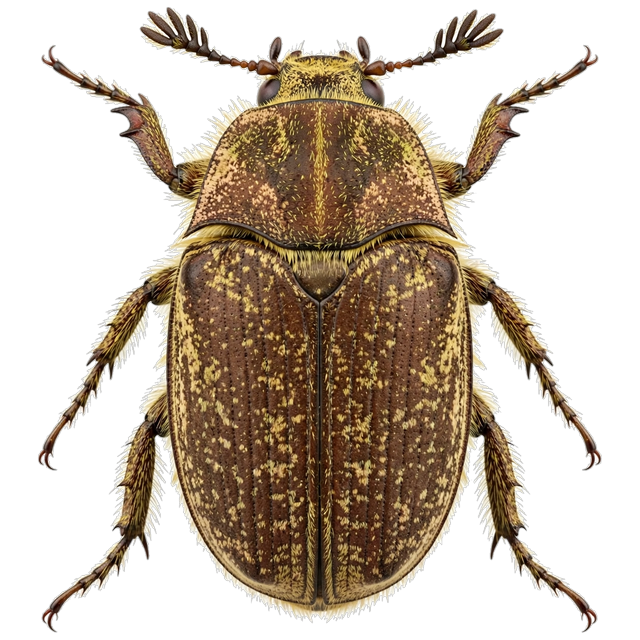
 Deathwatch beetle
Xestobium rufovillosum (De Geer, 1774)
Deathwatch beetle
The beetle that taps inside old church beams, its mating knock was once thought to foretell death.
- Order
- Coleoptera
- Family
- Ptinidae
- Group
- Fabric & structural beetles
- Ontario status
- Not established in Ontario, a pest of ancient European oak buildings; reference species
Why it matters
The great heritage-building pest of Europe, and a cultural artifact as much as an insect. Included as the reference anobiid wood borer and for the exam's wood-borer comparisons.
Origin
Europe, where it has lived in oak buildings for centuries, cathedrals, manor houses, old ships.
Behavior
Adults tap their heads against the wood to attract mates, a rhythmic ticking audible in quiet old buildings. The 'deathwatch' name comes from the tapping heard during silent sickroom vigils in centuries past.
Living conditions
Old, damp hardwood, especially oak already softened by fungal decay. It needs the rot as much as the wood.
Signs of presence
- Round 3 mm exit holes in old oak timbers (in the UK and Europe)
- Audible tapping in quiet buildings in spring
- Bun-shaped frass pellets in galleries
Weaknesses
- Needs decaying damp oak, dry, sound wood is immune
- Slow life cycle gives long detection windows
- Not present in North American buildings in any established way
Myths and facts
Myth The tapping predicts death.
Reality It predicts mating. The beetle knocks to attract a partner, the superstition came from hearing it during deathbed vigils.
Research notes
Morphology
Adult 6-9 mm, stout, dark brown with patches of yellowish hairs. Larva C-shaped, white, up to ~10 mm. Exit holes round, ~3 mm. Frass bun-shaped pellets, the anobiid signature.
Diagnostics
3 mm round holes + bun-shaped pellet frass + old decaying hardwood (UK/Europe context) = deathwatch beetle.
Easily confused with
- Drugstore beetle, Stegobium paniceum Same family, but the drugstore beetle attacks stored products, not structural oak; the deathwatch beetle is triple the size.
Life cycle
- Adult
- Emerge in spring; tap to mate; live weeks
- Egg
- Laid in cracks of decaying oak
- Egg to adult
- Often 3-5 years
- Generations per year
- Far less than one
- Nymph or larva
- Larvae feed 1-5+ years in fungal-decayed wood
Development
Complete metamorphosis; very slow in cool old buildings.
Reproduction
Low fecundity; females lay in wood already conditioned by fungal decay.
Distribution
- Global
- Europe; introduced records rare
- Native range
- Europe
- Ontario
- Not established; reference species
Ecology
Obligate associate of fungal-decayed hardwood, the fungus, not just the wood, is the requirement. A natural dead-wood decomposer turned heritage pest.
Resistance
Unknown, no documented resistance.
IPM implications
Heritage conservation logic: control the decay (moisture, fungi) and the beetle has no habitat. Insecticidal treatment of cathedral timbers is a last resort, environmental management of the building is the IPM.
Chemical ecology
Tapping is vibrational (substrate-borne) communication, not chemical; aggregation at decay volatiles.
Genetics and DNA
No reference genome published as of 2026.
Taxonomy
Order Coleoptera, family Ptinidae (formerly Anobiidae, the family is named for this beetle's relatives; 'deathwatch' is the type concept). Described by De Geer, 1774.
Open questions
Fungal-species specificity of larval nutrition; acoustic monitoring thresholds.
References
- Ebeling, W. (1978). Urban Entomology. University of California, Riverside.