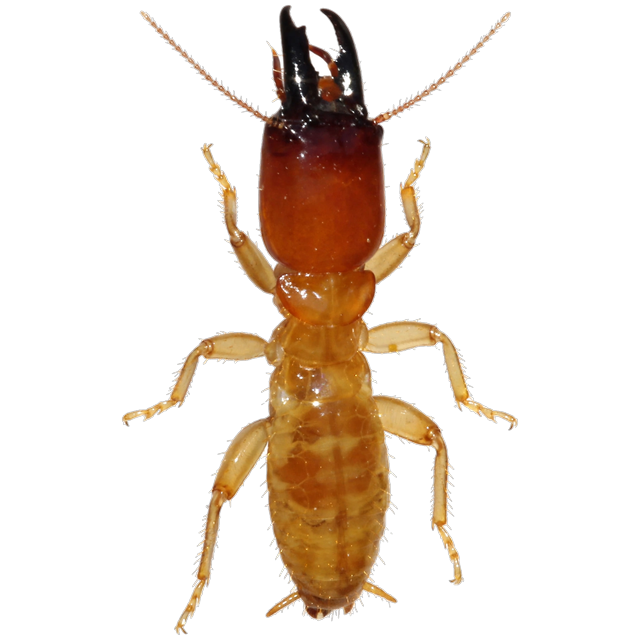
 Dampwood termite
Zootermopsis spp. Emerson, 1933
Dampwood termite
The giant of the termite world, a colony that only moves into wood that is already rotting wet.
- Order
- Blattodea
- Family
- Archotermopsidae
- Group
- Termites
- Ontario status
- Not established in Ontario, Pacific Northwest genus of very wet decaying wood; reference species
Why it matters
Rarely a structural pest, it only attacks wood that is already failing from rot. Its value is comparative: the largest, most primitive-looking termites in North America, and a textbook example of the moisture spectrum across termite families.
Origin
Pacific coastal North America, from British Columbia to California, the wet forests of the coast.
Behavior
Colonies are small (a few thousand) and entirely contained in the wet wood. Large soldiers guard gallery entrances. Swarmers fly on warm late-summer evenings.
Living conditions
Only colonizes wood that is already decayed and saturated, stumps, fallen logs, fence posts rotting at the soil line, pilings. Will not touch sound dry lumber.
Signs of presence
- Very large termites (soldiers up to ~20 mm) in rotting stumps or posts
- Galleries in punky, waterlogged wood with a clean, almost sanded appearance
- Large shed wings after late-summer swarms
Weaknesses
- Requires saturated, decaying wood, dry the wood out and the colony cannot survive
- Large size makes them conspicuous; infestations are easy to spot
- Small colonies confined to one wood member
Myths and facts
Myth Big termites do the most damage.
Reality The giant dampwood termites are minor pests. The small subterranean species cause nearly all structural damage.
Research notes
Morphology
Among the largest North American termites: soldiers 15-20 mm with massive dark mandibles; pseudergates pale, ~12-15 mm; alates 20+ mm including wings, dark brown. Size alone is nearly diagnostic in North America.
Diagnostics
Size + wet rotting wood habitat + Pacific Northwest range. Fecal pellets are larger and less regular than drywood hexagonal pellets.
Easily confused with
- Carpenter ant, Camponotus pennsylvanicus Ants have pinched waists and elbowed antennae; dampwood termites are far larger than any subterranean termite and lack the ant waist.
Life cycle
- Adult
- Alates disperse in late summer; soldiers terminal
- Egg
- Laid in batches in moist galleries
- Egg to adult
- Slow, often 2+ years in cool coastal wood
- Generations per year
- Small perennial colonies, a few thousand individuals
- Nymph or larva
- Pseudergates labor and may differentiate into soldiers or reproductives
Development
Hemimetabolous with pseudergate developmental flexibility.
Reproduction
Low fecundity; colonies founded by single pairs in wet wood; slow growth.
Distribution
- Global
- Restricted to native range
- Native range
- Pacific coastal forests, BC to California
- Ontario
- Not established; reference species only
Ecology
Obligate to waterlogged decaying wood; gut flagellates digest cellulose; contributes to forest decomposition, ecologically a decomposer, not a pest, in natural settings.
Resistance
Unknown, no documented resistance; rarely targeted by control.
IPM implications
The IPM implication is almost entirely moisture: replace or dry the decaying wood and the infestation ends. Chemical intervention is rarely warranted, this is a building-maintenance problem wearing a termite costume.
Chemical ecology
Soldier defensive secretions; limited trail pheromone use.
Genetics and DNA
Reference genome published - Zootermopsis nevadensis (~560 Mb) was the FIRST termite genome sequenced (Terrapon et al. 2014, Nature Communications); high-resolution assembly added in the 2025 47-genome study.
Taxonomy
Order Blattodea, family Archotermopsidae (formerly Termopsidae). Considered among the most basal (primitive) living termites; no true worker caste, pseudergates.
Open questions
Symbiont community differences across the moisture gradient between dampwood and drywood lineages.
References
- Bignell, D.E., Roisin, Y. & Lo, N. (eds.) (2011). Biology of Termites: A Modern Synthesis. Springer.