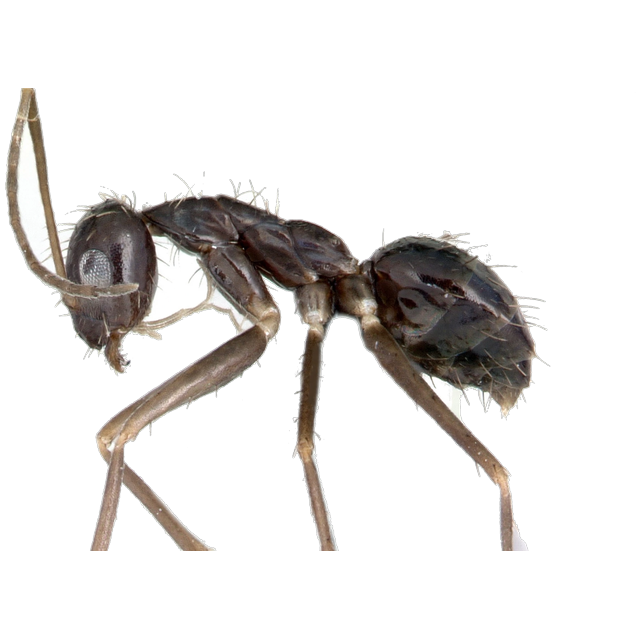
 Crazy ant
Paratrechina longicornis (Latreille, 1802)
Crazy ant
The ant that runs like it is panicking, long-legged, erratic, and unmistakable in motion.
- Order
- Hymenoptera
- Family
- Formicidae
- Group
- Ants
- Ontario status
- Not established outdoors in Ontario; occasional heated-building records, tropical species
Why it matters
A food contaminator where it establishes indoors; in the US South it is a major tramp-ant pest. In Ontario it is an occasional indoor curiosity and an identification reference.
Origin
Tropical in origin (likely Asia or the Pacific); spread worldwide with shipping and now common in warm regions.
Behavior
Famous for its erratic, jerky, high-speed running, it looks 'crazy' compared to the orderly trails of other ants. Forages day and night.
Living conditions
Needs year-round warmth. In Ontario it can only survive inside heated buildings, it does not live outdoors here.
Signs of presence
- Fast, jerky, direction-changing ants unlike any orderly trail
- Very long legs and antennae visible even without magnification
- Activity in warm, moist indoor areas
Weaknesses
- Killed by cold, cannot survive an Ontario winter outdoors
- Needs constant indoor warmth and moisture
- Erratic foraging makes it conspicuous and easy to spot
Myths and facts
Myth Erratic movement means the ants are poisoned.
Reality The jerky running is normal for this species, it is how it got its name.
Research notes
Morphology
Workers 2.2-3 mm, dark brown to black, slender. Exceptionally long legs and 12-segmented antennae (scape exceeding head by half its length). Single node; body with long coarse hairs.
Diagnostics
Confirm by erratic rapid movement + very long legs/antennae + single node. Movement alone is nearly diagnostic.
Easily confused with
- Odorous house ant, Tapinoma sessile Odorous house ant moves in orderly trails and smells of rotten coconut when crushed; crazy ant moves erratically with no odor.
Life cycle
- Adult
- Workers live ~2-3 months.
- Egg
- Eggs hatch in ~2 weeks at warm temperatures.
- Egg to adult
- ~5-7 weeks at warm temperatures
- Generations per year
- Continuous in heated buildings
- Nymph or larva
- Legless larvae; pupae in cocoons.
Development
Complete metamorphosis: egg → larva → pupa → adult.
Reproduction
Multiple queens (highly polygynous); colonies bud readily; colonies can be very large.
Distribution
- Global
- Pantropical; heated buildings in temperate zones
- Native range
- Likely tropical Asia or Pacific
- Ontario
- Not established outdoors; sporadic heated-building interceptions
Ecology
Opportunistic omnivore; nests in any sheltered warm crevice, soil, wall voids, potted plants. Foraging is rapid and seemingly random but chemically guided.
Resistance
Limited published data.
IPM implications
In Ontario, occurrence is sporadic and building-limited, locate the indoor harborage (warm, moist voids; plant soil) rather than treating perimeters. Budding biology means disturbance-tolerant, colony-level approaches apply as with other polygynous tramp ants.
Chemical ecology
Trail and recruitment pheromones studied as models of mass foraging; erratic individual movement with coordinated colony-level recruitment.
Genetics and DNA
No reference genome published as of 2026.
Taxonomy
Order Hymenoptera, family Formicidae, subfamily Formicinae, genus Paratrechina. Described by Latreille, 1802. Pantropical tramp species.
Open questions
Overwintering potential in Ontario's urban heat islands under climate warming.
References
- Hölldobler, B. & Wilson, E.O. 1990, The Ants, Harvard University Press
- Mallis Handbook of Pest Control